[pageLogInLogOut]

#Nonwovens / Technical Textiles

Swedish automation keeps filter products moving
Members of TMAS – the Swedish textile machinery association – are providing crucial manufacturing and automation services to the filtration sector, which is an often invisible but very significant part of the global textile industry.
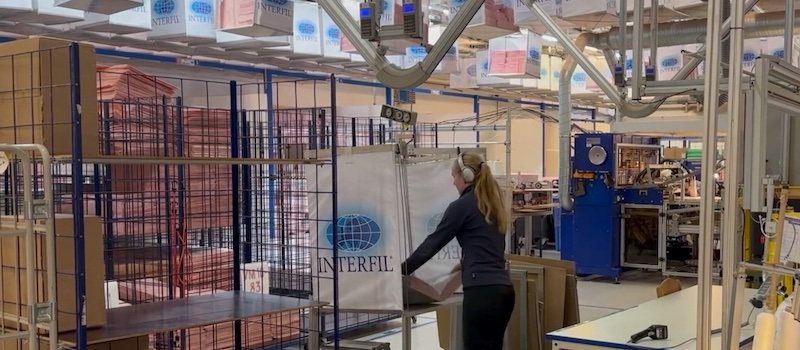
Interfil manufactures produces a staggering range of over 15,000 filter media variants © 2025 TMAS


Technical woven and nonwoven fabrics are used in a wide variety of products in filtration systems for air, gas and liquid filtration, touching on almost every facet of life in the 21st Century.

They are crucial to aerospace and road transportation and a vast range of industrial processes and also to be found in every home, hotel and institutional building in air conditioning systems and household appliances such as washing machines and vacuum cleaners.

At its Skjåk manufacturing plant in Norway, for example, Interfil manufactures an annual 230,000 air filter units from a staggering range of some 15,000 variants, with 9,000 products moving continuously through the differing stages of the plant at any time each day, and a daily finished output of 1,100 products.

It’s a similar situation at the US plant of Filtration System Products (FSP) in Farmington, St Louis, which now has a daily production of over 2,200 filter hoses and media.
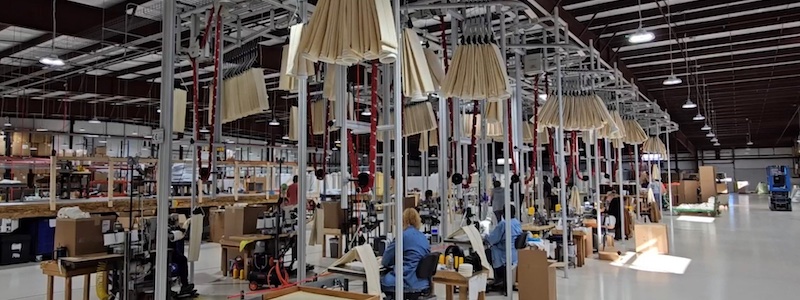
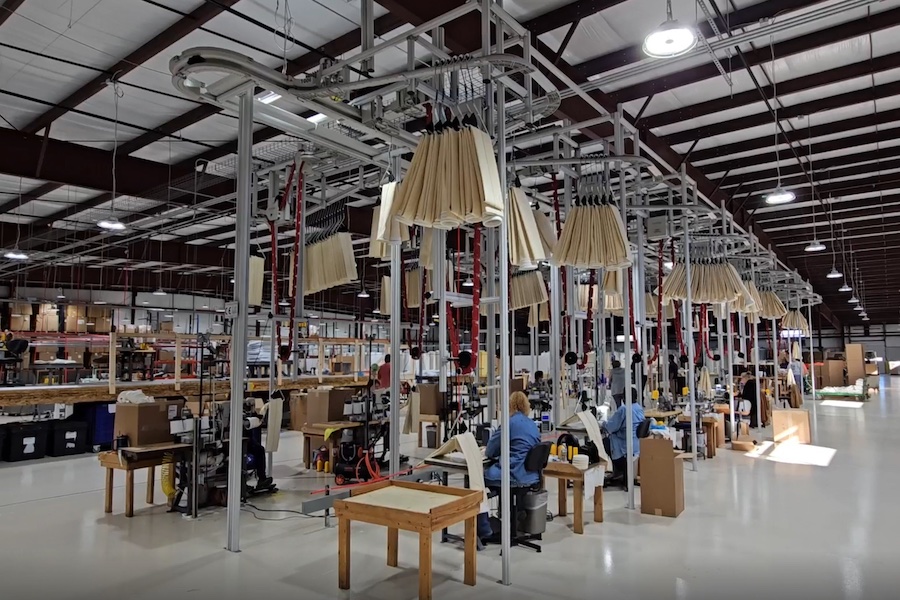
Eton automation at FSP in St Louis © 2025 TMAS


Material handling

Both Interfil and FSP rely on the automated material handling expertise of TMAS member Eton Systems.

Eton’s individually addressable product carriers are designed to eliminate manual transportation and minimise handling throughout a manufacturing plant, ensuring each individual product arrives at its correct position precisely when required for each separate process step.

Interfil has relied on Eton automation since 2014, when a 50-metre overhead conveyor system was designed and installed to link the company’s two production halls at the Skjåk plant, eliminating the need for manual handling and truck transport between the facilities. This has resolved the challenge of having semi-finished products made far from the final assembly area, not only improving efficiency, quality control and component traceability across all parts of production, but also increasing on-site safety due to the need for fewer trucks.
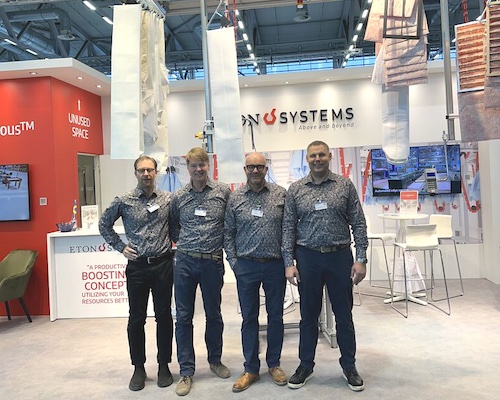
The Eton Systems team at the recent Filtech exhibition in Cologne, Germany. Left to right: Magnus Sundgren, Fredrik Andersson, Sven Sörbö and Olof Strömberg © 2025 TMAS


FSP has meanwhile calculated that since installing an Eton system in 2023, it has increased its production output by 60% using the same number of operators and the same working hours as with the previous manual system. Eton’s inbuilt quality system also ensures that only 100% perfect products are unloaded from the system, allowing for a much more efficient quality control process. In addition, Eton’s compact method of moving single units through the production process has saved floor space and created a safer and more ergonomic work environment.

“FSP wasn’t sure if it was possible to find an automated production system that could handle the varying demands of filtration media production, due to the many style variations, but our system enables all carriers to be tracked in real-time and proved to be the perfect solution,” says Eton CEO Jerker Krabbe.

Filter bag production

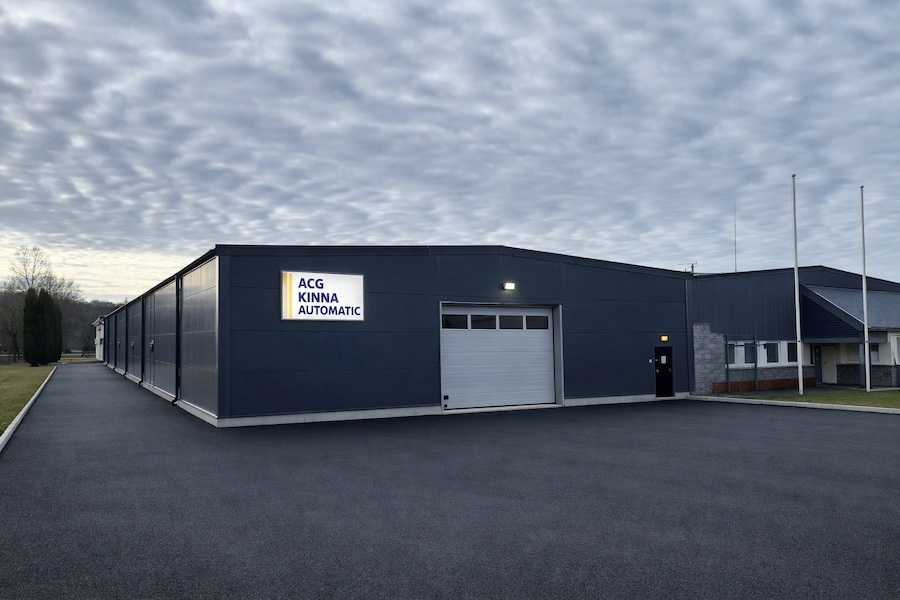
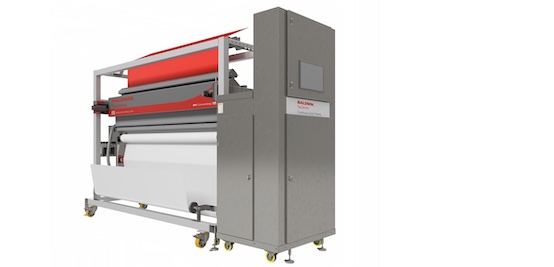
A fully automated microfactory for the production of fully finished filter bags has meanwhile been developed by TMAS members ACG Kinna Automatic and ACG Nyström, in cooperation with Juki Central Europe.

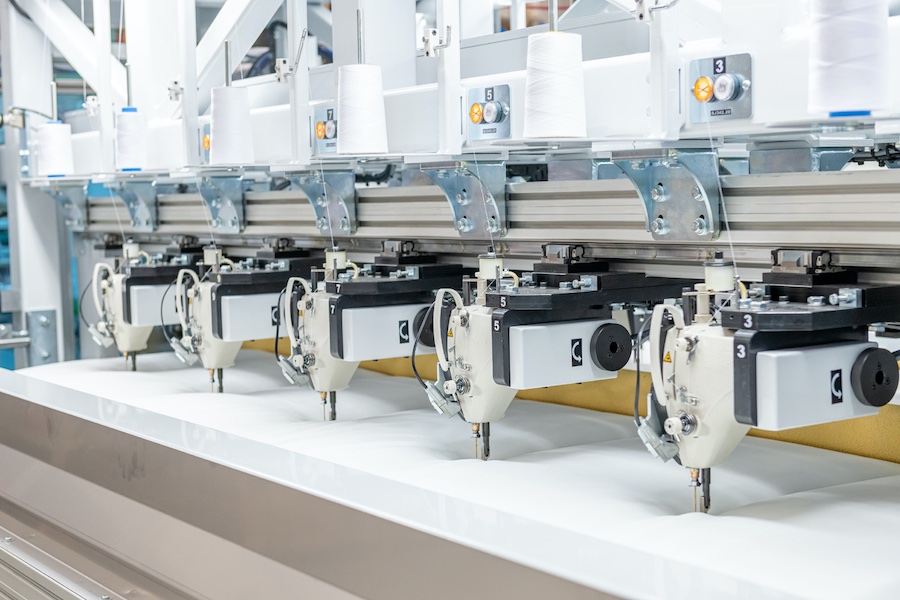
ACG’s microfactory for filter bag production © 2025 TMAS


Until now, woven or nonwoven needlefelt filter bags been assembled and finished in laborious and time-consuming cut and sew operations by third party suppliers.

“The automation of these essential steps eliminates the need for the many hours of labour-intensive manual work that has previously been necessary,” says ACG Kinna Automatic CEO Christian Moore. “The output is 120 finished filter bags per hour and the entire configuration is guided by precise automatic steering and alignment, with quality control handled by the latest high-definition vision cameras. This type of automation is the way forward, not just for filter bags, but for many industries who heavily rely on such consumables in their operations.”

The ACG microfactory’s configuration is based on two separate interconnecting modules – the Smart Filter Line (SFL) and the Filtermaster 2.0.

The SFL handles the fabric feeding from rolls and its folding prior to seam construction, which can either be by automatic sewing, welding or with sewing and taping, depending on specifications. Very rapid changeover of the modular seaming methods can be achieved during product changes. The specific size of the now fully-tubular fabric is then precisely cut to size for each individual unit and further folded ready to be fed into the Filtermaster 2.0.

The Filtermaster 2.0 then automatically attaches the reinforcement, bottom and snap rings onto the filter tube with a second Juki sewing head on a robotic arm, to form the fully finished filter bag ready for packaging.

“The innovations coming from our companies are far-ranging and characterised by an advanced grasp of automation techniques and the need for more sustainable processing methods that is being demanded by their customers,” says TMAS Secretary General Therese Premler-Andersson. “Eliminating manual transportation and minimising handling is proving essential for textile manufacturers, especially across Europe and the United States, in providing competitive advantages.”
More News from Textile Machinery Association of Sweden

More News on Nonwovens / Technical Textiles

#ITMA Asia + CITME Singapore 2025

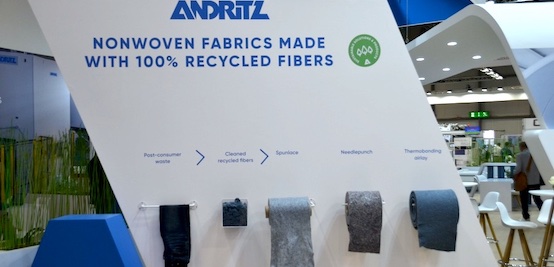
ANDRITZ sets focus on textile recycling and durable nonwoven production technologies at ITMA Asia 2025

International technology Group ANDRITZ will be presenting its innovative nonwovens production and textile solutions at ITMA ASIA + CITME 2025 in Singapore, from October 28 to 31, 2025 (Hall 2, D106). ANDRITZ will showcase its MMCF production plants, textile sorting and recycling, bast fiber processing, needlepunch, airlay, and life-cycle service technologies, with a focus on sustainable solutions. Discover how these innovations can grow your business opportunities and support a greener future.

#ITMA Asia + CITME Singapore 2025

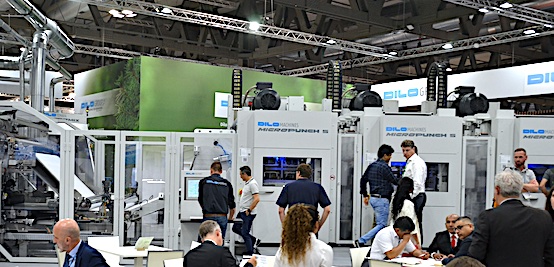
Dilo Group at ITMA ASIA Singapore 2025

At ITMA ASIA Singapore, the Dilo Group will exhibit at Booth No. H2 – D202. Together with Kansan Materials, Izmir, the company will present its latest developments and looks forward to welcoming visitors to exchange ideas and explore innovations in needling technology.

#Nonwovens

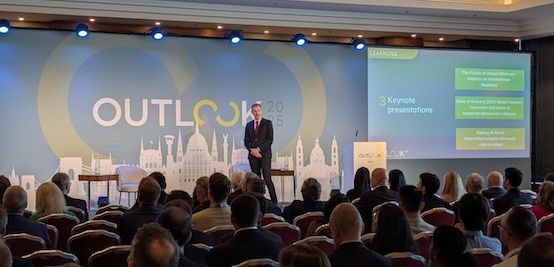
OUTLOOK™ 2025: Charting a sustainable and innovative future for the Nonwovens Industry

EDANA concluded its flagship event, OUTLOOK™ 2025, last week, marking it as a major success and addressing the biggest questions facing the industry. The three-day conference highlighted the urgent need for a unified approach to sustainability, regulation, and innovation in the absorbent hygiene and wipes sectors.

#Nonwovens

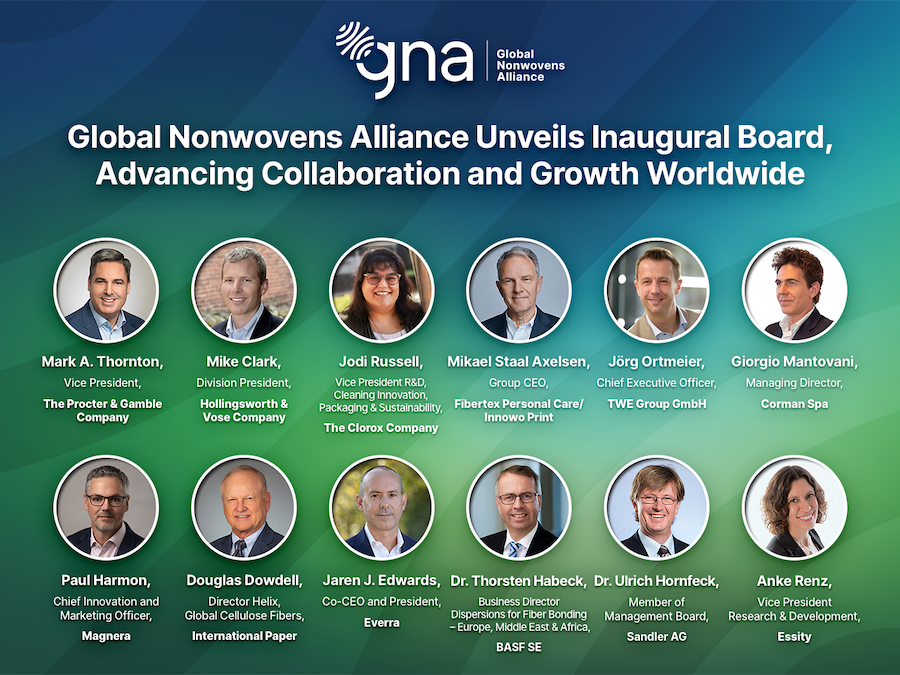
Global Nonwovens Alliance unveils Inaugural Board, advancing collaboration and growth worldwide

The Global Nonwovens Alliance (GNA), a tax-exempt federation jointly founded by INDA, the Association of the Nonwoven Fabrics Industry, and EDANA, the Voice of Nonwovens, announces the appointment of its founding Board of Directors. This group of leaders represents some of the most influential executives across the nonwovens value chain and reflects GNA’s mission to foster global collaboration, innovation, and growth in the industry.

Latest News

#Textiles & Apparel / Garment

Texworld Apparel Sourcing Paris unveils redesigned show layout for 2026

From February 2 to 4, 2026, Texworld Apparel Sourcing Paris will once again bring together all the key players in textiles and clothing at the Paris-Le Bourget Exhibition Center. For 3 days, visitors will discover, compare and select among 1,300 suppliers who will shape the collections of tomorrow, from ready-to-wear to luxury.

#Industry 4.0 / Digitalization

Lenze receives IEC 62443-4-1 certification: TÜV Rheinland confirms cyber-secure development process

Lenze SE has been certified according to IEC 62443-4-1 since November 2025. TÜV Rheinland thus confirms that Lenze meets the requirements of this internationally recognized standard for a secure development process for industrial automation and drive products. The certification is an important milestone on the way to implementing the EU Cyber Resilience Act (CRA), which will become mandatory for machine manufacturers and their suppliers from December 2027.

#Digital Printing

Epson future proofs textile printing with Epson Textile Academy 2.0

Technology leader Epson today hosted its second Textile Academy Event at the company’s Textile Innovation Centre in Lutterworth, Leicestershire. Building on the success of its inaugural Textile Academy earlier this year, the event welcomed Textile Design BA students from Nottingham Trent University (NTU) and Loughborough University. The event features workshops designed to enhance student’s practical textile printing skills; corporate and entrepreneurial business acumen; marketing and self-branding; and environmental awareness around the textile industry.

#Fabrics

MUNICH FABRIC START: Frank Junker steps down as Creative Director and Shareholder

The organisers of MUNICH FABRIC START Exhibitions GmbH today announced Frank Junker's decision to step down as Creative Director and shareholder of MUNICH FABRIC START Exhibitions GmbH after around 20 years. The long-standing advisor to the international fabric trade show in Munich wishes to devote himself to new entrepreneurial tasks and projects in the event industry.

TOP