[pageLogInLogOut]

#Associations

Free trade deal boosts export potential
© 2022 SWISSMEM
The time is right for Swiss textile machinery companies to grow their export business with Indonesia – one of the world’s top 10 textile producers. A free trade agreement between the two countries came into force in 2021, and market analyses show that there is scope for a significant increase in business in textile and textile machinery sectors.

Symposium in Indonesia by Swiss Textile Machinery Association

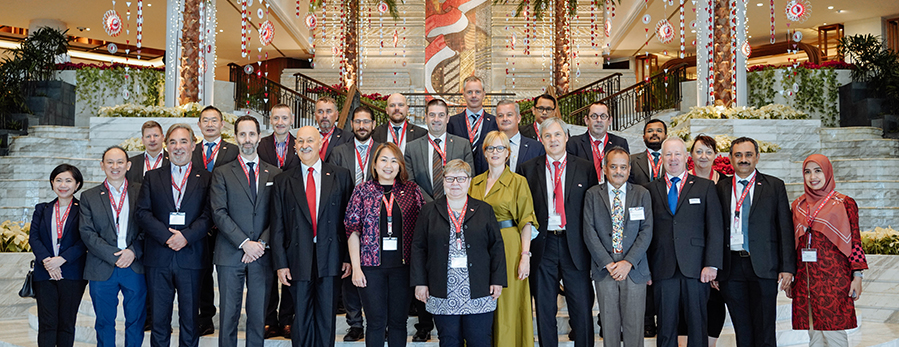
This was the background to a successful symposium in the Indonesian capital Jakarta last month when Swiss Textile Machinery Association members presented their products and innovations to an invited audience of 200 delegates from Indonesian textile companies.

The symposium audience was welcomed by Philippe Strub, of the Swiss Embassy in Indonesia; Ignatius Warsito, from the Indonesia Ministry of Industry’s Chemical, Pharmaceutical and Textile Industry branch; Anne Patricia Sutanto, of the Indonesian Textile Association (API); and Ernesto Maurer, President of the Swiss Textile Machinery Association.

Swiss companies taking part were: Stäubli, Zeta Datatec, Loepfe, Saurer, Benninger, Rieter, Bräcker, Jakob Müller, Maag, Uster and SERV.

The presentations were followed by panel discussions with speakers, and there were also networking opportunities at the companies’ exhibition tables.

Also taking part in a panel at the event was Testex, the independent Swiss organisation which provides testing, certification, OEKO-TEX®and other labels for the textile industry. Discussion focused on the relevance of innovation in textile technology to sustainability and ‘saving the planet.’

Recent years have seen an acceleration in trade relations between Switzerland and Indonesia, which in 2008 was classed as one of eight priority countries for economic development cooperation by SECO, the Swiss Secretariat for Economic Affairs, with a joint economic and trade commission established the following year.


Collaboration was heightened further in 2018 with a Comprehensive Economic Partnership Agreement (CEPA) for Indonesia with Switzerland and the other EFTA countries. This more extensive form of free trade agreement was accepted after a popular referendum, and ultimately came into force in November 2021.

Trading between the two countries is supported by SERV, the Swiss export risk insurance organisation. This insures export goods against political and commercial risks and facilitates credit.

The Swiss Textile Machinery Association is the representative body for Switzerland’s producers of textile equipment, systems, and services. Currently 43 companies are affiliated, offering solutions covering the entire textile value chain, from spinning to weaving, knitting, finishing, embroidery, and quality control. The Association is an industry sector of Swissmem, the national representative body for technology companies.

Cornelia Buchwalder, Secretary General of the Swiss Textile Machinery Association, said the Indonesia Symposium was ideally-timed, right after the CEPA came into effect: “With the free trade agreement in place, there is even greater potential for the development of trade between our countries,” she said.

“Business in textile and textile machinery is actually below the relative market shares for the sectors, so this stronger cooperation is probably overdue. It was a successful symposium, with enthusiastic participation from Indonesian textile companies, so we are optimistic about future export prospects for Swiss textile machinery.”
More News from Swissmem Textile Machinery Division

More News on Associations

#Associations

Sustainability: European industry calls on EU to keep Single-Use Plastics Directive unchanged

A broad coalition of European industry associations, including EDANA, Euratex and Plastics Europe, has urged EU institutions to maintain the current legal framework of the Single-Use Plastics Directive (SUPD). In a joint statement, the organisations argue that reopening the Directive at this stage would create legal uncertainty, increase regulatory complexity and undermine investment, while its implementation across the European Union is still incomplete.

#Associations

Textile machinery: Italian technology charts the course for revival

Operating in a scenario characterized by geopolitical instability, slowing industrial investments, and new protectionist pressures. This is the main challenge for the Italian textile machinery industry that emerged during the General Assembly of ACIMIT (Association of Italian Textile Machinery Manufacturers), held today in Milan at the Shareholders’ Hall of Palazzo Edison.

#Recycling / Circular Economy

New skills for a circular textile economy

Based on the results of a comprehensive analysis, the Erasmus+ project Skills4Circularity is developing three practical training modules covering recycling technologies, eco-design for the circular economy and sustainable manufacturing. The content of the first module, Recycling Technologies, has now been developed and validated together with industry representatives. The module provides participants with knowledge of regulatory requirements, material sorting and the preparation of textile waste for recycling.

#Associations

Bangladesh: Italian textile machinery mission stops in Dhaka and Chittagong

Technological upgrading and the transition toward higher value-added production are driving the new Italian industrial mission to Bangladesh. This year, the mission will split between the country’s two main manufacturing hubs, where Italian manufacturers will meet the leaders of the local textile supply chain in two strategic stages: July 7th in Dhaka and July 9th in Chittagong.

Latest News

#Research & Development

ALADIN paves the way for circular and demand-driven textile production in Europe

Textile production can be organized sustainably by utilizing short supply chains and preventing overproduction. This can already be achieved today by intelligently connecting and efficiently utilizing existing infrastructure. At the same time, production becomes circular when innovative technologies and materials are used that enable high-quality recycling. The ALADIN research project, launched in May 2026 and co-funded with five million euros under the EU Horizon Europe program, is creating the conditions for this.

#Nonwovens

Katharina Obergruber appointed to the Management Board of Sandler AG

The Supervisory Board of Sandler AG has appointed Katharina Obergruber to the company’s Management Board. Effective September 1, 2026, the Board will consist of Philipp Ebbinghaus (CEO), Dr. Ulrich Hornfeck (currently CCO, future COO), and Katharina Obergruber (CCO). Katharina Obergruber, currently Chief Sales Officer Hygiene and member of the Management Team of Sandler AG, will assume responsibility for all sales activities as Chief Commercial Officer. She will assume this role from Dr. Ulrich Hornfeck, who will focus primarily on production and supply chain topics.

#Recycling / Circular Economy

Ence and ShareTex begin initial testing of the ATENEA innovation project to promote textile recycling in Spain

Ence and ShareTex are making progress on the Atenea R&D project, which aims to develop a complete value chain for textile recycling in Spain. Specifically, the goal of the ATENEA project—which is funded by the Center for Technological Development and Innovation (CDTI)—is to connect all the necessary stages for the recovery of textile waste, from collection and management, through recycling and transformation into new raw materials, to their incorporation into new textile products.

#Recycling / Circular Economy

DePoly Inaugurates its Showcase Plant in Monthey Switzerland

What if used plastic bottles, PET packaging material and polyester textiles could become raw materials just as high performing as virgin resources? That is the ambition of DePoly, a circular materials company based in Sion, Switzerland which inaugurated its Showcase Plant in Monthey on July 6th & 7th. The first depolymerization facility of its kind and scale in Switzerland, this industrial Showcase Plant represents a major milestone in the company's growth and its journey toward commercialization.

TOP



