[pageLogInLogOut]

#Associations

Worldwide shipments of new textile machinery decreased in 2020

In 2020, global shipments of spinning, texturing, weaving, knitting, and finishing machines decreased on average compared to 2019. Deliveries of new short-staple spindles, open-end rotors, and long-staple spindles dropped by -48%, -27%, and -46%, respectively. The number of shipped draw-texturing spindles declined by -30% and deliveries of shuttle-less looms shrunk by -16%. Shipments of flat knitting machines contracted by -53%, while shipped large circular machines marked the exception with a 13% growth. The sum of all deliveries in the finishing segment also dropped by -17% on average.

These are the main results of the 43rd annual International Textile Machinery Shipment Statistics (ITMSS) just released by the International Textile Manufacturers Federation (ITMF). The report covers six segments of textile machinery, namely spinning, draw-texturing, weaving, large circular knitting, flat knitting and finishing. A summary of the findings for each category is presented below. The 2020 survey has been compiled in cooperation with more than 200 textile machinery manufacturers representing a comprehensive measure of world production. 

Spinning Machinery

The total number of shipped short-staple spindles decreased by about 3.3 million units in 2020 to a level of 3.63 million. Most of the new short-staple spindles (88%) were shipped to Asia & Oceania, where delivery decreased by -50%. While levels stayed relatively small, Europe saw shipments increasing by +76% (mainly in Turkey). The six largest investors in the short-staple segment were China, India, Turkey, Pakistan, Bangladesh, and Uzbekistan.

422 thousand open-end rotors were shipped worldwide in 2020. This represents 151 thousand units less compared to 2019. 83% of global shipments went to Asia & Oceania where deliveries decreased by -32% to 351 thousand rotors. Turkey, and Pakistan were the world’s 2nd and 3rd largest investors in open-end rotors after China and saw investments surging by +290% and +42%, respectively. China, India, Uzbekistan, and Brazil, the world’s 1st, and 4th to 6th largest investors in 2020 decreased investment by -30% on average.

Global shipments of long-staple (wool) spindles decreased from about 40 thousand in 2019 to nearly 22 thousand in 2020 (-46%). This effect was mainly driven by a fall in deliveries to Asia & Oceania with a decrease in investment of -75%. 80% of total deliveries were shipped to Iran, Turkey, and Italy.

Texturing Machinery

Global shipments of single heater draw-texturing spindles (mainly used for polyamide filaments) decreased by -36% from nearly 26’000 units in 2019 to 16’000 in 2020. With a share of 89%, Asia & Oceania was the strongest destination for single heater draw-texturing spindles. China, Japan, and Chinese Taipei were the main investors in this segment with a share of 63%, 9%, and 8% of global deliveries, respectively.

In the category of double heater draw-texturing spindles (mainly used for polyester filaments) global shipments decreased by -30% to a level of 325 thousand spindles. Asia’s share of worldwide shipments remained stable at 90%. Thereby, China remained the largest investor accounting for 78% of global shipments.


Weaving Machinery

In 2020, worldwide shipments of shuttle-less looms decreased by -16% to 112 thousand units. Shipments in the categories “air-jet” and “rapier and projectile” fell by -3% to 29’337 units and -15% to 21’542, respectively. The deliveries of water-jet looms decreased by -21% to 61’483. The main destination for shuttle-less looms in 2020 was Asia & Oceania with 94% of all worldwide deliveries. 98%, 93%, 81% of global water-jet, air-jet, and rapier/projectile looms were shipped to that region. The main investor was China in all three sub-categories. Deliveries of weaving machines to this country cover 74% of total deliveries.

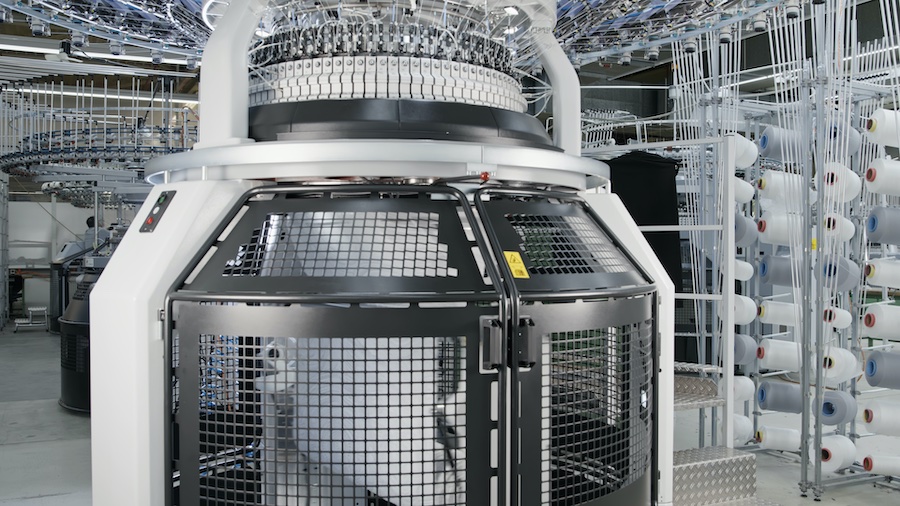
Circular & Flat Knitting Machinery

Global shipments of large circular knitting machines grew by +12% to 30’231 units in 2020. The region Asia & Oceania was the world’s leading investor in this category with 81% of worldwide shipments. With 62% of all deliveries (i.e.15’980 units), China was the favoured destination. India and Turkey ranked second and third with 2’433 and 2’381 units, respectively.

In 2020, the segment of electronic flat knitting machines decreased by -52% to around 66 thousand machines. Asia & Oceania was the main destination for these machines with a share of 77% of world shipments. China remained the world’s largest investor with an 38%-share of total shipments despite a -74%-decrease in investments. Shipments to China dropped from about 69 thousand units in 2019 to 17 thousand units in 2020.

Finishing Machinery

In the “fabrics continuous” segment, shipments of Sanforizers / Compacters grew by +75%. All other subsegment either remained stable or shrunk. Since 2019, ITMF estimates the number of shipped stenters non-reported by the survey participants to inform on the global market size for that category. The market for stenters is expected to have been stable since 2019 and thus deliveries must have reached 1’731 units in 2020.

In the “fabrics discontinuous” segment, the number of jigger dyeing / beam dyeing shipped dropped by +8.5% to 529 units. Deliveries in the categories “Air Jet Dyeing” and “Overflow Dyeing” respectively decreased by -18% and -21% in 2020.




More News from TEXDATA International

#People

Happy Holidays!

Dear reader, the year 2025 is drawing to a close. We are entering what we hope will be a peaceful holiday season, spending time with our families and taking a moment to pause and reflect. We hope we have been able to support you once again this year with relevant news and articles, and we look forward to surprising you with many innovations in the coming year. Enjoy the festive season, stay healthy, and we wish you a happy and joyful holiday season.

#Recycling / Circular Economy

textile.4U publishes special edition “Top 100 Textile Recycling Companies 2025”

With a comprehensive 176-page special edition, textile.4U is dedicating its latest issue entirely to one of the most dynamic and influential topics in today’s textile industry: textile recycling. The new issue, published exclusively in high-quality print, presents the Top 100 textile recycling companies researched and selected by TexData – organizations that already play a key role in the transition to circular textiles or are expected to have a significant impact in the near future.

#Recycling / Circular Economy

Responsible Textile Recovery Act of 2024 signed by Governor

Senator Josh Newman (D-Fullerton) is proud to announce that Senate Bill 707 (SB 707), the Responsible Textile Recovery Act of 2024, has been signed into law by the Governor of California, Gavin Newsom. This groundbreaking legislation establishes the country’s first Extended Producer Responsibility (EPR) textile recycling program, marking a significant step forward in the state’s efforts to combat waste and promote sustainability.

#Textiles & Apparel / Garment

Modtissimo promotes sustainability with 28 coordinates in the Green Circle

Modtissimo is proving more and more to be a textile and clothing show that delivers the latest innovations in the area of sustainability, with the iTechStyle Green Circle being the main showcase for companies' creations. In this 60+4 edition, taking place on 12 and 13 September, 28 coordinates will be exhibited in a section organised by CITEVE and curated by Paulo Gomes.

More News on Associations

#Associations

Businesses urge European Commission to allow continued sale of products already lawfully placed on the market before the Empowering Consumers Directive’s application to avoid unnecessary waste and costs

EDANA, the voice of nonwovens, alongside a coalition of leading European business associations, has issued a joint statement urging the European Commission to introduce a "grandfathering clause" to the Empowering Consumers for the Green Transition (ECGT) Directive. The coalition warns that without transitional provisions for products already lawfully placed on the market, the new rules could inadvertently lead to massive waste and economic disruption.

#Associations

Joint Statement: Urgent clarification needed on scope of Textiles EPR for PPE and Medical Devices

EDANA, the voice of nonwovens, alongside fellow industry associations CIRFS (European Man-Made Fibres Association), EURATEX (The European Apparel and Textile Confederation), ESF (European Safety Federation), and EuroCommerce (Retail & Wholesale), has issued a joint statement raising critical concerns regarding the transposition of Directive (EU) 2025/1892, the targeted revision of the Waste Framework Directive.

#Associations

Young researchers recognised for cutting-edge work in recycling, fibre technology and textile mechanics

At the Aachen-Dresden-Denkendorf International Textile Conference held in Aachen at the end of November, Peter D. Dornier, Chairman of the Walter Reiners Foundation of the VDMA, honoured five successful young engineers. Promotion and sustainability prizes were awarded in the categories bachelor/project theses and diploma/master theses. Academic theses that develop solutions for resource-saving products and technologies, for example, are eligible for the sustainability awards.

#Europe

Level playing field at stake: Europe’s textile industry demands decisive action

Yesterday, the European Parliament took a welcomed and necessary step by voting a resolution calling for stronger market surveillance, reinforced customs controls and faster enforcement of the Digital Services Act in case of infringements. For Europe’s textile and clothing manufacturers, this is the first political acknowledgement that the system is broken — and that enforcement must finally match the scale of the problem.

Latest News

#Weaving

Lindauer Dornier announces leadership transition in weaving machine business

After more than ten successful years at Lindauer DORNIER GmbH, Mr Wolfgang Schöffl will leave the family-owned company at the end of the year to enter well-deserved retirement.

#Heimtextil 2026

Texpertise Focus AI: Messe Frankfurt puts Artificial Intelligence centre stage at its international textile and apparel trade fairs

Under the banner 'Texpertise Focus AI, Messe Frankfurt will place a strong emphasis on Artificial Intelligence (AI) across its international textile and apparel trade fairs from 2026 onwards, setting a future-shaping signal for the industry. The initiative highlights the responsible use of AI along the entire textile value chain, from fibre production to the point of sale. The programme will launch at Heimtextil in Frankfurt in January 2026.

#Technical Textiles

Autoneum and Polestar set new benchmarks for passenger experience and sustainability

As the global market leader in sustainable acoustic and thermal management, Autoneum is a key supplier of interior and exterior components for the highly anticipated Polestar 5 model. The successful collaboration between Autoneum and Polestar marks a significant milestone in sustainable automotive engineering: the electric grand tourer sports car features several innovations in lightweight, fully recyclable polyester-based components that ensure a superior driving experience. Polestar 5 was revealed at the IAA Mobility 2025 in Munich and is available in 24 markets.

#Natural Fibers

Cashmere producers stress the importance of The Good Cashmere Standard®

At the invitation of the Aid by Trade Foundation (AbTF), over 70 experts from the cashmere production and supply chain, as well as other specialists, met at the GCS Unit Meeting in Shanghai, China to discuss the progress and new objectives of The Good Cashmere Standard (GCS). The meeting focused on implementation and verification of the standard, important aspects of animal welfare and the importance of the standard in the global textile market.

TOP