[pageLogInLogOut]

#Associations

The European Textiles Industry makes a final call to reach an agreement on EU-UK negotiations – nearly 130,000 jobs are at stake.

A new study, commissioned by EURATEX with the University of Leuven[1], reveals that a “no deal” Brexit would have a detrimental impact on the textile and clothing industry (T&C) with job losses over 100,000 for the EU27 and over 27,000 for the UK. Output losses for the UK would be 41.8% of its value added in T&C production, while the EU-27 as a whole would lose about 9.7%.

Negotiators are making a final effort, but a “no deal” can still occur if there is no timely ratification of the Withdrawal Agreement, or if the Withdrawal Agreement is ratified but no agreement on the EU-UK future relationship is struck before the end of the transition period.

A soft Brexit scenario would minimize the damage, but it would still disrupt European value chains and lead to heavy job losses. A soft Brexit would still be significant with, for UK, 4 759 jobs lost and an output loss of 7.3% of its value added; while for the EU27, 17 786 jobs will be lost and there would be output losses of 1.7% of its value added.

Under a no deal Brexit, the output losses for the UK would be 41.8% of its value added in production, while the EU-27 as a whole would lose about 9.7% of its GDP. For the UK this corresponds to absolute job losses of 27 141 jobs, while for the EU-27 as a whole the job loss would amount to 101 756 jobs lost.

With no surprise, the largest share of the EU27 job losses take place, in decreasing order, in Italy, Romania, Portugal, Germany, France, Spain and Poland. Under a hard Brexit, about respectively 27 000, 12 000 and 11 000 jobs will be lost in Italy, Romania and Portugal, which corresponds to about 27%, 12% and 10% of the EU-27 total working population in the sector.

However, as a proportion of the sector employment and value added in the country, Ireland, Belgium, the Netherlands, Sweden, France, Denmark and Czechia would be the most affected countries within the EU-27,  both in terms of value added as in job losses. For Ireland and Belgium, a “no deal” Brexit would lead torespectively -23% and -14% of job losses in the sector and an output loss of -40% and -25% of their sector value added.


Dirk Vantyghem, Director General of EURATEX commented on the study results: “These figures reflect companies’ legitimate concern with a no-deal Brexit. EU-UK trade relations are an essential component of their competitive business model, on both sides. For the T&C industry, we have offered a win-win solution (integrating the UK in the PEM Convention), which would limit disruptions in the T&C value chain to a minimum.”

EURATEX President, Alberto Paccanelli, complemented: “I call on political leaders on both sides to use their common sense, and think about the jobs which are at stake. Our companies try to maintain employment levels, despite the impact of Covid19; we cannot add more burden to them.”

1. Study conducted by Prof. Hylke Vandenbussche. Faculty of Economics and business, University of Leuven, Belgium. Full details available with EURATEX (contact Roberta Adinolfi – adinolfi@euratex.eu).
More News from European Apparel and Textile Confederation (EURATEX)

#Europe

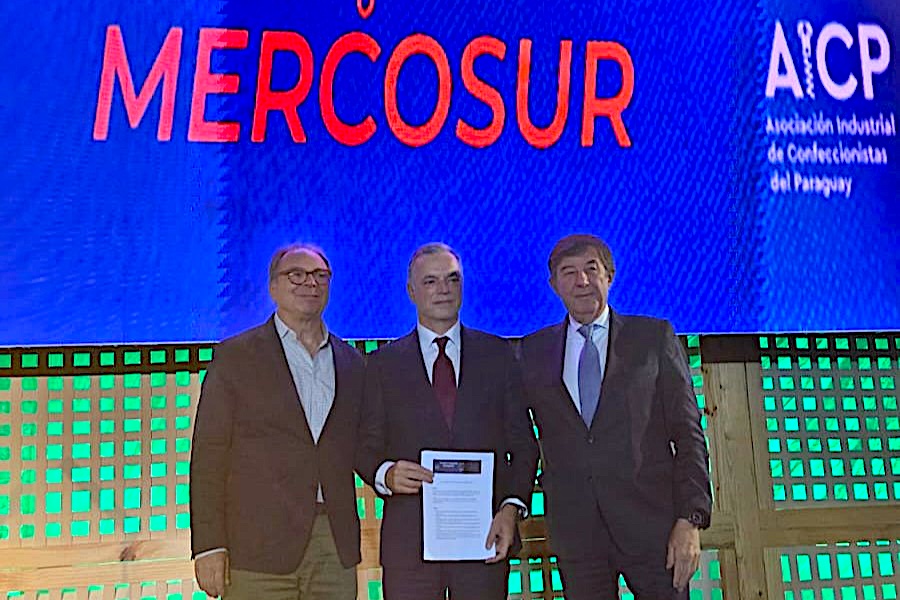
FITA, ABIT and EURATEX underline strategic importance of Mercosur – EU Partnership Agreement for the textile and apparel industry

The Argentine Textile Industry Federation (FITA), the Brazilian Textile and Apparel Industry Association (ABIT), and the European Apparel and Textile Confederation (EURATEX) continue to monitor the process of internalizing the Mercosur-European Union Partnership Agreement. This agreement is essential for the competitiveness of our industries, on both sides of the Atlantic.

#Associations

Industry associations warn against state-run EPR models in the EU

European industry associations, led by Euratex, have raised concerns over a growing trend in several EU Member States to introduce state-run Producer Responsibility Organisations (PROs) within Extended Producer Responsibility (EPR) schemes.

#Associations

European business associations celebrate the signature of the EU-Mercosur FTA

The 17th January marks a historic milestone with the signing of the EU-Mercosur Trade Agreement, creating the biggest trading block in the world. European business – represented by more than 28 associations across a wide range of sectors – warmly welcomes this signature. It sends a strong and timely signal that the EU remains open and is committed to rules-based global trade. In a time of global uncertainty, this agreement is a key growth booster.

#Europe

Level playing field at stake: Europe’s textile industry demands decisive action

Yesterday, the European Parliament took a welcomed and necessary step by voting a resolution calling for stronger market surveillance, reinforced customs controls and faster enforcement of the Digital Services Act in case of infringements. For Europe’s textile and clothing manufacturers, this is the first political acknowledgement that the system is broken — and that enforcement must finally match the scale of the problem.

More News on Associations

#Composites

Alliance for European Flax-Linen & Hemp expands bio-materials presence at JEC World 2026

The Alliance for European Flax-Linen & Hemp is pleased to announce its participation at JEC World 2026, featuring a significantly expanded presence and an enhanced offering for the global composites industry.

#Associations

INDA announces future dates and locations for FiltXPO™ and IDEA® events

INDA, the Association of the Nonwoven Fabrics Industry, announced the future dates and locations for its FiltXPO™ and IDEA® events, reaffirming its long-term commitment to serving the global filtration, nonwovens, and engineered materials communities.

#Associations

Latest news from Bremen: ICAC Plenary Meeting to take place right before the International Cotton Conference

The International Cotton Advisory Committee (ICAC) will hold its 83rd Plenary Meeting on 23–24 March 2026 at the Parliament building in Bremen. The meeting will take place immediately ahead of the 38th International Cotton Conference Bremen (25–27 March 2026) and marks a historic premiere: for the first time, the ICAC Plenary will be hosted in close cooperation with the Bremen Cotton Exchange and the Faserinstitut Bremen e.V. (FIBRE).

#Associations

Textile machinery: the upcoming Colombiatex 2026 speaks Italian

Numerous Italian textile machinery companies will be attending the upcoming Colombiatex, the premier trade fair for the Colombian textile supply chain, held in Medellin from January 27 to 29, 2026. This year’s edition further confirms the strong bond between local textile manufacturers and Italian technology providers.

Latest News

#Functional Fabrics

“Action helps us change what we do!”

DAY 0 takes place deliberately before PERFORMANCE DAYS begins. It is conceived as a space for reflection, dialogue and active engagement — a moment to pause before the fair, rethink established systems and address sustainability not as a trend, but as a fundamental transformation challenge. Under the guiding metaphor “Turn the Tap Off”, DAY 0 focuses on root causes rather than symptoms, systemic change rather than isolated solutions, and collective responsibility rather than individual silos.

#Textiles & Apparel / Garment

Pets in fashion: functional and sustainable textiles find new market at Intertextile Apparel

China’s pet economy is booming, especially amongst younger generations, and pet apparel – from designer outfits to functional garments – was a RMB 3.5 billion (over USD 500 million) market in 2024, growing more than 20% annually¹. To help exhibitors harness this trend, Intertextile Shanghai Apparel Fabrics – Spring Edition 2026 will launch the Pet Boutique, presenting a range of innovative, sustainable materials that prioritise both functionality and comfort for pets.

#Sustainability

VAUDE eliminates PFAS from all products

PFAS (per- and polyfluoroalkyl substances) are now detectable worldwide – in drinking water, soil and the human body. These so-called “forever chemicals” are considered hazardous to health and potentially carcinogenic, as they do not break down and remain in the environment permanently. Despite these risks, PFAS are still used in a wide range of products. More than 15 years ago, VAUDE made a strategic decision to gradually eliminate PFAS from all product categories.

#Man-Made Fibers

Lenzing AG to become majority owner of TreeToTextile AB and accelerates industrialization of new fibers

The Lenzing Group is taking another strategic milestone by acquiring a controlling majority in the Swedish innovation company TreeToTextile AB. This step strengthens Lenzing’s position as a leading provider of sustainable, wood‑based specialty fibers and expands its innovation pipeline with a highly scalable, patent‑protected technology platform. The transaction is executed through the issuance of new shares.

TOP