[pageLogInLogOut]
TRÜTZSCHLER SPINNING - THE NEW CARD

#Recycling / Circular Economy

Fashion for Good launches Cotton Reloop Matrix Project to unlock commercial scale for recycled cotton
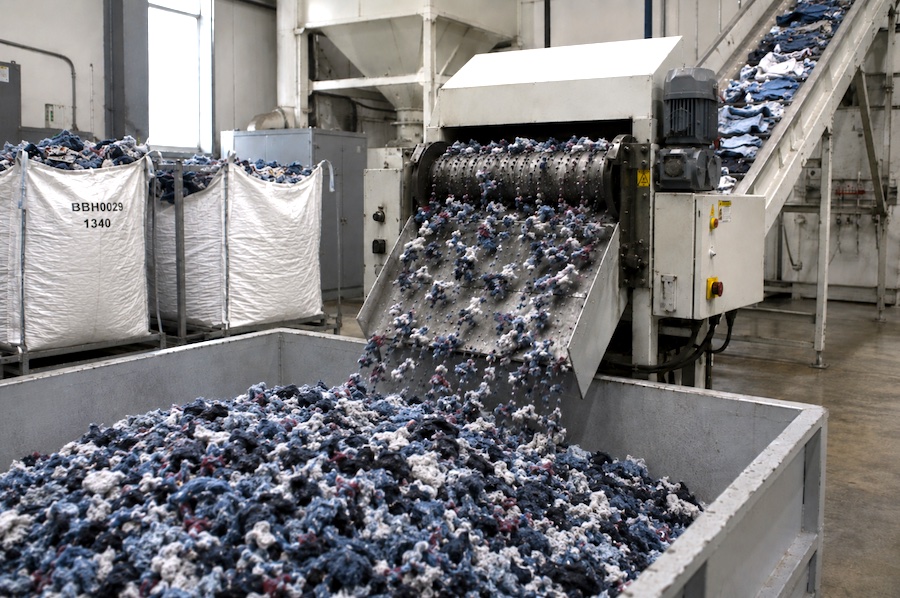
Photo: AI-generated (ChatGPT)
Fashion for Good today announces the launch of the Cotton Reloop Matrix Project, a cross-industry initiative that will map and physically validate the quality of commercially available recycled cotton yarns against brand specifications, giving the industry a data-backed overview of how quality, price, and recycled content intersect. The project is convened with Fashion for Good partners Arvind, BESTSELLER, C&A, Interloop, Reformation, and Shahi, together with ecosystem partner Uster.

Cotton accounts for 19% of global fibre production and is a core part of the material mix. Although alternative recycling pathways exist to utilise cotton-rich textile waste feedstock, they do not produce a cotton output. Therefore, mechanical recycling is a crucial pathway to utilise waste and create recycled cotton yarns and fabrics.

Through the mechanical recycling process, textile waste is shredded and re-opened into loose fibres that can be respun into yarn. However, shredding shortens and weakens the fibres, so only 45 to 50% of the input survives as usable material. The rest is lost as short fibres and processing waste, and because the surviving fibres are shorter than virgin cotton, spinners can only blend a limited share back into new yarn. In practice, that caps most yarns at around 10% recycled content: any higher and the fabric isn't durable enough for commercial use. While recyclers have available capacities, integrating a meaningful percentage of recycled cotton remains complex for brands navigating trade-offs around quality and price.

Testing happens in isolation, with recyclers and brands working from separate data sets, and no shared reference comparison to close the gap between them. Alongside this, brands often evaluate recycled blends against 100% virgin cotton standards, which makes for a challenging comparison for recycled cotton. To help unlock greater market adoption, the industry must shift its focus from virgin parity to fit for purpose, matching the realistic performance profile of recycled fibres to appropriate product applications while utilising targeted quality augmentation pathways where higher performance is required.

Katrin Ley, Managing Director at Fashion for Good, highlights the need for a common evidence base: “Recycled cotton has been talked about as a scale-ready solution for years, but the industry has been working from fragmented data and siloed testing. This project is about closing that gap with hard evidence. By plotting real recycler capabilities against real brand quality targets, and by co-developing the operational standards to support them, we can move recycled cotton from a case-by-case experiment to a category the industry can actually plan around.”

Nikki Player, Senior Director of Raw Materials at Reformation, sees the shared evidence base as an opportunity to increase recycled cotton content: “Recycled cotton isn't new to us: it's a fiber we've worked with for years. What's been limiting is the ability to scale to higher blend percentages without compromising fabric quality or hand-feel. What this project offers is a shared reference point where brands and recyclers work from the same evidence. We hope this opens the door to greater scalability and uptake over time.”

The Cotton Reloop Matrix Project is convened with a coalition spanning the cotton value chain: Fashion for Good partners BESTSELLER, C&A, Reformation, Interloop as manufacturing partner, Arvind, and Shahi as advisors to the project; and ecosystem partner Uster, whose spinning and yarn-testing expertise underpins the physical validation phase.

The Cotton Reloop Matrix Project works in two parallel tracks.

First, Fashion for Good maps what recyclers can produce today against what brands need, across knit and woven categories. The result is a Quality Matrix that shows, at a glance, where recycled cotton is ready for commercial use and where targeted innovation can extend its reach.

Second, the project moves from the map to the mill. Selected recyclers, in collaboration with the project partners, will produce 10 demonstrator fabrics and run five quality augmentation trials in real production conditions, generating a Trade-off Analysis that shows how recycled content, price and quality shape one another.

Best practices from these trials will be captured in a universal, open-source spinning Standard Operating Procedure (SOP), designed to support consistent manufacturing across global supply chains. The project closes with the Roadmap for Cotton Circularity, an industry-facing report setting out the data infrastructure needed to scale recycled cotton adoption across product categories and regions.

Sources: Textile Exchange (2025), Materials Market Report 2025, 18 September 2025; Anas, M. S., Faheem, M., & Mikučionienė, D. (2025), “Challenges and limitations in recycling of post-consumer cotton denim waste into new textiles”, Journal of Natural Fibers, 22(1), 2570080.



More News from Fashion for Good

#Sustainability

Wendy Woods named Chair of the Fashion for Good BV Board

Fashion for Good is pleased to welcome Wendy Woods as its new board chair, succeeding Jill Beraud as of 1 September 2026, who had led the board since 2022.

#Textile chemistry

Fashion for Good launches DW(O)R-X to navigate the emerging landscape of PFAS-free finishes

Fashion for Good announced the launch of Project DW(O)R-X, a collaborative initiative designed to benchmark PFAS alternative durable water- and oil-repellent (DW(O)R) chemistries. Responding to growing market demand for alternatives to PFAS‑based finishes, the project aims to generate reliable, comparable data that can support informed sourcing decisions and the assessment of emerging chemistries.

#Sustainability

Closing the Footwear Loop reveals challenges and opportunities for circular footwear

The footwear industry faces one of the most complex circularity challenges in the fashion sector. A new Phase 1 report from the Fashion for Good initiative Closing the Footwear Loop, developed together with Circle Economy, provides new insights into the composition, condition and recycling potential of post-consumer footwear waste.

#Recycling / Circular Economy

Project REWEAR investigates diverse economies of rewear as a global practice of circularity

Every year, European households discard millions of tonnes of clothing. Around a quarter of what gets separately collected is exported, much of it classified as rewearable. A significant share ends up in markets like Kantamanto in Accra, Ghana, where an estimated 15 million garments arrive every week. New research published today reveals what happens when that clothing arrives.

More News on Recycling / Circular Economy

#Recycling / Circular Economy

The Or Foundation, adidas, BESTSELLER, H&M Group, and Inditex launch Apparel Recovery Coalition, responding to impacts of post-consumer textile exports

adidas, BESTSELLER, H&M Group, Inditex and The Or Foundation, with support from Circle Economy, unveiled the Apparel Recovery Coalition (ARC). The coalition will explore how producer responsibility systems can support circular pathways such as reuse, upcycling, recycling, and responsible waste management in countries that receive large volumes of exported secondhand apparel.

#Recycling / Circular Economy

Syre appoints Tim King as CEO

Syre has appointed Tim King as its new Chief Executive Officer, succeeding Dennis Nobelius, who has decided to leave the company after more than three years as CEO to pursue new opportunities in another industry. King, who has been with Syre since its early days, has been responsible for the company's industrial development and the execution of its strategy.

#Recycled Fibers

Recover™ launches Recover™One, a 100% recycled fiber blend range that eliminates downstream overdyeing

Recover™, a leading materials science company and global producer of recycled cotton at scale, today announces the launch of Recover™One, a new range of fiber blends made entirely from recycled materials. Developed to support the textile industry’s transition toward greater circularity, Recover™One combines recycled polyester and Recover recycled cotton to create soft, smooth, high-performance fabrics for a wide range of applications.

#Recycling / Circular Economy

Samsara Eco survey highlights link between garment durability and brand loyalty

Samsara Eco has published its 2026 Circular-Conscious Consumer Report, examining how garment quality, durability and material transparency influence purchasing decisions and brand loyalty. The survey, conducted among 5,208 predominantly young, circularity-conscious consumers across 120 countries, suggests that poor garment performance can have consequences for brands beyond direct product complaints and returns.

Latest News

#Functional Fabrics

ROICA™ presents stretch textile innovations from nine partners at PERFORMANCE DAYS 2026

ROICA™ by Asahi Kasei will return to PERFORMANCE DAYS Munich on October 13–14, 2026, presenting textile developments from seven European partners and two Japanese specialists under its global brand message, “STRETCH YOUR FUTURE.” Visitors can discover the developments at Booth P10 in Hall A4.

#IGATEX 2026

SHIMA SEIKI to showcase flat knitting and digital design solutions at IGATEX Pakistan 2026

Leading computerized flat knitting technology provider SHIMA SEIKI MFG., LTD. of Wakayama, Japan, together with its Pakistani representative ALMURTAZA MACHINERY CO., (PVT) Ltd., will exhibit at the upcoming International Exhibition for Garment, Textile Machinery and Accessories (IGATEX Pakistan 2026) in Lahore, Pakistan, from October 15–18. SHIMA SEIKI will introduce computerized flat knitting machines, 3D design software and various web platforms as proposals for sustainable production through innovative shaping technology and the latest digital solutions.

#Dyeing, Drying, Finishing

Brazilian market leader Cedro Têxtil focuses on greater efficiency, sustainability, and product quality with Brückner

After more than 150 years of company history, Cedro Têxtil is once again embracing the challenges of a changing industry. Widely recognized as the largest manufacturer of workwear fabrics in Latin America, the Brazilian textile company continues to invest in the modernization of its production facilities. A key milestone in this process was the decision to install a state-of-the-art Brückner stenter frame just over a year ago.

#Digital Printing

Growth at the speed of demand: Kornit Digital brings digital textile innovation to PERFORMANCE DAYS 2026

Kornit Digital Ltd. (NASDAQ: KRNT) (“Kornit”), a global pioneer in on-demand digital fashion and textile production, will showcase the possibilities of digital, on-demand production at PERFORMANCE DAYS 2026, October 13–14 at Messe München, Hall 6, Booth E08.

TOP