[pageLogInLogOut]

#Yarn & Fiber

No mosquitoes, bedbugs and mites
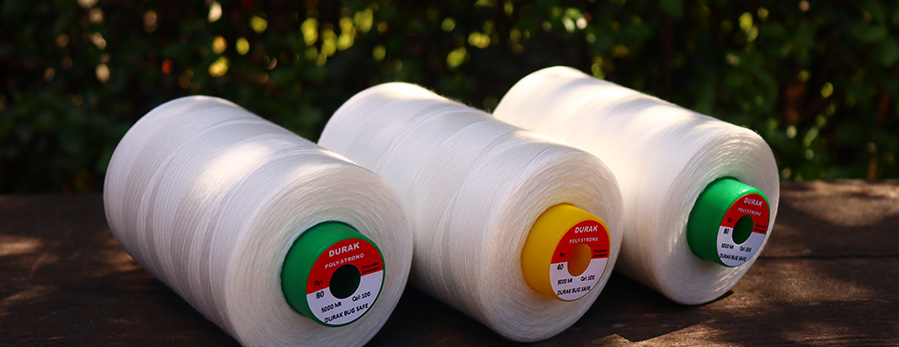
(c) 2024 Durak Tekstil - Durak Bug Safe thread
Durak Bug Safe thread, the latest development of Durak Tekstil, offers a healthy and sustainable option for keeping invisibly small insects and pests away from textile products without containing harmful chemicals.

Durak Tekstil, manufacturer of industrial sewing and embroidery threads, eliminates the problem of insects and flies in many applications, especially in bed and home textile products, with the Bug Safe thread it has developed. Bug Safe thread, free of any chemicals harmful to humans and the environment in addition to its protective feature against insects, contributes to the protection of the ecosystem and the environment by repelling these creatures instead of killing them.

Almost invisible to the naked eye, these insects and pests need moist and warm environments to live and reproduce. Organic particles such as human and pet skin residues and food crumbs penetrate the inner layers of furniture, carpets, bedding and even toys, creating a favourable environment for these creatures. Durak Tekstil has developed the Durak Bug Safe thread with intensive R&D studies to keep invisibly small creatures such as mosquitoes, bed bugs and mites, which are risky for health and comfort, away from textile products and usage areas. This new solution, free of prohibited permethrin chemicals, prevents the settlement and reproduction of these creatures in textile products, especially in seam areas. Durak Bug Safe thread, with a special and natural odour component, has proven its success in various textile applications such as bedding, furniture, carpets and curtains with its insect-repellent feature. Developed primarily for sewing purposes, the thread can also be preferred for mosquito-repellent embroidery applications.

More in-depth and long-lasting insect protection

Durak Tekstil Board Member and Marketing Director Yi?it Durak said that people can encounter insects and pests in all areas of life and stated that a lot of methods are used in textile products in this regard: “People can create favourable environments for insects with both food residues and their own sheds. An average adult sheds 1.5 grams of skin per day, which can be enough for one million dust mites to live. External odour and chemical treatments such as sprays can be used to control them on textile surfaces such as beds, sofas, carpets and curtains; however, their effectiveness is short-term and narrow in scope. Holes and nooks and crannies created during the sewing of textiles can become ideal environments for these pests to live and lay eggs, and solutions such as sprays are not effective here. In these solutions, which may contain prohibited components, the killed pests still remain on the textile surfaces. Therefore, we need a different solution to make our living space more sterile and comfortable. While developing the Durak Bug Safe thread, we focussed on exactly this need. As a healthy and sustainable solution, Durak Bug Safe, instead of killing pests, keeps them away from textile surfaces and repels them.”

Reminding that permethrin chemical components, a kind of prohibited pesticide, are widely used in anti-insect products, Durak emphasised that this poses risks for both the environment and human health. Durak continued his words as follows; “Our main priority was not to use banned chemicals while developing a healthier and sustainable solution for textiles that we directly contact such as mattresses, sofas and carpets. While developing the Durak Bug Safe thread, we used a special fragrance of natural volatile geranium and lemongrass essential oils without permethrin for insect and pest repellency. Thus, we obtained a shield that creates an insect-free area. While protecting our personal comfort and health, we did not harm the ecosystem.”

Independent test laboratory registered the success of Durak Bug Safe

Yigit Durak explained that they cooperated with an independent test laboratory in Germany during the development process of the Durak Bug Safe thread and stated that in addition to the certification of the technical competence of the thread, the tests on living organisms were also carried out within the framework of ethical principles. He expressed; “The qualitative measurements made on the samples we have prepared have proved the repellency level of our thread for mites, bedbugs and mosquitoes. It has been reported that we have obtained successful results in the preliminary tests for OEKO-TEX. When the tests are completed, we will receive the OEKO-TEX Class 1 certificate.”

Durak Bug Safe thread, which does not allow insects to live and reproduce in sewing and embroidery application areas, was developed in light colour, but it can be produced in any colour according to customer demand. The new thread, which maintains its insect-repellent function up to 50 washes, provides lifetime protection as long as it is not washed. Durak Bug Safe thread offers new opportunities and new market opportunities to manufacturers with its suitability for various textile applications.

He noted that the Durak Bug Safe thread will become an assertive product in both local and global markets, saying that especially geographies in humid and hot climatic conditions come to the fore. Durak also expressed that they appeal to numerous different segments from toys to furniture, carpets to clothing products, and underlined that they have developed a suitable solution for protective clothing for those working in the agricultural sector and outdoor products such as tents. Durak concluded; “While developing and protecting the living spaces of humans, we need to respect the living spaces of other living things as a part of the ecosystem. We are pleased to launch our Durak Bug Safe thread with insect/pest deterrent/repellent feature that increases the hygiene in our living space while increasing the comfort of the users.”



More News from TEXDATA International

#Techtextil 2026

Textile Chemicals & Dyes: Innovation in Textile Chemistry moves into focus at Techtextil 2026

From PFAS-free finishes and water-saving dyeing technologies to advanced coatings and recycling-compatible formulations, innovation in textile chemistry is accelerating across the industry. Reflecting this development, Techtextil 2026 introduces Textile Chemicals & Dyes as a dedicated product segment, highlighting the growing role of chemical solutions in shaping the next generation of technical textiles.

#Recycling / Circular Economy

textile.4U publishes special edition “Top 100 Textile Recycling Companies 2025”

With a comprehensive 176-page special edition, textile.4U is dedicating its latest issue entirely to one of the most dynamic and influential topics in today’s textile industry: textile recycling. The new issue, published exclusively in high-quality print, presents the Top 100 textile recycling companies researched and selected by TexData – organizations that already play a key role in the transition to circular textiles or are expected to have a significant impact in the near future.

#Recycling / Circular Economy

Responsible Textile Recovery Act of 2024 signed by Governor

Senator Josh Newman (D-Fullerton) is proud to announce that Senate Bill 707 (SB 707), the Responsible Textile Recovery Act of 2024, has been signed into law by the Governor of California, Gavin Newsom. This groundbreaking legislation establishes the country’s first Extended Producer Responsibility (EPR) textile recycling program, marking a significant step forward in the state’s efforts to combat waste and promote sustainability.

#Textiles & Apparel / Garment

Modtissimo promotes sustainability with 28 coordinates in the Green Circle

Modtissimo is proving more and more to be a textile and clothing show that delivers the latest innovations in the area of sustainability, with the iTechStyle Green Circle being the main showcase for companies' creations. In this 60+4 edition, taking place on 12 and 13 September, 28 coordinates will be exhibited in a section organised by CITEVE and curated by Paulo Gomes.

More News on Yarn & Fiber

#Raw Materials

Lenzing Group positions bio‑based materials as a strategic asset for Europe’s economic security

The Lenzing Group, a leading supplier of regenerated cellulose fibers for the textile and nonwovens industries, hosted a high‑level roundtable in Brussels to discuss how bio‑based materials can strengthen Europe’s economic security and support the shift toward a fossil‑free future. Organized in cooperation with Euractiv, the event brought together representatives of the European Commission, the UK Mission to the EU, academia, civil society, and industry.

#Yarn & Fiber

Teijin Carbon strengthens high‑end sports offering with advanced prepreg and resin technologies for next‑generation bicycle performance

High‑end bicycle manufacturers are entering a new era in which modern frames and components must be lighter, stiffer, tougher and more sustainable – all while enabling fast, repeatable and cost‑efficient production. To support this shift, Teijin Carbon is expanding its portfolio of advanced prepreg systems developed specifically for premium road, gravel and mountain bike applications.

#Yarns

Durak Tekstil to showcase its innovations for mattress industry at ISPA EXPO 2026

Durak Tekstil threads that meet the standards required for high-quality, long-lasting and comfortable products demanded by the mattress industry, while also offering new possibilities, will be exhibited at ISPA EXPO 2026. The fact that the fair is being held in the U.S.—one of Durak Tekstil’s key target markets—also carries great significance.

#Yarns

B.I.G. Yarns achieves EcoVadis Platinum Rating, ranking among top 1% of companies worldwide

B.I.G. Yarns, the carpet yarn brand of B.I.G. and a leading manufacturer of polyamide (PA), polypropylene (PP) and polyester (PET) yarns for contract, automotive, and high-end residential applications, has been awarded the EcoVadis Platinum Medal, placing the company among the top 1% of more than 130.000 companies assessed globally.

Latest News

#Techtextil 2026

DIENES at Techtextil 2026: Flexible pilot lines for bio-based fiber development

The growing relevance of bio-based materials in technical textiles is accompanied by increasing demands for reproducibility, high-quality data, and scalable process routes. Especially when working with cellulose and its derivatives, chitosan, lignin-based approaches, or bio-based PAN as a carbon-fiber precursor, R&D teams face variable feedstock quality, tighter process windows, and the need for reliable comparability across trials. This calls for flexible, data-driven experimental setups that can be reconfigured efficiently when recipes, solvents, and raw-material batches change.

#Texprocess 2026

Gunold showcases embroidery product range and services at Texprocess

At Texprocess 2026, GUNOLD will present numerous hands-on examples related to embroidery in Hall 8, Booth E20. The focus is on creative embroidery designs as well as the extensive product range of threads, nonwovens, and accessories for embroidery and embellishment. “Trade visitors can once again look forward to many new and creative embroidery designs. Of course, we will also showcase the matching products required to bring these ideas to life,” announces Marketing Manager Stephan Gunold.

#Nonwovens

EDANA and more than 70 industry organisations call for consistent exemptions in EU packaging regulation

EDANA, together with more than 70 industry associations and organisations, has issued a joint statement commenting on the European Commission’s Delegated Act under Article 29 of the Packaging and Packaging Waste Regulation (PPWR).

#Raw Materials

A Powerful Opening: Global thought leaders launch the International Cotton Conference Bremen

The International Cotton Conference Bremen will open on 25 March 2026 in the Parliament building of the Free Hanseatic City of Bremen with a keynote session of exceptional calibre. Distinguished international experts will set the stage for the conference by offering incisive perspectives on the most pressing challenges and the defining trends shaping the future of the global cotton trade. Their insights will span a broad spectrum — from geopolitically driven disruptions affecting global supply chains to the opportunities emerging from innovation-led agriculture capable of supporting a growing world population. Together, these opening keynotes will frame the dialogue of the conference, highlighting both the complexity of today’s market environment and the pathways toward a resilient and forward-looking cotton sector.

TOP