[pageLogInLogOut]

#Yarn & Fiber

Following sustainable fibers from feedstock to store stocks

With a portfolio that incorporates renewable resources and waste content as feedstocks, Eastman Naia™ cellulosic yarns and fibers are fully traceable, sustainable solutions for fashion and home textile brands. Now, there's an innovative way to share that traceability information from across the entire supply chain.

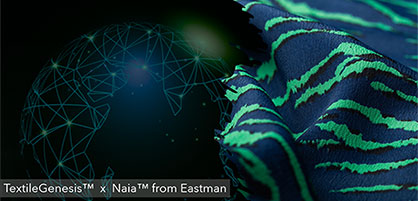
Eastman partners with award-winning TextileGenesis™ traceability technology to provide track-and-trace solutions for Naia™ brand.

Eastman, manufacturer of Naia™ products — including Naia™ Renew, a fully sustainable material made with renewable bio-based and molecularly recycled waste — has collaborated with TextileGenesis™ to use blockchain technology to identify and track the path Naia™ takes from raw materials to final garment.

Proven traceability helps verify a product's sustainability story. Using advanced digital technologies and supply chain modeling, TextileGenesis™ traces every phase of garment making, citing farm and factory locations and every process used to get a product from point of origin to final retail destination.

Here's how it works.

The pioneering TextileGenesis™ system engages all tiers of a supplier's ecosystem to create unprecedented traceability based on five key principles:

Verifying the point of origin by digitizing any textile asset (e.g., fiber, filament, yarn, fabric, garment) to ensure there is no double counting

Capturing real-time shipment transactions across supply tiers

Value chain modeling, using augmented intelligence to gain insight on complex textile value chains along with wastage and loss factors

Creating a cross-industry ecosystem by working with organizations, exchanges, established protocols, and sustainable fiber producers — applying premier environmental, social and governance (ESG) standards

Supporting independent, third-party verification, including by those that perform forensic fiber audits and verify the ESG credentials of suppliers

"Traceability in the textiles supply chain is a crucial step for a more transparent industry overall," said Claudia de Witte, sustainability leader, Eastman Textile Fibers. "Joining the TextileGenesis™ platform is an exciting addition to our existing Naia™ verification program. By collaborating with fellow innovators, we are delivering on our 2022 sustainability goal to enable advanced technology and information solutions for tracking and tracing our materials."

According to de Witte, the TextileGenesis™ partnership demonstrates Eastman's commitment to partner with industry leaders to implement systematic changes that help ensure that sustainable textiles are accessible to all.

"Traceability is fast becoming a key prerequisite to sustainable product offerings," said Amit Gautam, TextileGenesis™ CEO and founder. "Our partnership with Eastman will create unprecedented supply chain traceability for Naia™ fibers and filament towards retail brands. It moves forward the sustainable fibers industry to create end-to-end traceability."


Empowering consumers to make ethical choices

Made with the vision to inspire more eco-friendly fashion and home textiles, Naia™ cellulosic yarns and fiber are responsibly sourced from sustainably managed pine and eucalyptus forests to ensure no deforestation of ancient and endangered forests. For further sustainability, Naia™ Renew gives brands the opportunity to offer circularity at scale. Produced from 60% sustainably sourced and traceable wood pulp and 40% certified* recycled waste materials, Naia™ Renew creates new value from hard-to-recycle materials that would otherwise be destined for landfills, incinerators, or other undesirable end-of-life destinations.
© 2022 Eastman
© 2022 Eastman


According to de Witte, "Understanding where materials come from is a vital part of a brand's sustainability story. By working with TextileGenesis™, we're giving our brand partners a Naia™ travel log from factory floors to retailers' doors, complete with snapshots that detail its journey across the value chain. And in the end, this gives consumers the information they need to make ethical decisions about their fashion." 

For more information on eco-conscious Naia™ and Eastman's sustainability goals, visit https://naia.eastman.com/sustainability.

*Naia™ Renew recycled content is achieved by allocation of recycled waste material using an ISCC-certified mass balance process.




More News from TEXDATA International

#People

Happy Holidays!

Dear reader, the year 2025 is drawing to a close. We are entering what we hope will be a peaceful holiday season, spending time with our families and taking a moment to pause and reflect. We hope we have been able to support you once again this year with relevant news and articles, and we look forward to surprising you with many innovations in the coming year. Enjoy the festive season, stay healthy, and we wish you a happy and joyful holiday season.

#Recycling / Circular Economy

textile.4U publishes special edition “Top 100 Textile Recycling Companies 2025”

With a comprehensive 176-page special edition, textile.4U is dedicating its latest issue entirely to one of the most dynamic and influential topics in today’s textile industry: textile recycling. The new issue, published exclusively in high-quality print, presents the Top 100 textile recycling companies researched and selected by TexData – organizations that already play a key role in the transition to circular textiles or are expected to have a significant impact in the near future.

#Recycling / Circular Economy

Responsible Textile Recovery Act of 2024 signed by Governor

Senator Josh Newman (D-Fullerton) is proud to announce that Senate Bill 707 (SB 707), the Responsible Textile Recovery Act of 2024, has been signed into law by the Governor of California, Gavin Newsom. This groundbreaking legislation establishes the country’s first Extended Producer Responsibility (EPR) textile recycling program, marking a significant step forward in the state’s efforts to combat waste and promote sustainability.

#Textiles & Apparel / Garment

Modtissimo promotes sustainability with 28 coordinates in the Green Circle

Modtissimo is proving more and more to be a textile and clothing show that delivers the latest innovations in the area of sustainability, with the iTechStyle Green Circle being the main showcase for companies' creations. In this 60+4 edition, taking place on 12 and 13 September, 28 coordinates will be exhibited in a section organised by CITEVE and curated by Paulo Gomes.

More News on Yarn & Fiber

#Weaving

Vandewiele Group: Innovation across the textile value chain at ICFE Istanbul 2026

At the 2026 Istanbul Carpet & Flooring Expo (ICFE), Vandewiele Group presents its latest advancements spanning the entire textile value chain. From spinning and weaving to tufting, carpet manufacturing and digital finishing, the Group demonstrates how integrated innovation can boost performance, efficiency and sustainability across all stages of production. As a global technology leader, Vandewiele continues to develop solutions that strengthen processes, enhance product quality and enable smarter, greener manufacturing.

#Man-Made Fibers

Trevira CS® ignites Heimtextil 2026 with "WE CARE" campaign

Indorama Ventures, a global sustainable chemical company, announces its Trevira CS® brand’s powerful and socially responsible presentation at Heimtextil 2026 in Frankfurt, Germany, from January 13 to 16, 2026. The impactful theme of the show: “WE CARE.”

#Recycled_Fibers

CARBIOS and Wankai sign strategic PET biorecycling pact

CARBIOS (Euronext Growth Paris: ALCRB) and Wankai New Materials (“Wankai”), a listed subsidiary of Zhink Group, the 3rd largest PET producer in China and 4th worldwide, announce the signing of the definitive agreement establishing a strategic partnership for the industrial rollout of CARBIOS’s PET biorecycling technology in Asia. The first milestone will be the construction of a PET biorecycling plant in China.

#Yarn & Fiber

Fulgar voice at the Milan Fashion Institute

Daniela Antunes, Marketing Manager at Fulgar, participated as an expert speaker at the XVII edition of the Master in Brand & Product Management of the prestigious Milano Fashion Institute, which trains well-rounded professionals capable of managing both the creative and strategic-managerial aspects of the fashion & luxury sector.

Latest News

#Weaving

Lindauer Dornier announces leadership transition in weaving machine business

After more than ten successful years at Lindauer DORNIER GmbH, Mr Wolfgang Schöffl will leave the family-owned company at the end of the year to enter well-deserved retirement.

#Heimtextil 2026

Texpertise Focus AI: Messe Frankfurt puts Artificial Intelligence centre stage at its international textile and apparel trade fairs

Under the banner 'Texpertise Focus AI, Messe Frankfurt will place a strong emphasis on Artificial Intelligence (AI) across its international textile and apparel trade fairs from 2026 onwards, setting a future-shaping signal for the industry. The initiative highlights the responsible use of AI along the entire textile value chain, from fibre production to the point of sale. The programme will launch at Heimtextil in Frankfurt in January 2026.

#Technical Textiles

Autoneum and Polestar set new benchmarks for passenger experience and sustainability

As the global market leader in sustainable acoustic and thermal management, Autoneum is a key supplier of interior and exterior components for the highly anticipated Polestar 5 model. The successful collaboration between Autoneum and Polestar marks a significant milestone in sustainable automotive engineering: the electric grand tourer sports car features several innovations in lightweight, fully recyclable polyester-based components that ensure a superior driving experience. Polestar 5 was revealed at the IAA Mobility 2025 in Munich and is available in 24 markets.

#Natural Fibers

Cashmere producers stress the importance of The Good Cashmere Standard®

At the invitation of the Aid by Trade Foundation (AbTF), over 70 experts from the cashmere production and supply chain, as well as other specialists, met at the GCS Unit Meeting in Shanghai, China to discuss the progress and new objectives of The Good Cashmere Standard (GCS). The meeting focused on implementation and verification of the standard, important aspects of animal welfare and the importance of the standard in the global textile market.

TOP