[pageLogInLogOut]

#Sustainability

Lindauer DORNIER continues to rely on solar power
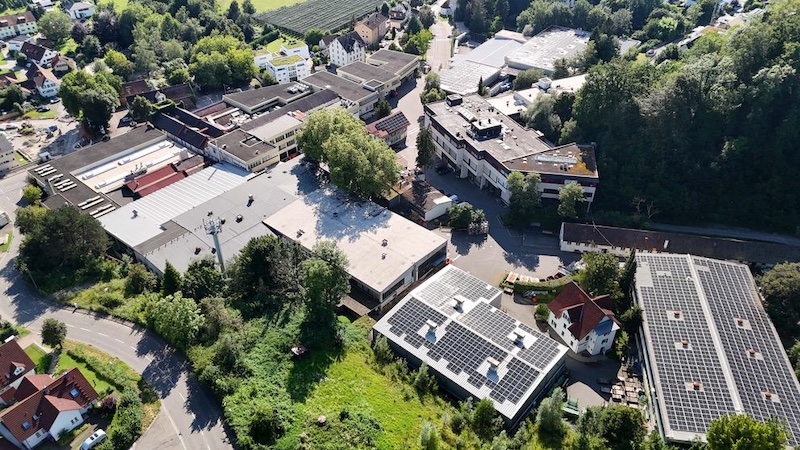
Lindauer DORNIER has put a new photovoltaic system into operation at its main plant in Lindau. Following the system at the Esseratsweiler plant, which was connected to the grid at the end of 2022, this is the machine and plant manufacturer's second photovoltaic system. In future, it will not only supply the company's own production, but also the public power grid with environmentally friendly solar energy. The family-owned company's aim is to cover its electricity needs entirely from renewables in the long term.
The aim of the family-owned company DORNIER is to cover its energy needs entirely from renewables in the long term and to reduce its CO2 footprint © Lindauer DORNIER


With a maximum output of up to 880 kWp (kilowatt peak), the new photovoltaic system can generate up to 880,000 kWh of solar power per year under optimal conditions. This amount could supply around 220 average four-person households with electricity for a year. Spread over six roofs and with a total area of around 4,000 m², the new system is the largest rooftop system in the district of Lindau, according to Energie-Atlas Bayern. ‘The project was a bit tricky because the feed-in points are spread across the entire factory premises, some of which are listed buildings – but the high planning effort paid off,’ says Franz-Peter Matheis, CFO at DORNIER. DORNIER uses the majority of the solar power generated for the production of its air-jet and rapier weaving machines. The surplus electricity is fed into the public power grid and thus also supplies private households in the region with environmentally friendly solar energy. ‘Our thanks go above all to Stadtwerke Lindau, who have supported us at all times, especially with the fast processing and certification of the system,’ says Matheis. If the company's own electricity supply is not sufficient, it obtains 100% green electricity from hydropower by cooperating with Stadtwerke Lindau as a regional electricity provider.

Aim: to cover energy needs entirely from renewables

The new photovoltaic system is part of large investments that DORNIER has recently made to strengthen sustainability and secure the future of its two production sites in Lindau and Esseratsweiler. In addition to the photovoltaic system on the roof of the film stretching system production hall in Esseratsweiler, which was commissioned in 2022, this also includes investments in the modernisation of the machinery, the expansion of digitisation, the self-supply of nitrogen (which eliminates CO2-intensive transport) and the construction of a new training centre for up to 75 trainees and dual students in Lindau.
More News from Lindauer DORNIER GmbH

#Weaving

Lindauer Dornier announces leadership transition in weaving machine business

After more than ten successful years at Lindauer DORNIER GmbH, Mr Wolfgang Schöffl will leave the family-owned company at the end of the year to enter well-deserved retirement.

#ITMA Asia + CITME Singapore 2025

DORNIER celebrates its anniversary at ITMA Asia + CITME

To mark its 75th anniversary, machine and plant manufacturer Lindauer DORNIER will be presenting the latest developments in its rapier and air-jet weaving machines at ITMA Asia + CITME in Singapore (Hall 2, Stand B401) from 28 to 31 October 2025. The focus will be on energy-efficient weaving technologies, new IoT solutions for networked textile production and systems for the series production of modern fibre composite components.

#Weaving

From the Venus flytrap to foldable aircraft wings: Peter Dornier Foundation Prize 2025 honours bionic research on 3D weaving technology

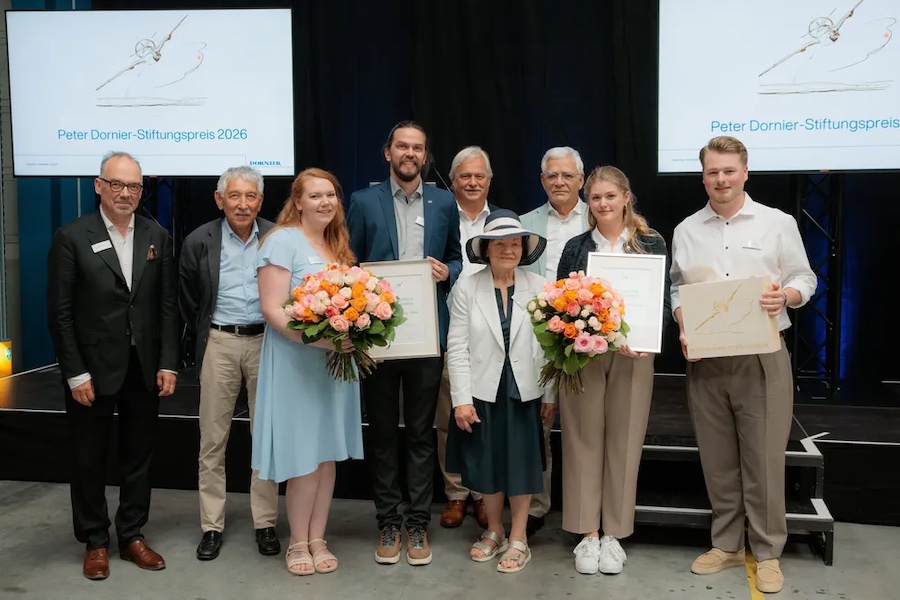
Long wings with foldable tips have the potential to reduce aircraft fuel consumption and make aviation more sustainable. An interdisciplinary research team has now developed a new solution based on the Venus flytrap: Freely movable wingtips made of fibre composites which are produced using innovative 3D weaving technology. For this pioneering combination of textile technology, aviation and bionics, researchers Patrick Meyer (TU Braunschweig) and Michael Vorhof (TU Dresden) were awarded the Peter Dornier Foundation Prize 2025 in mid-July.

#Weaving

Pattern-controlled “pic-a-pic” setting of rapier release timing on right-hand side

DORNIER PIRO enables the operator to set the timing of the rapier release on the right-hand side of the machine “pic-a-pic” and pattern-controlled. For applications with weft yarns of different fineness or elasticity, the optimum timing can be set for each weft channel. This offers great potential for reducing weft waste on the right-hand side.

More News on Sustainability

#Sustainability

Ying McGuire becomes new CEO of Cascale

Cascale today announced the appointment of Ying McGuire as Chief Executive Officer, effective June 1, 2026.

#Sustainability

VAUDE eliminates PFAS from all products

PFAS (per- and polyfluoroalkyl substances) are now detectable worldwide – in drinking water, soil and the human body. These so-called “forever chemicals” are considered hazardous to health and potentially carcinogenic, as they do not break down and remain in the environment permanently. Despite these risks, PFAS are still used in a wide range of products. More than 15 years ago, VAUDE made a strategic decision to gradually eliminate PFAS from all product categories.

#Sustainability

OEKO-TEX® chooses TextileGenesis to advance digital traceability for organic cotton

OEKO-TEX® today announced a full collaboration with TextileGenesis, a Lectra company, to digitally trace and authenticate organic cotton, strengthening fraud prevention across the supply chain. This announcement follows a successful pilot and brings together OEKO-TEX®’s certification expertise and closed testing system with TextileGenesis’ digital traceability platform to deliver a secure, end-to-end solution for managing certified organic cotton flows.

#Europe

ICAC to support European Commission on pending PEF legislation

The International Cotton Advisory Committee (ICAC) is proud to announce that it has been included as a member of the European Commission’s Technical Advisory Board (TAB) on the Product Environmental Footprint methodology. The Commission developed the Product Environmental Footprint (PEF) to assess and communicate the life cycle environmental performance of products and organizations.

Latest News

#Technical Textiles

Sustainable, lightweight, and sound absorbing: Polyester-based front trunk solution for BEVs

As car manufacturers look to further reduce their carbon footprint, Autoneum has developed an innovative front trunk solution for battery electric vehicles (BEVs), made entirely from polyester-based textile. The Ultra-Silent Frunk offers significant weight reduction, improved acoustic and thermal insulation, and uses up to 70 percent recycled material, supporting sustainable and efficient vehicle design. Autoneum, global technology leader in acoustic and thermal management for vehicles, has already received orders for the new frunk from three major OEMs in Asia and Europe to be built in three BEV models. Series production for two BEVs has been underway in China and Germany since last year.

#Raw Materials

Modern testing methods for raw cotton

The 38th International Cotton Conference Bremen will take place from 25 to 27 March 2026 at the Bremen Parliament. This conference has traditionally stood for in-depth expertise and international exchange. The program will focus on technical innovations, market trends, and regulatory frameworks across the entire value chain – from agriculture to the circular economy. With high-profile speakers, the conference is regarded as the key meeting point for the global cotton industry. Today’s focus: Cotton quality and testing methods.

#Spinning

Rieter responds to higher raw material prices

Global political and economic developments have been leading to rising raw material and energy costs for some time. The textile machinery industry is also affected by this trend. Rieter machines and components consist to a large extent of steel, copper, aluminum and electronics. These materials in particular have seen higher demand and higher prices in recent months.

#Weaving

Stäubli demonstrates how innovation translates into real benefits for weaving mills at SITEX 2026

One of India’s most prominent textile industry events, SITEX 2026, is held from February 21 to 23 in Surat. Committed to empowering Indian weaving mills with state‑of‑the‑art solutions tailored to regional needs, Stäubli will present a selection of solutions designed for performance, reliability, and power efficiency. Through its weaving preparation, cam and dobby shedding solutions and Jacquard technologies, Stäubli highlights its global expertise tailored to the specific needs of the local market.

TOP