[pageLogInLogOut]

#Weaving

How the TIEPRO warp tying machine delights weavers worldwide
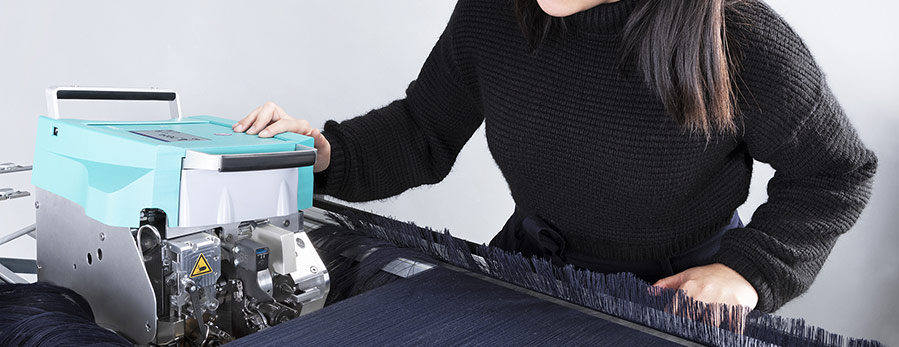
Stäubli Tiepro warp tying machine with operator © 2021 Stäubli
Stäubli unveiled the revolutionary TIEPRO tying machine in 2019. In the short time since then, this machine has become a standard workhorse in renowned weaving mills around the world. Offering unique, easy-handling properties and efficient warp-sheet processing, it has thoroughly convinced operators and managers alike. TIEPRO has become a must-have for forward-looking weaving mills. What makes it so special?

Warp tying is an essential process in every weaving mill. Until the beginning of the last century, this process was conducted manually. The first warp tying machines appeared in the 1930s. Mechanized warp tying had revolutionized the industry worldwide. At that time, the Swiss company Uster offered the KLEINUSTER/USTERMATIC for automatic warp tying. As part of its global marketing strategy, Stäubli acquired this product line and developed it further, which resulted in the TOPMATIC, one of the world’s leading tying machines. The design successfully integrates the workflow requirements of the mill with a number of various technical weaving solutions developed by Stäubli. Continuing development made this machine a highly reliable and important component in many mills. In line with its credo – every development must bring customer benefits – Stäubli constantly pursues its commitment to R&D. Its new TIEPRO warp-tying machine incorporates very special and unique features that make it as inevitable as the tying process itself.

Easy and rapid start-up

Any type of tying machine to be used in a mill must first be placed on the warp-tying frame at the weaving machine. An operator has to dock the machine by hand. Equipped with robotics, TIEPRO docks itself to the old and the new warp sheets. Afterwards, the operator can simply confirm start-up by pushing the start button – and automatic warp tying begins. Thus, TIEPRO leaves staff more time to oversee the weaving hall or handle other tasks.

Easy handling

Before tying, and during the warp stretching on the tying frame, typically, the yarns of new and old warp sheets don’t align precisely. This fact can require time-consuming effort during the tying process. But not with TIEPRO. It easily handles misalignments of up to 10 mm, ensuring precise and quick preparation.

TIEPRO incorporates a revolutionary form of automatic Double End Detection (DED) as a standard feature. Stäubli DED detects double ends automatically before the warp yarn is cut.

This outstanding feature is unique. Another standard feature is the Auto Reverse function, which works in conjunction with DED during the yarn separation process. Double ends caused e.g. by sticky yarns are detected by the sensor, immediately extracted, and separated. This process is done automatically within milliseconds and is virtually impossible to follow visually. It requires no operator intervention. Once done, the yarn separation process automatically restarts.


Sustainable and highly available for processing

Warp tying machines typically operate using separation needles. TIEPRO is the only one in the world that uses separation cones. The cones are made of top-grade, long-lasting materials, sure to last for many years. This is a great advantage over conventional machines, which require regular replacement of the separation needles. Another benefit is that TIEPRO does tying without an oil bath. These two attributes make for low maintenance and high availability in the mill.

The TIEPRO warp tying machine covers a broad range of applications and handles warps with or without a 1:1 lease. The design is a result of Stäubli’s closeness to mills, understanding of their needs, and constant and successful collaboration with them. The overall concept of the machine makes for less operator intervention, increased efficiency in warp tying, and the highest operational availability.  

Stäubli historic warp tying machine © 2021 Stäubli


More News from Stäubli AG

#Techtextil 2026

From preparation to 3D weaving: Stäubli’s solutions at Techtextil 2026

Stäubli, a global leader in high performance weaving technologies, is pleased to announce its participation at Techtextil 2026 in Frankfurt, Germany, the leading international trade fair for technical textiles and nonwovens. As technical textiles continue their rapid expansion across demanding markets such as defense, mobility, aerospace, construction, energy… Stäubli will showcase innovative solutions designed to empower mills to produce the next generation of advanced fabrics. Stäubli will exhibit its trend-setting technologies at the Swiss Pavilion Booth B01.6 in Hall 12.0.

#Weaving

Stäubli demonstrates how innovation translates into real benefits for weaving mills at SITEX 2026

One of India’s most prominent textile industry events, SITEX 2026, is held from February 21 to 23 in Surat. Committed to empowering Indian weaving mills with state‑of‑the‑art solutions tailored to regional needs, Stäubli will present a selection of solutions designed for performance, reliability, and power efficiency. Through its weaving preparation, cam and dobby shedding solutions and Jacquard technologies, Stäubli highlights its global expertise tailored to the specific needs of the local market.

#Composites

Breaking new ground in Technical Textiles: Stäubli at JEC World 2026

Stäubli, a global leader in industrial and mechatronic solutions, will showcase its cutting-edge weaving machinery solutions for technical textiles at JEC World 2026, from 10 to 12 March in Paris-Nord Villepinte.

#ITMA Asia + CITME Singapore 2025

Stäubli showcases advanced weaving technologies at ITMA Asia Singapore 2025

At ITMA Asia 2025 in Singapore, Stäubli will showcase its latest innovations in weaving technology. After several years, the exhibition returns to Singapore — a strategic hub that provides easy access to key textile markets across Southeast Asia. Taking place from 28 to 31 October 2025, this year’s edition focuses on green technologies that promote sustainable development across the textile industry.

More News on Weaving

#Techtextil 2026

Crealet to showcase electronic warp feeding solutions at techtextil 2026

Crealet AG will present its latest developments in electronic warp yarn feeding at Techtextil 2026 in Frankfurt. The company will exhibit at the Swiss Pavilion (Hall 12.0, Booth B01), organised by Swiss Textile Machinery.

#Weaving

Itema America acquires Palmetto Loom Reed, strengthening local manufacturing and service in the U.S.

Itema America, the U.S. subsidiary of Italy-based Itema Group, has acquired – through an Assets Purchase Agreement – Palmetto Loom Reed, a Greenville, South Carolina-based manufacturer of weaving reeds and one of the last remaining domestic producers of these precision components in the United States.

#Weaving

Itema exhibits the two best-selling high-end rapier weaving machines of the Region, R9500EVO and Galileo-RX at SITEX 2026

Following the opening of its new Surat Service Center in November, Itema will exhibit at SITEX (Stand 286) from February 21st to 23rd at the Surat International Exhibition and Convention Centre (SIECC). Surat has long been one of Itema’s most strategic markets, a role further reinforced by the inauguration of the Surat Service Center last November. Equipped with an advanced electronic repair center, a weaving machine behavior simulator, and a local spare parts warehouse, the new facility strengthens Itema’s presence in the region while bringing the company even closer to its Customers.

#Weaving

Groz-Beckert launches comprehensive Reed Portfolio in Ichalkaranji to advance weaving excellence in India

Groz-Beckert, the world’s leading provider of industrial machine needles, precision parts, and systems for the textile industry, hosted an exclusive customer event titled “Advancing Weaving Excellence – Reed Portfolio Launch” in Ichalkaranji, one of India’s most prominent weaving hubs.

Latest News

#Techtextil 2026

Performance Apparels: Functional textiles drive innovation at Techtextil 2026

From high-performance fibres and advanced membranes to smart textiles and sustainable material concepts – functional apparel is becoming one of the most dynamic innovation fields in technical textiles. At Techtextil 2026, exhibitors demonstrate how new materials, finishing technologies and digital functions are shaping the next generation of protective, workwear and outdoor systems.

#Textile chemistry

A flagship for chemical production: BASF inaugurates world-scale Verbund site in China

BASF today (March 26, 2026) celebrated the official inauguration of its newly built, world-scale Verbund site in Zhanjiang, Guangdong Province in southern China. Covering an area of around four square kilometers, it is more than a major BASF project in the chemical growth market of China. “Zhanjiang shows what the future of chemistry looks like: efficient, digital and sustainable by design. The site showcases a smart integrated Verbund structure on an industrial scale,” said Dr. Markus Kamieth, CEO of BASF, at the ceremony attended by representatives from government, customers, business partners and employees.

#Nonwovens

VEOCEL™ Lyocell production expands to Asia – Launching a new chapter for nonwovens in the region

VEOCEL™, Lenzing's flagship specialty nonwovens brand, expands production at its Thai plant in Prachinburi. This is the first-ever production of its nonwoven-grade lyocell fibers in Asia. Built in 2022 with a 100,000-ton annual production capacity, the facility - previously focused on fibers for textile applications - now can directly meet the demand for VEOCEL™’s biodegradable¹, wood-based lyocell fibers for nonwovens products. These fibers are an essential ingredient for high-quality nonwovens products, ranging from baby wipes to facial sheet masks and everyday personal hygiene items.

#Research & Development

Hof University develops sustainable textile coating for the fashion of tomorrow from mushrooms

Clothing is often treated as disposable: T-shirts for events, general merchandise, or short-term campaigns frequently end up in the trash after only a few uses. This is particularly problematic given that their production still largely relies on fossil-based materials. This is precisely where a new research project at Hof University of Applied Sciences comes in.

TOP