[pageLogInLogOut]

#Textile chemistry

BASF inaugurates new Catalyst Development and Solids Processing Center in Ludwigshafen
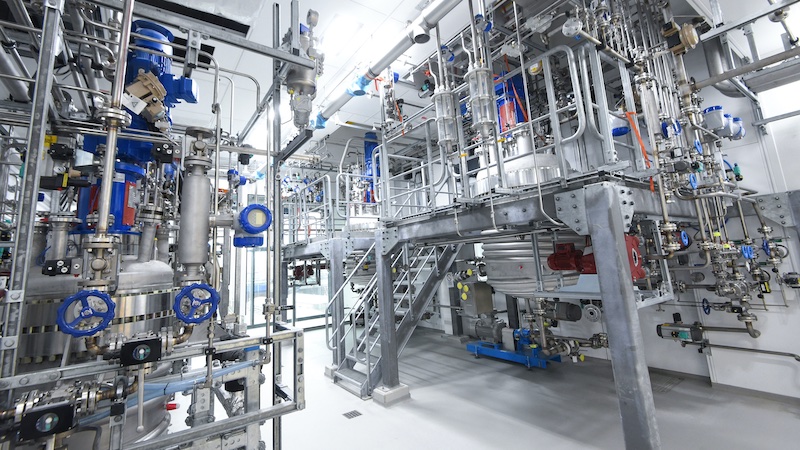
BASF officially opened its new Catalyst Development and Solids Processing Center in Ludwigshafen, Germany, on December 12, 2024. This research facility will serve as a hub for pilot-scale synthesis of chemical catalysts, enabling BASF to offer its global customers faster access to innovative technologies. This pilot plant will also be of central importance for the development of new solids processing technologies.
With its new Catalyst Development and Solids Processing Center in Ludwigshafen, Germany, BASF will serve as a hub for pilot-scale synthesis of chemical catalysts, enabling the company to offer its global customers faster access to innovative technologies. This pilot plant will also be of central importances for the development of new solids processing technologies.<br />
The picture shows a reactor for the synthesis of solids © 2024  Photo: BASF SE
With its new Catalyst Development and Solids Processing Center in Ludwigshafen, Germany, BASF will serve as a hub for pilot-scale synthesis of chemical catalysts, enabling the company to offer its global customers faster access to innovative technologies. This pilot plant will also be of central importances for the development of new solids processing technologies. The picture shows a reactor for the synthesis of solids © 2024 Photo: BASF SE


“With cutting-edge process equipment, our new Catalyst Development and Solids Processing Center enables BASF to conduct more focused and rapid development of innovative catalyst and process technologies, which we and our customers urgently need for the green transformation,” said Dr. Helmut Winterling, President Group Research at BASF. “It is also an important investment in the future of our research and development activities at the Ludwigshafen site.”

Catalysts play a key role in industrial chemistry. More than 80 percent of all chemical products come into contact with a catalyst at least once during their production. Catalysts reduce the energy demand and the amount of undesired by-products. Thereby, they minimize raw material consumption and shrink the carbon footprint of products. Catalysts are used in many areas, including the chemical and petrochemical industries, as well as in innovative processes essential for the green transformation. BASF not only develops catalyst and process technologies for its customers worldwide, it also uses them in its own manufacturing plants.

At the new Center, BASF will develop and optimize innovative process technologies and catalysis processes. “The technical capabilities of the new research facility will strengthen our innovative power and improve our competitiveness in a global market environment,” said Dr. Detlef Ruff, Senior Vice President Process Catalysts at BASF. “This new center offers us the ideal conditions to transition lab-developed catalysts to production scale. It will enable us to provide our customers with high-quality pilot samples of new catalysts. We can thus react more flexibly to the needs of the market and supply innovative technological solutions faster – a crucial factor in successfully launching new products.”

BASF constructed the new Center within three years to replace an older building. The new building has state-of-the-art safety features and is equipped with numerous new technologies for R&D activities. In total, the company invested a high double-digit million-euro figure in the new Catalyst Development and Solids Processing Center.

More News from BASF Aktiengesellschaft
Performance Chemicals for Textiles Europe

#Recycling / Circular Economy

trinamiX with new management

BASF is examining strategic options for its subsidiary trinamiX GmbH. trinamiX specializes in biometric imaging and mobile material analysis. These activities are not part of BASF’s core business, on which the company is focusing as part of the implementation of its new strategy.

#Research & Development

How innovations drive BASF’s success

“Innovation has always been part of BASF’s DNA. Especially in these volatile times, it is crucial to leverage our innovative strength to develop competitive solutions that differentiate us as a company in our markets and give us a competitive edge,” said Dr. Stephan Kothrade, Member of the Board of Executive Directors of BASF and Chief Technology Officer, at the company’s Research Press Briefing held today. To achieve this, BASF implemented its “Winning Ways” strategy about a year ago with the clear goal of becoming the preferred chemical company to enable its customers’ green transformation.

#Nonwovens

Turning diaper waste into new value: BASF, Essity and TU Wien pioneer circular solutions

BASF, one of the world’s leading chemical companies and manufacturer of superabsorbent polymers (SAP), and Essity, a global leading hygiene and health company, joined forces together with the Technical University of Wien to revolutionize recycling of absorbent hygiene products (AHP).

#Textiles & Apparel / Garment

BASF at SIMAC 2025: Recycling meets Performance – PU solutions for the future of footwear

BASF is presenting new materials, concepts and recycling methods for polyurethanes in footwear at SIMAC Tanning Tech. The leading international trade fair will take place from September 23-25 in Milan, Italy. We will showcase our unique and integrated toolbox of Elastopan® (PU) and thermoplastic polyurethanes Elastollan® and Infinergy®. Together with our partners and customers we bring innovative products to the market offering utmost lightness paired with mechanical performance and automated processing.

More News on Textile chemistry

#Textile chemistry

RUDOLF gets the exclusive global distribution rights for Sanitized® textile technologies

With effect from today, RUDOLF officially assumes exclusive global distribution rights for Sanitized® textile technologies from SANITIZED AG. This is the next milestone in the strategic collaboration announced in 2025, with the partnership between the two companies now fully implemented and expanded worldwide.

#Denim

organIQ seek: smart alternative to potassium permanganate

CHT Group announces new technical findings within its organIQ seek platform that significantly advance the transition toward permanganate-free denim bleaching. Through extensive industrial testing and application research, CHT confirms that organIQ seek can now be used with remarkable effectiveness as a substitute for potassium permanganate in spray bleach, while remaining aligned with sustainability expectations and cost realities in the European market. At the COLOMBIATEX in Medellín as well as at the Exintex in Puebla and the Kingpins Show in Amsterdam the CHT Group will present organIQ seek as an alternative to potassium permanganate.

#Textile chemistry

Archroma brings high-impact textile innovations to Colombiatex 2026

Archroma, a global leader in specialty chemicals towards sustainable solutions, is proud to announce its participation in Colombiatex 2026, one of the most influential textile and apparel industry events in the Americas. The event will take place in Medellín, Colombia, from January 27 to 29, where Archroma will welcome visitors at Booth PC006.

#Textile chemistry

Devan unveils innovative textile solutions to enhance comfort during sleep at Heimtextil 2026

From 13 to 16 January 2026, Devan was exhibiting at Heimtextil in Frankfurt, the world’s leading international trade fair for home and contract textiles. The event brought together key players from across the global textile value chain, providing the ideal platform for Devan to present its latest innovations.

Latest News

#Sustainability

Ying McGuire becomes new CEO of Cascale

Cascale today announced the appointment of Ying McGuire as Chief Executive Officer, effective June 1, 2026.

#Technical Textiles

Sustainable, lightweight, and sound absorbing: Polyester-based front trunk solution for BEVs

As car manufacturers look to further reduce their carbon footprint, Autoneum has developed an innovative front trunk solution for battery electric vehicles (BEVs), made entirely from polyester-based textile. The Ultra-Silent Frunk offers significant weight reduction, improved acoustic and thermal insulation, and uses up to 70 percent recycled material, supporting sustainable and efficient vehicle design. Autoneum, global technology leader in acoustic and thermal management for vehicles, has already received orders for the new frunk from three major OEMs in Asia and Europe to be built in three BEV models. Series production for two BEVs has been underway in China and Germany since last year.

#Raw Materials

Modern testing methods for raw cotton

The 38th International Cotton Conference Bremen will take place from 25 to 27 March 2026 at the Bremen Parliament. This conference has traditionally stood for in-depth expertise and international exchange. The program will focus on technical innovations, market trends, and regulatory frameworks across the entire value chain – from agriculture to the circular economy. With high-profile speakers, the conference is regarded as the key meeting point for the global cotton industry. Today’s focus: Cotton quality and testing methods.

#Spinning

Rieter responds to higher raw material prices

Global political and economic developments have been leading to rising raw material and energy costs for some time. The textile machinery industry is also affected by this trend. Rieter machines and components consist to a large extent of steel, copper, aluminum and electronics. These materials in particular have seen higher demand and higher prices in recent months.

TOP