[pageLogInLogOut]

#Sustainability

Revisiting GCA Alumni: How EON, Dimpora & saltyco are powering the future textile industry
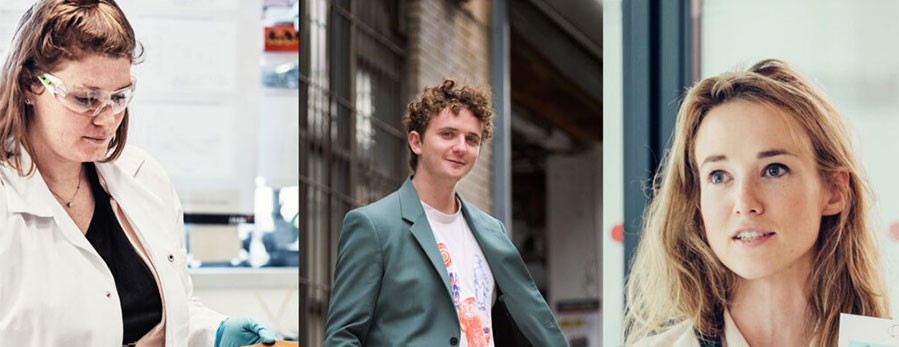
Anna Beltzung, Dimpora, Julian Ellis-Brown, saltyco and Natasha Franck, EON. © 2023 H&M
To radically transform the textile industry, the boldest ideas must succeed. Here, H&M Foundation checks in with three future-shaping innovators whose digital tools, ground-breaking materials, and regenerative processes are reshaping the textile industry in real-time.

The Global Change Award is a global innovation challenge seeking bright minds that can reinvent fashion and change the way it is seen, worn, and made. Every year, H&M Foundation selects and support the most impactful innovations with the ultimate aspiration of turning the entire textile industry planet positive. EON, saltyco and Dimpora are all past winners who are now part of the GCA Alumni, a group of brilliant minds from across the world that share learnings and network with each other, and that are supported by H&M Foundation and our partners.

EON’s digital ID is enabling over 100 million items to be resold and recycled

“EON embeds principles of connectivity, intelligence and circularity in hundreds of millions of products, and has built some of the industry’s most fundamental product data infrastructure for circular commerce: connecting data between suppliers, brands, resellers, recyclers, customers, and more,” declares EON’s founder and CEO Natasha Frank.

According to her, every single product has a story to tell: from where and how it was made, to when and by what brand it was sold. EON gives the world’s products a voice — in the shape of a digital ID — that unlocks total traceability and boosts the resale and recycling of discarded items.

Since winning the Global Change Award in 2017, EON has scaled at lightning speed and entered into global partnerships with retail heavyweights like Net-A-Porter and Zalando.
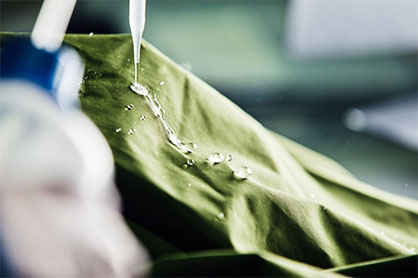
Dimpora lab. © 2023 H&M


“EON was just an idea when I applied for the GCA. Winning the award encouraged me to turn it into a business, and seven years later, here I am.”

Natasha Franck


In seven short years, the company has enabled more than a hundred million products to become digital and traceable. Still, these astounding numbers are just a fraction of the 80 billion pieces of clothing sold worldwide yearly. But the company’s implementation rate is constantly adding speed, and to Natasha Franck, reaching billions of products will be achieved within this decade.

“In five years, every product will have a unique digital ID, giving every product a voice and ensuring products are valued, managed and utilised to benefit our society, economy and environment. EON’s technology is powering that future.”

Dimpora’s mineral-based membranes are moving from lab to launch

The clothes designed to shield us from the elements are almost exclusively crafted from materials that harm the environment. As a consequence, conventional activewear presents a conflict between the desire to experience the natural world, and the desire to maintain it. With biodegradable, non-toxic and mineral-based membranes, Dimpora is resolving this conflict.

“We push for circularity of our membranes and laminates, ensuring we design products with an end-of-life strategy. We use our platform technology to turn the most circular and sustainable raw materials into functional membranes,” says Dimpora’s founder and CTO Anna Beltzog.


When winning the GCA in 2019, the company had only developed early lab samples based on co-founder Mario Stucki’s PHD thesis. The win catalysed their scaling journey.

“The accelerator programme opened up doors and allowed us to build a network in three textile hubs worldwide. And what really helped was the financial contribution, the help in marketing materials, and the recognition in the industry: we were taken seriously!”

Anna Beltzog

Four years in the making, Dimpora has grown from a team of two to a company of eleven and in 2022, the start-up commercialised its first product.

“We are now producing thousands of square meters in a single production run. This made it possible to serve our first commercial order with the Swiss glove brand Snowlife in 2022. And the re-order is already delivered for the coming season.”

Saltyco’s latest pilot can produce 400 tonnes of regenerative fibre-filler

BioPuff by saltyco isn’t a vegan alternative to goose down; it’s a regenerative alternative to it. With cutting-edge technology, saltyco turns native wetland plants into fibre-filler and heals damaged lands in the process.

“For the textile industry to reach net zero, both wetland regeneration and the move to healthier textiles must happen. BioPuff is a solution that brings these two urgent challenges together in one solution,” says Julian Ellis-Brown, co-founder and CEO of saltyco.

The team’s disruptive idea won them the GCA in 2022, an event transforming their start-up journey in a number of ways, according to the founders.
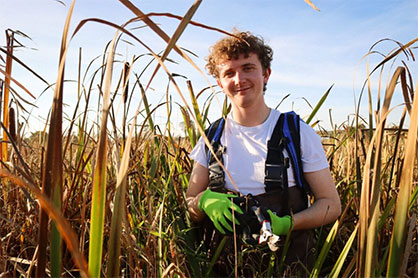
Julian Ellis-Brown harvesting bulrush plants.  © 2023 H&M
Julian Ellis-Brown harvesting bulrush plants. © 2023 H&M


“The win helped build confidence with investors as it showcased an industry-leading organisation was getting behind our idea. The GCA also built traction with brands, exposing us to more innovators within fashion who are keen to explore next-generation textiles.”

Julian Ellis-Brown

Introducing a novel technology and a game-changing material innovation to society is a time-consuming and complex process. Currently, the saltyco team is focusing on sampling, product development, and launching a seed funding round.

“Our new pilot machinery will have the capacity to produce 400 tonnes of BioPuff per year, regenerating thousands of hectares of wetland and locking tens of thousands of kilograms of CO2 back into the ground,” says Julian Ellis-Brown.

Explore all past GCA winners and subscribe to the GCA Newsletter to track their progress.



More News from TEXDATA International

#Texprocess 2026

Texprocess 2026: Automation, digitalisation and AI redefine textile processing

Making investment decisions in textile processing has become significantly more demanding. Increasing energy costs, a shortage of skilled labour and ongoing geopolitical uncertainties are compelling companies to focus on technologies that deliver clear gains in efficiency and process reliability. This applies equally to apparel manufacturing and to the processing of technical textiles and high-performance materials. As a result, modernisation initiatives are assessed more carefully – even as the need to upgrade production systems continues to intensify.

#Techtextil 2026

Techtextil 2026: Between innovation pressure & market reality

From 21 to 24 April 2026, Techtextil in Frankfurt am Main will once again become the central meeting point for the international technical textiles and nonwovens industry. Running in parallel, Texprocess will focus on the industrial implementation of textile processing technologies as the leading platform in this field. Together, the two trade fairs form a closely integrated presentation and working platform along the entire textile value chain – from material development to finished applications.

#Techtextil 2026

Between geopolitical pressure and industrial resilience

In this interview, Dr. Janpeter Horn (VDMA) discusses the current challenges facing textile machinery manufacturers, shaped by geopolitical tensions, regulatory developments and subdued investment. He also outlines why innovation strength, integrated solutions and strategic positioning remain key to global competitiveness.

#Texprocess 2026

Between investment restraint and modernization pressure

Texprocess 2026 takes place in a complex market environment shaped by uncertainty and innovation pressure. In this interview, Elgar Straub (VDMA) explains why the trade fair is particularly relevant this year and which technologies are driving efficiency and competitiveness.

More News on Sustainability

#Sustainability

A new standard to combat plastic waste in forests

With DIN SPEC 35808 “Tree Shelter for Forestry Applications,” the testing and research service provider Hohenstein, in collaboration with Rottenburg University of Forestry, as well as forestry authorities and industry partners, has established a clear framework for bio-based and fully biodegradable tree shelters. The pre-standard defines requirements and practical testing methods designed to reduce plastic waste in forests and strengthen the long-term protection of soil and the environment.

#Denim

Denim moves towards sustainability

EIM (Environmental Impact Measurement), the global reference platform for measuring the environmental impact of garment finishing, presents the second edition of its annual report Denim Industry Progress & Insights 2025. The study analyses over 100,000 real denim finishing processes, providing an accurate and up-to-date view of the industry’s evolution towards more sustainable models.

#Recycling / Circular Economy

Europe’s textile future at a turning point: New 2030 Circularity Blueprint aims to scale recycling and unlock investment opportunities

The EU textile system is at a critical crossroads. Today, less than 1% of discarded garments are recycled into new garments, despite EU-wide obligations for separate collection. In response, Global Fashion Agenda (GFA) is launching the 2030 Circularity Blueprint, in partnership with ReHubs. This ambitious initiative is designed to support the transformation of the EU textile ecosystem to advance textile-to-textile recycling and drive the transition to a circular economy.

#Sustainability

Number of GOTS-certified facilities grow 15% globally as demand for credible sustainability standards continues to strengthen

Global Organic Textile Standard (GOTS) certification continued to grow in 2025, with nearly 18,000 certified facilities worldwide, despite ongoing geopolitical uncertainty and rapidly evolving regulatory requirements across global textile supply chains.

Latest News

#INDEX 2026

ANDRITZ at INDEX ’26: Driving sustainability with next-generation nonwoven technologies

From May 19-22, ANDRITZ Nonwoven & Textile is presenting its innovative solutions for the nonwoven & textile industry in Geneva, Switzerland. ANDRITZ will focus on technologies for sustainable and durable nonwovens, converting, sustainable fiber processes, textile recycling, and life-cycle services on booth 2114 in hall 02.

#INDEX 2026

INDEX™26: World’s leading nonwovens exhibition presents groundbreaking product launches, exclusive seminars and immersive experiences

From 19 to 22 May 2026, 620 exhibitors from 44 countries will gather in Geneva at Palexpo for INDEX™26. The exhibition aims to demonstrate how the future of technical materials will increasingly be shaped by collaborative supply chains and integrated innovation across the nonwovens industry. This year’s edition focuses not only on individual technological advances, but also on how cooperation throughout the value chain can enhance the performance, sustainability and value of nonwoven solutions.

#INDEX 2026

The LYCRA Company launches LYCRA® ADAPTIV fiber for nonwovens, advancing comfort and fit in disposable hygiene at INDEX™ 26

The LYCRA Company, a leader in innovative and sustainable fibers for apparel and personal care, today announced the official global launch of LYCRA® ADAPTIV fiber for nonwovens at INDEX™ 26, in Geneva, Switzerland, May 19–22. This breakthrough stretch fiber, already trusted by leading global apparel brands, now ushers in a new era of comfort, fit, and performance for baby diapers, disposable hygiene products, adult incontinence, and feminine care.

#INDEX 2026

Innovations for today – solutions for tomorrow: Trützschler Nonwovens at INDEX™ 2026

From 19 to 22 May, Trützschler Nonwovens will present itself at booth 1641 as a long-term partner to its customers. The focus will be on new products for all nonwoven processes, further developments of the digital working environment T‑ONE, and an expanded service portfolio.

TOP