[pageLogInLogOut]

#Sustainability

Unique equipment for biotechnological capture and conversion of CO2 into chemical building blocks developed in the BioRECO2VER project
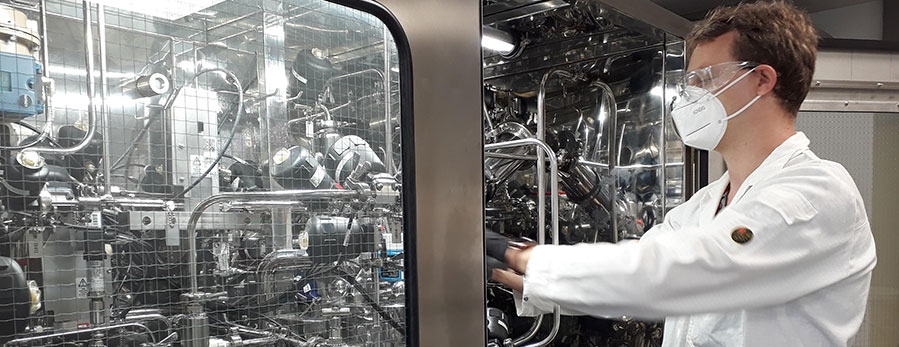
Scientist at research institute VITO preparing the high pressure fermenter Source: VITO
Carbon is the main element in numerous materials used in industrial processes and in our daily lives. It is currently mostly provided from fossil sources. But what if carbon could be used directly from CO2 emissions?

CO2 as renewable carbon source

Biotechnology shows particularly great potential for the eco-effective conversion of climate-damaging CO2 emissions into valuable basic chemicals. A consortium of 12 partners investigated this pathway in the EU-funded BioRECO2VER project, examining the conversion of CO2 emissions from refineries and the cement industry into the chemical building blocks isobutene (C4H8) and lactate (C2H6O3). 

Innovative chemo-enzymatic concept for CO2 Capture 

Project partner Luleå University of Technology (LTU) focused on the first process step of capturing and concentrating CO2 from industrial point sources. Their team developed a hybrid chemo-enzymatic process consisting of a novel solvent blend and an ultrastable carbonic anhydrase (CA) enzyme. The solvent blend included an amino acid ionic liquid and a tertiary amine and displayed a good compromise between enzyme compatibility, absorption rate, capacity and desorption potential. In addition, LTU generated ultrastable enzyme mutants that showed 50% increased resistance to selected flue gas inhibitors compared to the original CA. This 3-component CO2 capture process was scaled up in a pilot rig, and the set-up further used for real off gas pre-treatment in the project. 
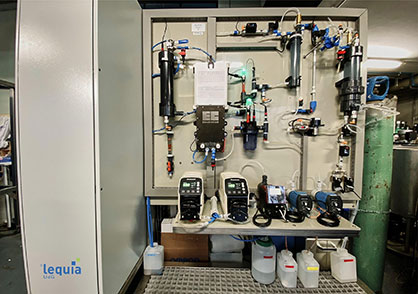
First BES-platform at the university of Girona, Spain. Source: UdG


Two unique pilots for biotechnological CO2 Conversion/Utilization

The biotechnological conversion of (captured) CO2 and the co-substrate hydrogen by microorganisms poses technical and economic challenges because it takes place in the liquid phase and the substrates are gases which are poorly soluble. The BioRECO2VER project investigated two approaches to address this: fermentation under elevated pressure and bio-electrochemistry with in situ production of hydrogen. 

Pressurized fermenter

Project coordinator VITO designed a flexible and multifunctional high-pressure fermenter, customized for research activities with advanced online sensors, monitoring and control, and also including a membrane filtration unit to achieve high concentrations of the microbial biocatalysts. The set-up was broadly tested in the BioRECO2VER project both with pure CO2 and CO2-rich off-gases but can also be used for investigations involving other poorly soluble gases, such as methane, oxygen, or synthesis gas. Pressures up to 10 bar can be applied. More information can be found here: http://nova-institute.eu/press/?id=279 


First solely CO2-based bio-electrochemical platform

University of Girona designed and tested a bio-electrochemical platform that is unique in the world. The key differentiators of the pilot plant are:

• Two parallel lines to test engineered strains and bio-electrochemical systems

• Fully automated pilot plant capable to control key operational parameters (pCO2, pO2, pH2, pH, Temperature) to intensify the process performance

• Solid-liquid separation unit (membrane) to recover the planktonic cells and return them into the bio-electrochemical systems. 

A video of the pilot is available here: http://bioreco2ver.eu/media/  

This unique infrastructure will be used beyond the project to support further research and development activities in the broad area of CO2 capture and conversion. 

Free access to all project results

Last November, the consortium shared the project highlights and additional results with a broad and international audience. All presentations can be freely accessed here: http://bioreco2ver.eu/webinar/ 

The BioRECO2VER project received funding from the European Union's Horizon 2020 research and innovation program under grant agreement number 760431. More information can be found at: http://www.bioreco2ver.eu/ and https://cordis.europa.eu/project/id/760431

More News from TEXDATA International

#Techtextil 2026

Textile Chemicals & Dyes: Innovation in Textile Chemistry moves into focus at Techtextil 2026

From PFAS-free finishes and water-saving dyeing technologies to advanced coatings and recycling-compatible formulations, innovation in textile chemistry is accelerating across the industry. Reflecting this development, Techtextil 2026 introduces Textile Chemicals & Dyes as a dedicated product segment, highlighting the growing role of chemical solutions in shaping the next generation of technical textiles.

#Recycling / Circular Economy

textile.4U publishes special edition “Top 100 Textile Recycling Companies 2025”

With a comprehensive 176-page special edition, textile.4U is dedicating its latest issue entirely to one of the most dynamic and influential topics in today’s textile industry: textile recycling. The new issue, published exclusively in high-quality print, presents the Top 100 textile recycling companies researched and selected by TexData – organizations that already play a key role in the transition to circular textiles or are expected to have a significant impact in the near future.

#Recycling / Circular Economy

Responsible Textile Recovery Act of 2024 signed by Governor

Senator Josh Newman (D-Fullerton) is proud to announce that Senate Bill 707 (SB 707), the Responsible Textile Recovery Act of 2024, has been signed into law by the Governor of California, Gavin Newsom. This groundbreaking legislation establishes the country’s first Extended Producer Responsibility (EPR) textile recycling program, marking a significant step forward in the state’s efforts to combat waste and promote sustainability.

#Textiles & Apparel / Garment

Modtissimo promotes sustainability with 28 coordinates in the Green Circle

Modtissimo is proving more and more to be a textile and clothing show that delivers the latest innovations in the area of sustainability, with the iTechStyle Green Circle being the main showcase for companies' creations. In this 60+4 edition, taking place on 12 and 13 September, 28 coordinates will be exhibited in a section organised by CITEVE and curated by Paulo Gomes.

More News on Sustainability

#Sustainability

GOTS version 8.0 released: advanced supply chain accountability, from fibre to finished product

Global Standard is pleased to announce the release of GOTS Version 8.0, the latest update to the world's leading processing standard for organic textiles. The updated Standard strengthens requirements for air emissions and waste management, as well as criteria for product safety. It introduces new provisions on circularity, microfibre management and updates in residue testing. Version 8.0 also elevates due diligence obligations and formalises governance requirements, including ESG disclosure, anti-corruption policies and conflict-of-interest safeguards, to support credible, responsible business conduct.

#Sustainability

The nova-Institute establishes new Renewable Feedstock Department to lay the groundwork for industrial defossilisation

The transition from fossil-based to renewable carbon – sourced from biomass, CO₂ utilisation and recycling – is the cornerstone of a climate-neutral chemical industry. The nova-Institute’s new department is dedicated to providing the essential data, analyses and strategic roadmaps required to secure a reliable future feedstock supply and make this transition a commercial and ecological reality.

#Sustainability

Textile Exchange unveils commitment-based pathway for members to accelerate responsible raw material production

Textile Exchange has unveiled further details about its new membership structure, designed to guide the fashion, textile, and apparel industry in a collective course of action toward preferred production systems for raw materials and fibers.

#Textile chemistry

Jeanologia urges industry to accelerate PP Spray phase-out following ZDHC Watchlist update

Potassium permanganate has officially entered the Chemical Watchlist of the ZDHC Foundation, signaling increased scrutiny and potential phase-out of one of the most hazardous chemicals still used in denim finishing. The inclusion confirms an industry shift that Jeanologia anticipated more than a decade ago.

Latest News

#Denim

Jeanologia launches Billy

The new AI extracts precise laser designs from a garment image in minutes, transforming how vintage denim is recreated for production. If Jeanologia’s laser changed the way jeans were made at the end of the last century, its AI now takes the next step: moving from reproducing wear to designing it. / archive photo © 2026 Jeanologia

#INDEX 2026

EDANA unveils nominees for INDEX™26 Awards: Highlighting the next generation of nonwoven excellence

EDANA is proud to unveil the highly anticipated nominees for the INDEX™26 Awards, the nonwoven industry’s highest accolade for technical and sustainable excellence. Out of a record-breaking field of entries, these finalists represent the cutting edge of material science—from bio-based hygiene fibers and PFAS-free protective textiles to revolutionary water-filtration machinery. Each nominee has been selected by a jury of industry experts for their ability to solve critical global challenges, including the transition to a circular economy and the pursuit of enhanced consumer performance.

#Raw Materials

Lenzing Group positions bio‑based materials as a strategic asset for Europe’s economic security

The Lenzing Group, a leading supplier of regenerated cellulose fibers for the textile and nonwovens industries, hosted a high‑level roundtable in Brussels to discuss how bio‑based materials can strengthen Europe’s economic security and support the shift toward a fossil‑free future. Organized in cooperation with Euractiv, the event brought together representatives of the European Commission, the UK Mission to the EU, academia, civil society, and industry.

#Natural Fibers

Beyond Cotton: Natural Fibres in the Spotlight at the Bremen Cotton Conference - Branded by DNFI

Climate targets, fragile supply chains, and rising regulatory requirements are fundamentally changing the perspective of the textile industry - the focus is increasingly shifting toward the base material. Not only cotton, but natural fibres are gaining significant importance: they stand out not only because of their outstanding functional properties, but also because they make a valuable contribution to the bioeconomy and responsible product development.

TOP