[pageLogInLogOut]

#Sustainability

bluesign releases 2025 revisions of its Chemical Reference Lists

Effective July 1, 2025, bluesign has published updated versions of its three core chemical reference lists: the bluesign® SYSTEM SUBSTANCES LIST (BSSL v16.0), the bluesign® SYSTEM BLACK LIMITS (BSBL v7.0), and the bluesign® RESTRICTED SUBSTANCES LIST (RSL v16.0). These updates reflect bluesign’s ongoing commitment to safe chemical management, environmental protection, and regulatory alignment.
© 2025 bluesign
© 2025 bluesign


The revisions integrate the latest toxicological and ecological findings, updated global classifications, and state-of-the-art analytical methods. Key changes include:

+ Addition of new SVHCs (Substances of Very High Concern)

+ Inclusion of substances newly classified under the EU CLP Regulation (EC) No 1272/2008 and California Proposition 65

+ Alignment with global RSL standards (AFIRM, AAFA)

+ Expanded BSBL thresholds for heavy metals to support ZDHC MRSL compliance

+ Introduction of enhanced testing protocols, especially for PFAS and organotin compounds

Updates to existing substance groups including nonylphenol ethoxylates, brominated diphenyl ethers, polybrominated biphenyls, and polychlorinated naphthalenes

The BSSL defines consumer safety limits for chemical substances in textile and leather articles. The BSBL sets hazard-based thresholds for finished chemical formulations, while the RSL provides a practical, test-oriented extract of the BSSL focused on the most critical regulated substances.

What are the bluesign Chemical Lists?

+ BSSL sets consumer safety limits for chemical substances in textile and leather articles.

+ BSBL defines hazard-based threshold limits for substances in finished chemical products (e.g., dyes, auxiliaries).

+ RSL is a practical extract of the BSSL, containing consumer safety limits and recommended testing methods for the most important and legally restricted substances in textile and leather articles as well as accessories

All updated lists are available for download at www.bluesign.com.

https://www.bluesign.com/en/downloads/


More News from bluesign technologies ag

#Sustainability

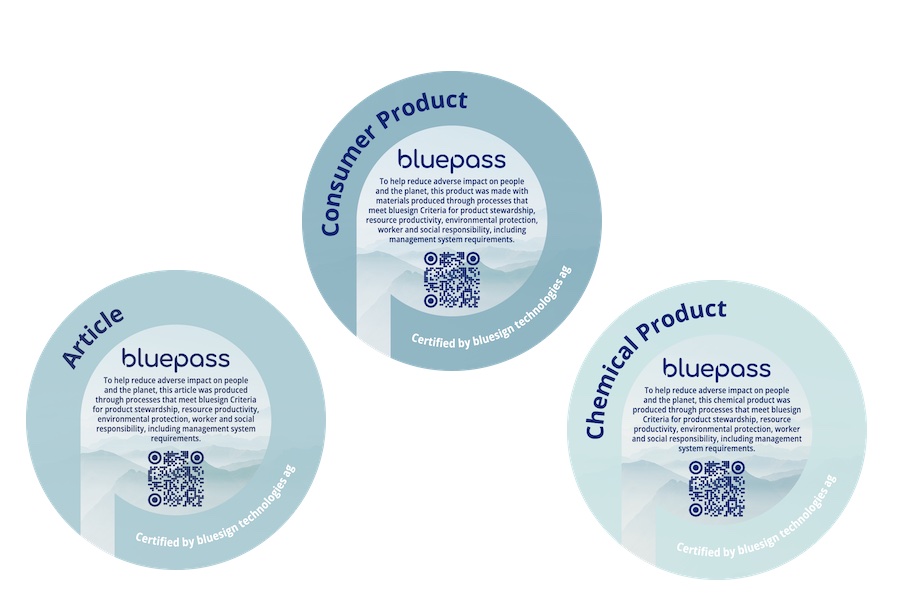
Storm Creek achieves bluesign® PRODUCT status

Storm Creek (ASI#/PPAI#) is proud to announce a meaningful sustainability milestone: the company has achieved bluesign® PRODUCT status: becoming the first US-based supplier in the promotional products industry to earn this globally respected certification. While this marks an industry first, for Storm Creek, it represents something far more important: a continuation of doing what they believe is right.

#Sustainability

bluesign® celebrates 25 years as a global leader in sustainable textile innovation

2025 marks a pivotal milestone for bluesign, the global authority in sustainable chemical and environmental management for the textile and fashion industry, as it celebrates 25 years of advancing cleaner, safer, and more responsible manufacturing practices across the global supply chain.

#Sustainability

bluesign to showcase sustainable textile solutions at Intertextile Shenzhen and Shanghai 2025

The global authority on sustainable textile production and chemical management, bluesign is pleased to announce its participation as an exhibitor at both Intertextile Shenzhen (June 11 - 13, 2025) and Intertextile Shanghai Apparel Fabrics - Autumn Edition (September 2 - 4, 2025), marking the company's inaugural collaboration with these leading global textile trade fairs.

#Sustainability

NEMO Equipment launches the first bluesign® product backpacking tent

Dagger OSMO™, a top-selling tent in specialty outdoor stores, and a favorite among backpackers and campers, is now a bluesign® PRODUCT. This milestone highlights NEMO’s commitment to clean chemistry and responsible manufacturing, adhering to the industry’s most rigorous environmental and worker safety standards. Made with solution-dyed, 100% recycled, PFAS- and FRC-free fabrics, the 2025 Dagger OSMO has more livable space without adding ounces thanks to new custom hardware and painstaking attention to every detail of the tent’s construction.

More News on Sustainability

#Sustainability

GOTS version 8.0 released: advanced supply chain accountability, from fibre to finished product

Global Standard is pleased to announce the release of GOTS Version 8.0, the latest update to the world's leading processing standard for organic textiles. The updated Standard strengthens requirements for air emissions and waste management, as well as criteria for product safety. It introduces new provisions on circularity, microfibre management and updates in residue testing. Version 8.0 also elevates due diligence obligations and formalises governance requirements, including ESG disclosure, anti-corruption policies and conflict-of-interest safeguards, to support credible, responsible business conduct.

#Sustainability

The nova-Institute establishes new Renewable Feedstock Department to lay the groundwork for industrial defossilisation

The transition from fossil-based to renewable carbon – sourced from biomass, CO₂ utilisation and recycling – is the cornerstone of a climate-neutral chemical industry. The nova-Institute’s new department is dedicated to providing the essential data, analyses and strategic roadmaps required to secure a reliable future feedstock supply and make this transition a commercial and ecological reality.

#Sustainability

Textile Exchange unveils commitment-based pathway for members to accelerate responsible raw material production

Textile Exchange has unveiled further details about its new membership structure, designed to guide the fashion, textile, and apparel industry in a collective course of action toward preferred production systems for raw materials and fibers.

#Textile chemistry

Jeanologia urges industry to accelerate PP Spray phase-out following ZDHC Watchlist update

Potassium permanganate has officially entered the Chemical Watchlist of the ZDHC Foundation, signaling increased scrutiny and potential phase-out of one of the most hazardous chemicals still used in denim finishing. The inclusion confirms an industry shift that Jeanologia anticipated more than a decade ago.

Latest News

#Techtextil 2026

Smart sensors, smart savings - Reducing energy and cost in textile finishing

As energy prices, sustainability requirements and quality expectations continue to rise, manufacturers of technical textiles face increasing pressure to optimize efficiency while ensuring process reliability. At the same time, skilled labor shortages require production systems that are intuitive, automated and easy to manage. PLEVA addresses these challenges with robust, maintenance-friendly sensor technologies combined with intelligent process control.

#Techtextil 2026

From preparation to 3D weaving: Stäubli’s solutions at Techtextil 2026

Stäubli, a global leader in high performance weaving technologies, is pleased to announce its participation at Techtextil 2026 in Frankfurt, Germany, the leading international trade fair for technical textiles and nonwovens. As technical textiles continue their rapid expansion across demanding markets such as defense, mobility, aerospace, construction, energy… Stäubli will showcase innovative solutions designed to empower mills to produce the next generation of advanced fabrics. Stäubli will exhibit its trend-setting technologies at the Swiss Pavilion Booth B01.6 in Hall 12.0.

#Associations

Azerbaijan Textile Association (ATA) becomes member of ITMF

The Azerbaijan Textile Association (ATA) has officially become a Member Association of the International Textile Manufacturers Federation (ITMF), further strengthening Azerbaijan’s integration into the global textile value chain.

#Techtextil 2026

DIENES at Techtextil 2026: Flexible pilot lines for bio-based fiber development

The growing relevance of bio-based materials in technical textiles is accompanied by increasing demands for reproducibility, high-quality data, and scalable process routes. Especially when working with cellulose and its derivatives, chitosan, lignin-based approaches, or bio-based PAN as a carbon-fiber precursor, R&D teams face variable feedstock quality, tighter process windows, and the need for reliable comparability across trials. This calls for flexible, data-driven experimental setups that can be reconfigured efficiently when recipes, solvents, and raw-material batches change.

TOP