[pageLogInLogOut]

#Spinning

Hidden secrets, open success

Where quality is critical and contamination just not acceptable, the Uster contamination sorter is the key to success. In fabric inspection, Uster Technologies offers the only safe and secure solution for nonwovens producers. Customers trust in Uster equipment – but they also understand that expert knowledge and the `Think Quality´ approach is what makes the real difference.

Practical cases and established success stories are always valuable in the nonwovens business: everybody wants to know the secrets of success. How do some companies achieve outstanding product quality standards and maintain a highly profitable business? Of course, this info is private and jealously guarded by the companies, as well as by the Uster experts who share their confidences.
© 2023 Uster
© 2023 Uster


Contamination control, part one

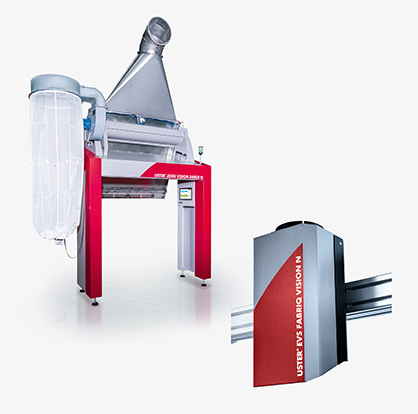
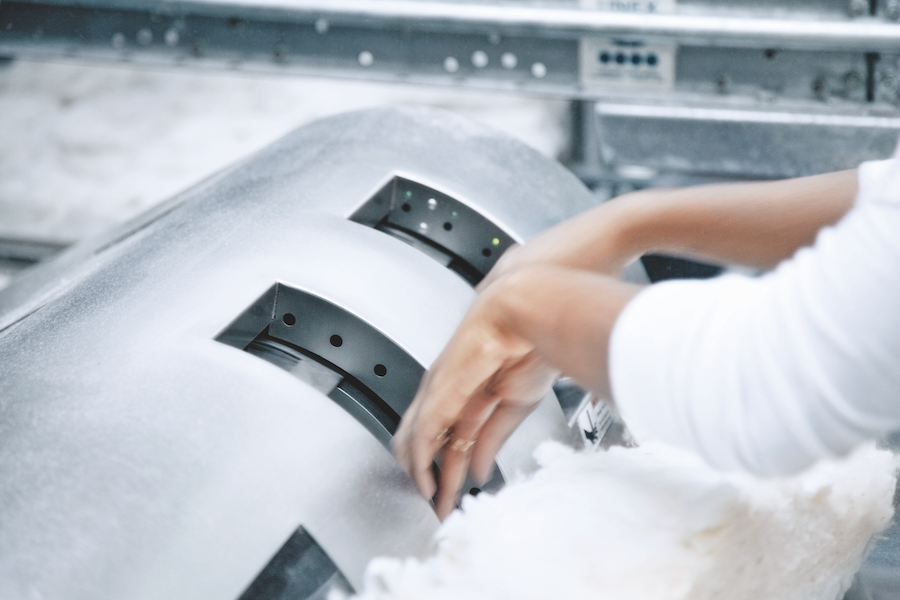
What Uster will do, however, is provide the key for companies to unlock these secrets for themselves. Basically, it’s the perfect combination of top technology and world-class application knowledge. Powerful imaging spectroscopes in the Uster contamination sorter will detect and eject any particle that differs even slightly in color from the main fiber. Nothing can hide: contamination in cotton or synthetic fibers can be reliably identified down to a size of one square millimeter. And here we open another secret of success: the Uster Jossi Vision Shield N is ideally located directly after the fine opener, exactly the point where contamination can’t hide from the spectroscopes.

Many nonwovens producers are now seeing the growing business potential in recycled fibers. Profit margins look fine, but getting the quality right is not easy. “It is a proven fact that recycled fibers are still today prone to infinite and inconsistent quality variations. Operating a high-performance contamination sorter in the production line is the best way to ensure an acceptable end-product,” says Mario Siegenthaler, Product Manager Fiber Cleaning at Uster Technologies.

Uster Jossi Vision Shield N can detect defects from any light pastel, grayish or brownish base material. “We use our know-how and expertise to further develop technologies in the ‘invisible’ range of IR and UV light for our imaging spectroscopes,” says Siegenthaler.


Contamination control, part two

Uster solutions have a two-way approach to superior quality control. Uster EVS Fabriq Vision N comes at the end of the production sequence, for automated detection of all the main defects arising from the process – and any remaining contamination. Even at full line speeds, Uster guarantees reliably high levels of fault detection for nonwovens manufacturers. Fabrics are automatically inspected and graded. It’s total control, preventing any defects in manufacturing from reaching the end-product.

The most common defects include unopened fibers, neps, black spots, holes and other issues, all of which are reliably detected by the Uster systems. They prevent raw material losses, second quality production, or – worst of all – customer claims. “Uster EVS Fabriq Vision N ensures reliable fault detection by using automated inspection during the production process – and significantly reduces the risk of customer claims. The system’s ability to capture any visible faults also allows web yield to be optimized,” says Michelle Salg, Product Manager Fabric Inspection at Uster Technologies.

Opening secrets

Uster’s automated quality monitoring solutions are also attracting interest from the nonwovens machinery manufacturers. “We are proud to say that completed projects show that the Uster Jossi Vision Shield N has a relevant impact on major business goals and influences key performance indicators positively,” says Siegenthaler. “With our reputation for attention to detail, nonwovens companies are eager to raise their issues for discussion.”

Nonwovens companies regularly call at Uster exhibition booths to leave samples for testing – or send them in later. “We consider this as a sign of trust. And of course, we like to help and use our expertise to give advises,” says Siegenthaler.

The producers also appreciate the detailed advice of Uster experts on obtaining greatest business value from their investment, by ideally integrating its systems into their production and processing environment. It is this perfect balance between open collaboration within the mill and total confidentiality outside that makes Uster a reliable partner for the nonwovens industry.

More News from Uster Technologies AG

#Spinning

Measure and control the fiber – optimize yarn quality

Producing consistent yarn quality is an everyday challenge – and a very difficult one. Detailed knowledge and understanding of the fiber raw material is absolutely critical to achieving the best possible quality in the yarn. To help spinners, Uster experts have put together guidelines for avoiding yarn irregularity claims, in a special edition of the Uster News Bulletin.

#ITMA Asia + CITME Singapore 2025

Uster presents novelties at ITMA Asia + CITME 2025

There’s news from Uster Technologies to be announced for the industry’s upcoming event in Singapore. The Uster 360Q universe is growing with new products, solutions and services. Innovation developments can also be recorded in the fields of man-made fiber testing and fabric inspection. Uster innovations address the industry’s trending topics as mill management and process control, optimization of delivered fabric quality and yield.

#Spinning

Uster Technologies marks 150 years of empowering quality excellence

Uster Technologies marks 150 years of excellence – a milestone that reflects continuous adaptation to customer needs and industry change. Over the decades, Uster has evolved from manufacturing quality testing instruments into a trusted partner shaping the future of textile production.

#Recycling / Circular Economy

Challenges of making yarn from recycled fibers

What does it take to spin quality yarn from recycled fibers? Uster Technologies brought textile industry leaders together to discuss the role of technology, data and automation – as well as the current challenges in using recycled raw material. Experts from Rieter, Säntis Textiles, Otto Yarns, and TVU commented on the current situation and looked into the future of spinning in a panel discussion organized at Uster headquarters.

More News on Spinning

#Spinning

Rieter advances strategic repositioning amid market volatility

Rieter successfully completed the acquisition of Barmag on February 2, 2026, and reached an important milestone in the company’s repositioning. Barmag will be integrated into the Rieter Group as the “Man-Made Fiber” Division. With this strategically transformative acquisition, Rieter is expanding its core business beyond the short-staple fiber business in a targeted way. This positions Rieter as the global market leader along the entire value chain for natural and man-made fibers. In addition, as a complete systems supplier, Rieter is further strengthening its technological leadership in the areas of automation and digitization.

#Spinning

A breakthrough innovation for diaper manufacturers

Developed and manufactured by Mesdan, Italy, the Loop knotter type 093E is a special version of the well-known Loop knotter, specifically designed to join hygiene-grade spandex yarns used in the personal care industry.

#Spinning

Rieter responds to higher raw material prices

Global political and economic developments have been leading to rising raw material and energy costs for some time. The textile machinery industry is also affected by this trend. Rieter machines and components consist to a large extent of steel, copper, aluminum and electronics. These materials in particular have seen higher demand and higher prices in recent months.

#ITM 2026

The hub of smart and sustainable transformation in yarn technologies: ITM 2026

With global fiber production projected to reach 169 million tons by 2030, yarn manufacturing is becoming one of the most strategic fields within the textile machinery industry. Located in Halls 6, 7, and 10, the Yarn Hall at ITM 2026 is set to bring together industry professionals with innovative solutions developed around automation, energy efficiency, digitalization, and circular production.

Latest News

#Recycled_Fibers

Selenis to double capacity in Portugal by Q3 2027 - Accelerating the Global transition to circular and low-carbon polyesters

Selenis, a global leader in high-performance specialty polyesters and part of the IMG Group, has announced a transformational expansion of its industrial headquarters in Portalegre, Portugal. This strategic investment is set to double the site’s production capacity by the third quarter of 2027, significantly accelerating the industrial scale-up of bio-based, medical-grade, and circular co-polyesters.

#Technical Textiles

Independent testing confirms no detectable PFAS in Milliken firefighter turnout gear fabrics

Independent laboratory testing has confirmed that Milliken fabrics used in the manufacturing of firefighter turnout gear contain no detectable PFAS, based on third-party analysis conducted by Forever Analytical, an independent laboratory specializing in screening products and environmental samples for the presence of per- and polyfluoroalkyl substances (PFAS).

#Home Textiles

Intertextile Shanghai Home Textiles returns in August as global sourcing hub and trend barometer for home textiles industry

Following the conclusion of Heimtextil last month, the flagship fair in Messe Frankfurt’s global home and contract textiles portfolio, Intertextile Shanghai Home Textiles – Autumn Edition will return 18 – 20 August 2026 at the National Exhibition and Convention Center (Shanghai). Building on the momentum generated in Frankfurt, the Shanghai fair will reinforce its position as the foremost home and contract textile platform in Asia – successfully bridging the gap between East and West, and connecting global product trends, supply-chain shifts, and buyer demand in one marketplace.

#Digital Printing

Express Print boosts production using an expanded fleet of Mimaki technologies

Express Print, a fast-growing Bulgarian provider of visual communication and soft signage solutions, has significantly enhanced its production workflow with a comprehensive portfolio of Mimaki digital printing systems. Based in Varna and active for more than 10 years, the company maintains a strong focus on the advertising sector. Over the years, it has steadily expanded its operations, driven by a clear vision to bring the full spectrum of large-format printing services in-house, avoiding outsourcing and ensuring complete control over production quality.

TOP