[pageLogInLogOut]

#Spinning

Spinnova invests in Rieter System

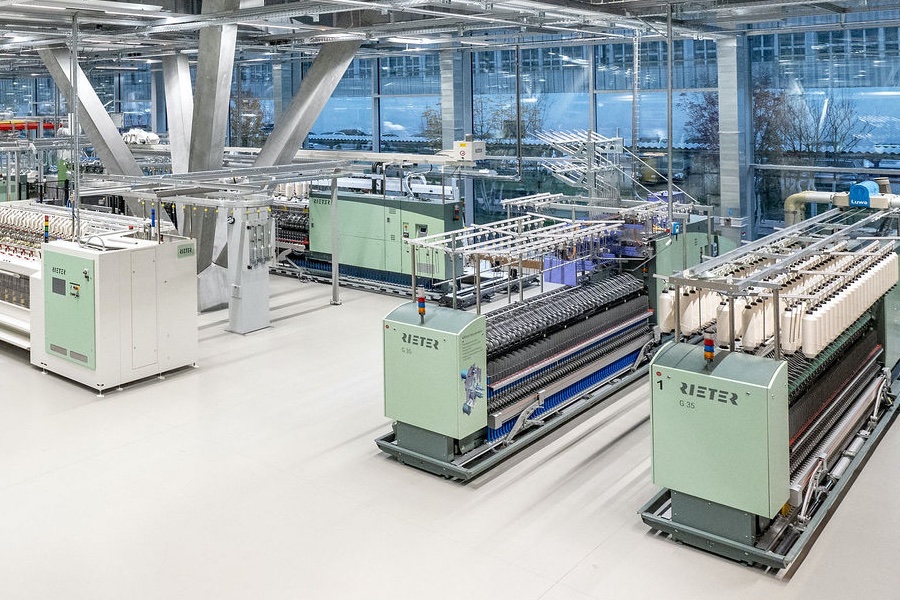
Spinnova is investing in a full Rieter system to get its wood-based fiber to the market. © 2022 Rieter
Rieter is helping Finland’s sustainable materials company Spinnova pioneer a wood-based textile fiber that requires zero chemicals, uses virtually no water, and hardly emits any carbon. Spinnova will spin the fiber into yarn on a Rieter system. The fully circular Spinnova yarn represents a breakthrough for sustainable fashion.

Following initial trials with the Spinnova fiber at our SpinCenter in Winterthur, Switzerland, Rieter will install a full system on Spinnova’s premises in Jyväskylä, Finland by end 2022. The industrial scale spinning facility will enable Spinnova to streamline its commercial textile development, enhance brand collaborations, and further improve the yarn’s market entry capabilities.

The sustainably sourced raw material Spinnova processes comes from the same wood pulp that is used to make paper, drawing from Finland’s long-standing expertise in the paper industry. Spinnova is also exploring other sustainable sources for fiber production, including leather and agricultural waste.

Spinnova’s technology uses a mechanical process where the fibers are produced by extruding the pulp through a nozzle and, in contrast to viscose ? also a wood-based fiber ? requires no harmful chemicals. In addition, the process requires 99% less water and has low carbon emissions compared to conventional viscose fiber production methods.

In-depth textile know-how from fiber to yarn

Rieter will continue to support Spinnova in defining the material characteristics required to create a wood-based fiber that can be spun into a yarn that meets the necessary textile properties.

The spinning line comprises a complete system of Rieter machines. With its unbeatable precision, the UNIblend A 81 will start with an initial mix of 70% cotton and 30% wood-based fiber on its way to achieve a 100% wood-based yarn.

“The proximity of a spinning facility will make a huge difference in our commercial phase. We can make fast trials, not lose lead time, and test smaller batches than before. This will significantly improve the textile R&D with our wood-based Spinnova fiber”, explains Spinnova’s CEO and co-founder Janne Poranen.

Fully flexible production with customized spinning systems

The in-house trials with the ring spinning machine G 38 already showed promising results. Thanks to the compacting device COMPACTdrum, the G 38 is fully flexible in producing both high quality ring and compact yarns. An additional highlight is that the G 38 is linked to the automatic winder Autoconer X6.


The fully automatic rotor spinning machine R 70, known for its stellar productivity, outstanding raw material utilization and low energy consumption, can produce up to four different yarn types at once. This will be important as the trials proceed.
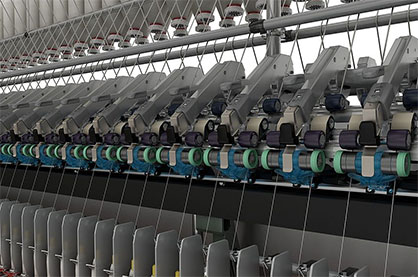
Thanks to the compacting device, Spinnova can easily switch between ring yarn and compact yarn. © 2022 Rieter


Rieter supports sustainable yarn production

Rieter’s system is ideally positioned to support Spinnova’s quest to achieve disruptive circularity as it is roughly 20% more energy efficient than lines made up of machines from different suppliers, thus helping to keep carbon emissions low.

“Sustainability is an integral part of the Rieter strategy, and fibers with minimal environmental impact play an important role in sustainable yarn production. Rieter is pleased to contribute with its state-of-the-art machinery to Spinnova’s product development”, says Roger Albrecht, Head of the Rieter Business Group Machines & Systems.



More News from Rieter Textile Systems

#Spinning

Rieter advances strategic repositioning amid market volatility

Rieter successfully completed the acquisition of Barmag on February 2, 2026, and reached an important milestone in the company’s repositioning. Barmag will be integrated into the Rieter Group as the “Man-Made Fiber” Division. With this strategically transformative acquisition, Rieter is expanding its core business beyond the short-staple fiber business in a targeted way. This positions Rieter as the global market leader along the entire value chain for natural and man-made fibers. In addition, as a complete systems supplier, Rieter is further strengthening its technological leadership in the areas of automation and digitization.

#Spinning

Rieter responds to higher raw material prices

Global political and economic developments have been leading to rising raw material and energy costs for some time. The textile machinery industry is also affected by this trend. Rieter machines and components consist to a large extent of steel, copper, aluminum and electronics. These materials in particular have seen higher demand and higher prices in recent months.

#Spinning

Rieter completes acquisition of Barmag

Rieter has successfully completed the acquisition of Barmag as of February 2, 2026. This strategically important acquisition makes Rieter the world’s leading system provider for natural and synthetic fibers.

#Spinning

Rieter adjusts group structure in preparation for Barmag integration

The planned acquisition of the “Barmag” Division of OC Oerlikon will create the leading system provider worldwide for natural and man-made fibers. Rieter is confident it will receive all regulatory approvals to complete the acquisition in the fourth quarter of 2025. The Rieter Group is therefore adjusting its Group structure as of January 1, 2026, to take this acquisition into account and to be able to provide an even more agile response to market challenges.

More News on Spinning

#Techtextil 2026

RETECH showcases high-precision godets for high-performance fiber processing at Techtextil 2026

RETECH designs and manufactures godets and draw frames for heated, ambient and cooled processes, enabling precise heat treatment and consistently high yarn quality for a wide range of polymers and applications, with process temperatures of up to 400 °C for high-performance fibers. The company’s key competence lies in exact and stable temperature and speed control, individually adapted to the specific material and process requirements.

#Spinning

Barmag presents the next generation of POY production – energy-efficient and partial-automated

With POY 2.0, Barmag is introducing a completely redesigned spinning concept that takes the production of partially oriented yarn (POY) to a new level in terms of technology and economy. The solution, which was presented to a selected audience of experts for the first time at ITMA Asia + CITME 2025, was met with great enthusiasm: several yarn producers worldwide immediately expressed their interest in a pilot plant.

#Spinning

Development of bio-based polyethylene fibers for textile applications – BB Engineering partici-pates in the bioPEtex research project

In the German research project bioPEtex, BB Engineering (BBE) is working with other partners to develop textiles made from 100% bio-based polyethylene (PE). The aim is to make use of this poly-mer, which has hardly been used in the chemical fiber industry to date. BBE is contributing its spinning and texturizing expertise and developing the texturing process on an industrial scale. The first promising results are already available – opening up new opportu-nities for sustainable and economically attractive applications in the textile industry.

#Techtextil 2026

Saurer sets new standards at Techtextil 2026

When the international textile industry gathers at Techtextil in Frankfurt from April 21 to 24, Saurer is going to present a powerful solution for the growing demands in the field of technical yarns with the TechnoCorder TC2plus.

Latest News

#Raw Materials

Lenzing Group positions bio‑based materials as a strategic asset for Europe’s economic security

The Lenzing Group, a leading supplier of regenerated cellulose fibers for the textile and nonwovens industries, hosted a high‑level roundtable in Brussels to discuss how bio‑based materials can strengthen Europe’s economic security and support the shift toward a fossil‑free future. Organized in cooperation with Euractiv, the event brought together representatives of the European Commission, the UK Mission to the EU, academia, civil society, and industry.

#Natural Fibers

Beyond Cotton: Natural Fibres in the Spotlight at the Bremen Cotton Conference - Branded by DNFI

Climate targets, fragile supply chains, and rising regulatory requirements are fundamentally changing the perspective of the textile industry - the focus is increasingly shifting toward the base material. Not only cotton, but natural fibres are gaining significant importance: they stand out not only because of their outstanding functional properties, but also because they make a valuable contribution to the bioeconomy and responsible product development.

#Textiles & Apparel / Garment

Coats to showcase innovative reinforcement and filler materials for leather goods and accessories at APLF 2026

Coats, a world-class Tier 2 manufacturer and trusted partner for the apparel and footwear industries, will be promoting four advanced materials from its ‘Lifestyle Solutions’ portfolio at APLF 2026 in Hong Kong in March. Each innovation has been specifically engineered to help luxury and premium brands elevate the craft, durability, sustainability and creative expression required in the manufacturing of handbags, purses, and other high-end designer accessories.

#Textiles & Apparel / Garment

Design, innovation and sustainability propel VIATT 2026’s expanding role in ASEAN textile sourcing

At its third edition, the Vietnam International Trade Fair for Apparel, Textiles, and Textile Technologies (VIATT) further reinforced its role as a key sourcing and business platform for ASEAN’s textile industry. The three-day fair welcomed over 17,000 visits from 54 countries and regions, and featured over 460 exhibitors from 21 countries and regions across 18,000 sqm. The 2026 edition was marked by the introduction of new international pavilions and zones, broadening the fair’s sourcing scope across new geographies and product categories. The fringe programme, headlined by the debut Trend Forum, further distinguished VIATT as the region’s most integrated textile trade platform – uniquely spanning the entire value chain.

TOP