[pageLogInLogOut]

#Research & Development

Keep away from cords and drawstrings!

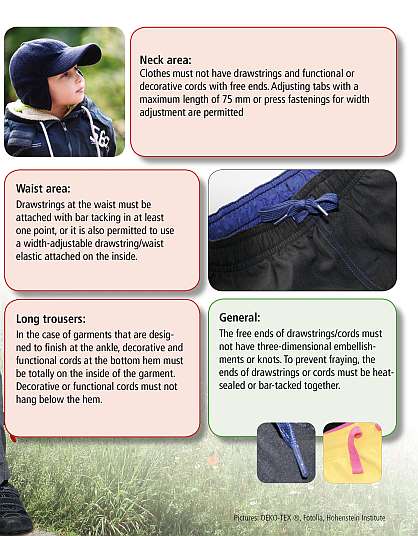
Clothing needs to be designed with safety in mind if escalators and playgrounds are not to become a death trap for children. The DIN EN 14682 standard "Safety of children's clothing - Cords and drawstrings on children's clothing" contains recommendations how garments for kids aged up to 14 years should be designed.

It is frightening how many recall campaigns are listed on the information page of the European Union(1)  for products presenting a risk of strangulation or serious injury. In the past fatalities and major injuries have unfortunately occurred time and time again due to the use of unsuitable closures on children's clothing. A fact that is barely recognised in the public debate surrounding the safety of textiles. Instead, the focus falls here on possible contamination with harmful substances.

Christiane Schulze from the Hohenstein Institute in Bönnigheim is pressing for even greater caution in the interest of children: "Most textiles on the market are now tested for harmful substances, as for example under OEKO-TEX® Standard 100. And there has been a significant fall in the number of complaints involving this aspect. I am hoping to see a similar positive trend where the Cord Regulations are concerned."

Christiane Schulze's team of staff are also making a contribution here, working on behalf of manufacturers and trading companies: They examine clothing designed for children and adolescents in relation to the DIN EN 14682 safety norm before manufacturing starts, so avoiding product recalls from the outset.

(1)

http://ec.europa.eu/consumers/safety/rapex/alerts
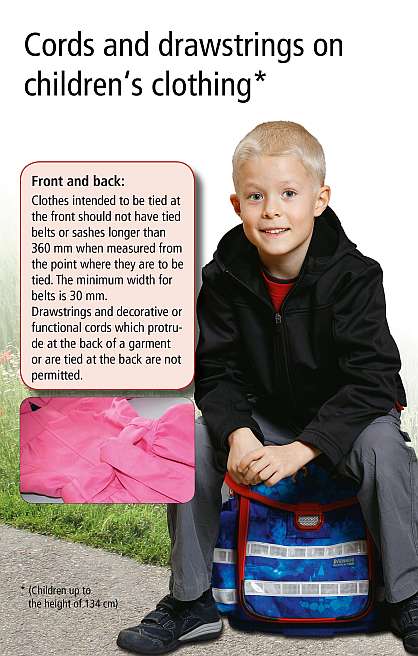
© Hohenstein Institute ® The ends of drawstrings/cords on children's clothing must not have knots or other decorative features. Safe alternatives are heat-sealing or bar-tacking the ends of such cords. Zips must not exceed a total length of 75 mm.

More News from Hohenstein Institute

#Research & Development

A smarter way to verified Chemical Compliance

Hohenstein and GoBlu Drive Innovation in Sustainable Supply Chain Management As regulatory demands, customer expectations, and sustainability goals continue to grow, the ability to manage chemical compliance and data across complex supply chains has become critical. Hohenstein and The BHive® by GoBlu are initiating a strategic partnership to enhance chemical management in the textile sector. The collaboration delivers more than just a service – it provides an integrated, future-ready solution for brands, manufacturers and suppliers seeking trusted chemical management and credible sustainability.

#Research & Development

Hohenstein achieves GLP Certification for Medical Device Testing

Since the middle of July, the testing service provider Hohenstein has been certified to conduct medical device testing in accordance with the internationally recognised Good Laboratory Practice (GLP) standard. This certification comprehensively covers chemical, physical and biological safety testing of medical devices.

#Research & Development

Hohenstein supports Global Textile Scheme Initiative

Global testing and research provider Hohenstein has acquired shares in Global Textile Scheme GmbH (GTS). In this way, Hohenstein aims to support GTS in harmonizing and automating data exchange along the entire supply chain. The aim of the GTS initiative is to create an international standard for handling structured product data in the textile and apparel industry.

#Research & Development

Hohenstein releases 2024 sustainability report

Responsible action is a defining value for Hohenstein, a global testing and research provider. Their 2024 Sustainability Report provides transparency through documented progress and detailed insights into how sustainability is embedded. It covers both the existing sustainability measures at the German headquarters and the company's goals for 2025 and beyond. The direct and indirect greenhouse gas emissions (Scope 1, 2 and 3) of all its locations worldwide were recorded for the first time.

More News on Research & Development

#Research & Development

More safety and comfort for protective clothing thanks to auxetic fabrics

When everyday materials are pulled, they stretch or elongate in the direction of the pull and become narrower in cross-section. We can also observe this property in two-dimensional textiles. Auxetic structures behave differently here. They have the striking property of not changing under tensile stress or even increasing their width or thickness. These properties are advantageous, for example, in protective textiles or textile filter media. The DITF are researching auxetic fabrics for various applications.

#Research & Development

Fraunhofer CCPE presents the “Monomaterial Design Set” – Innovative solutions for circular product design

Composite materials made from different types of plastic often extend the lifetime of products but make recycling more difficult in the circular economy. That is why Fraunhofer CCPE has developed the “Monomaterial Design Set”. This new approach helps to reduce the variety of plastics used in durable products and offers circular solutions for designers and product developers.

#Research & Development

How innovations drive BASF’s success

“Innovation has always been part of BASF’s DNA. Especially in these volatile times, it is crucial to leverage our innovative strength to develop competitive solutions that differentiate us as a company in our markets and give us a competitive edge,” said Dr. Stephan Kothrade, Member of the Board of Executive Directors of BASF and Chief Technology Officer, at the company’s Research Press Briefing held today. To achieve this, BASF implemented its “Winning Ways” strategy about a year ago with the clear goal of becoming the preferred chemical company to enable its customers’ green transformation.

#Research & Development

Small tolerances, big impact and a recyclable alternative to elastane

ITA Master's student Janne Warnecke investigated tension differences over the fabric width in the weaving process and thereby contributed to quality assurance; ITA Bachelor's student Jasmin Roos found a basis for the development of recyclable yarns and textiles. For these developments, they were awarded the Walter Reiners Foundation's Promotion and Sustainability Prizes on 27 November. Peter D. Dornier, Chairman of the Walter Reiners Foundation, presented the awards at the Aachen-Dresden-Denkendorf International Textile Conference (ADD-ITC) in Aachen, Germany.

Latest News

#People

Happy Holidays!

Dear reader, the year 2025 is drawing to a close. We are entering what we hope will be a peaceful holiday season, spending time with our families and taking a moment to pause and reflect. We hope we have been able to support you once again this year with relevant news and articles, and we look forward to surprising you with many innovations in the coming year. Enjoy the festive season, stay healthy, and we wish you a happy and joyful holiday season.

#Weaving

Lindauer Dornier announces leadership transition in weaving machine business

After more than ten successful years at Lindauer DORNIER GmbH, Mr Wolfgang Schöffl will leave the family-owned company at the end of the year to enter well-deserved retirement.

#Heimtextil 2026

Texpertise Focus AI: Messe Frankfurt puts Artificial Intelligence centre stage at its international textile and apparel trade fairs

Under the banner 'Texpertise Focus AI, Messe Frankfurt will place a strong emphasis on Artificial Intelligence (AI) across its international textile and apparel trade fairs from 2026 onwards, setting a future-shaping signal for the industry. The initiative highlights the responsible use of AI along the entire textile value chain, from fibre production to the point of sale. The programme will launch at Heimtextil in Frankfurt in January 2026.

#Technical Textiles

Autoneum and Polestar set new benchmarks for passenger experience and sustainability

As the global market leader in sustainable acoustic and thermal management, Autoneum is a key supplier of interior and exterior components for the highly anticipated Polestar 5 model. The successful collaboration between Autoneum and Polestar marks a significant milestone in sustainable automotive engineering: the electric grand tourer sports car features several innovations in lightweight, fully recyclable polyester-based components that ensure a superior driving experience. Polestar 5 was revealed at the IAA Mobility 2025 in Munich and is available in 24 markets.

TOP