[pageLogInLogOut]

#Research & Development

Researchers develop living material from fungi
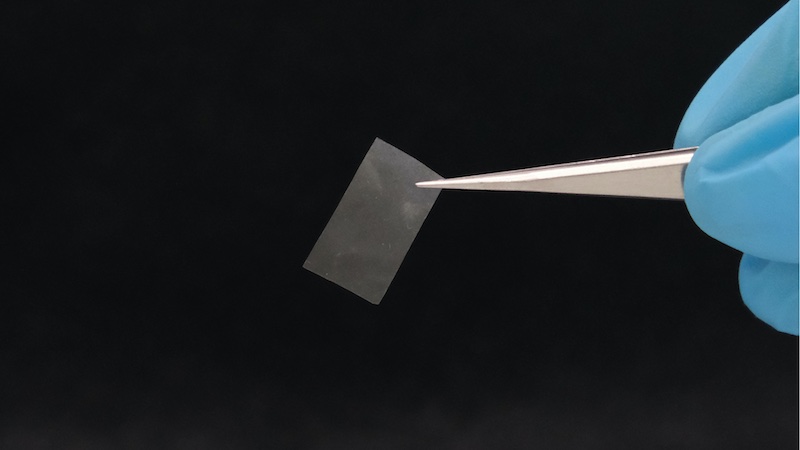
Fungi are considered a promising source of biodegradable materials. Empa researchers have developed a new material based on a fungal mycelium and its own extracellular matrix. This gives the biomaterial particularly advantageous properties.
The thin mycelial film is almost transparent and has good tensile strength. It could be used as a living bioplastic © 2025 Picture: Empa


Sustainably produced, biodegradable materials are an important focus of modern materials science. However, when working natural materials such as cellulose, lignin or chitin, researchers face a trade-off. Although these substances are biodegradable in their pure form, they are often not ideal when it comes to performance. Chemical processing steps can be used to make them stronger, more resistant or more supple – but in doing so, their sustainability is often compromised.

Empa researchers from the Cellulose and Wood Materials laboratory have now developed a bio-based material that cleverly avoids this compromise. Not only is it completely biodegradable, it is also tear-resistant and has versatile functional properties. All this with minimal processing steps and without chemicals – you can even eat it. Its secret: It's alive.

Optimized by nature
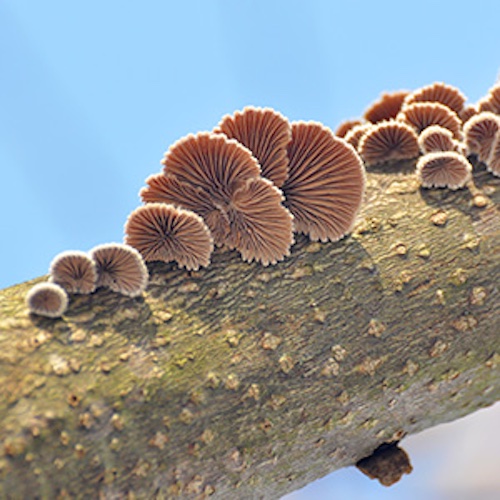
In nature, the split-gill mushroom grows on dead wood and forms fruiting bodies that are considered edible mushrooms in many parts of the world. © 2025 EMPA /  Image: Adobe Stock
In nature, the split-gill mushroom grows on dead wood and forms fruiting bodies that are considered edible mushrooms in many parts of the world. © 2025 EMPA / Image: Adobe Stock


As the basis for their novel material, the researchers used the mycelium of the split-gill mushroom, a widespread edible fungus that grows on dead wood. Mycelia are root-like filamentous fungal structures that are already being actively researched as potential sources of materials. Normally, the mycelial fibers – known as hyphae – are cleaned and, if necessary, chemically processed, which brings about the above-mentioned trade-off between performance and sustainability.

The Empa researchers chose a different approach. Instead of treating the mycelium, they use it as a whole. As it grows, the fungus not only forms hyphae, but also a so-called extracellular matrix: a network of various fiber-like macromolecules, proteins and other biological substances that the living cells secrete. “The fungus uses this extracellular matrix to give itself structure and other functional properties. Why shouldn't we do the same?” explains Empa researcher Ashutosh Sinha. “Nature has already developed an optimized system,” adds Gustav Nyström, head of the Cellulose and Wood Materials lab.

With a bit of additional optimization, the researchers gave nature a helping hand. From the enormous genetic diversity of the split-gill, they selected a strain that produces particularly high levels of two specific macromolecules: the long-chain polysaccharide schizophyllan and the soap-like protein hydrophobin. Due to their structure, hydrophobins collect at interfaces between polar and apolar liquids, for example water and oil. Schizophyllan is a nanofiber: less than a nanometer thick, but more than a thousand times as long. Together, these two biomolecules give the living mycelium material properties that make it suitable for a wide range of applications.

A living emulsifier
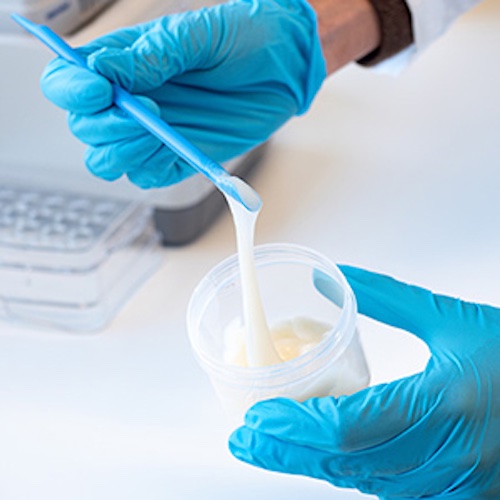
Thanks to the auxiliary molecules in their extracellular matrix, the mycelial fibers are good natural emulsifiers – they are even safe to eat. © 2025 Image: Empa


The researchers demonstrated the versatility of their material in the laboratory. In their study, which was published recently in the journal Advanced Materials, they showcased two possible applications for the living material: a plastic-like film and an emulsion. Emulsions are mixtures of two or more liquids that normally do not mix. All you have to do to see an example is open the fridge: Milk, salad dressing or mayonnaise are all emulsions. And various cosmetics, paints and varnishes also take the form of emulsions.

One challenge is to stabilize such mixtures so that they do not separate into the individual liquids over time. This is where the living mycelium shows its strengths: Both the schizophyllan fibers and the hydrophobins act as emulsifiers. And the fungus keeps releasing more of these molecules. “This is probably the only type of emulsion that becomes more stable over time,” says Sinha. Both the fungal filaments themselves and their extracellular molecules are completely non-toxic, biologically compatible and edible – the split-gill mushroom is routinely eaten in many parts of the world. “Its use as an emulsifier in the cosmetics and food industry is therefore particularly interesting,” says Nyström.

From compost bags to batteries
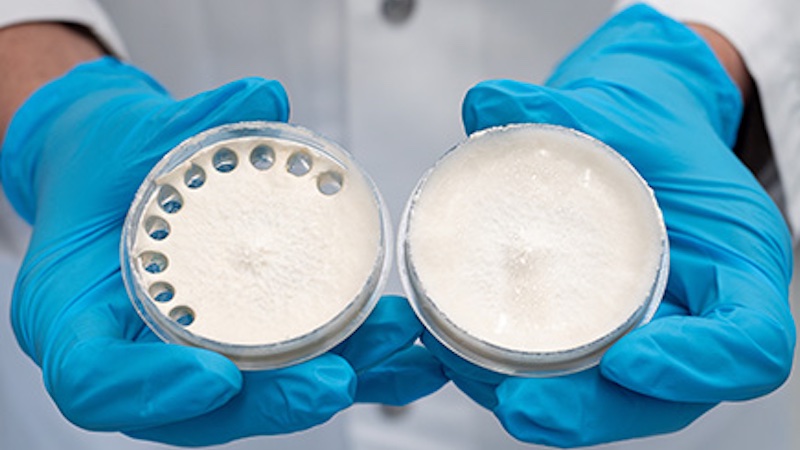
The fungal culture of the split-gill mushroom on a culture medium. Samples were taken from the Petri dish on the right  © 2025 EMPA
The fungal culture of the split-gill mushroom on a culture medium. Samples were taken from the Petri dish on the right © 2025 EMPA


The living fungal network is also suitable for classic material applications. In a second experiment, the researchers manufactured the mycelium into thin films. The extracellular matrix with its long schizophyllan fibers gives the material very good tensile strength, which can be further enhanced by targeted alignment of the fungal and polysaccharide fibers within it.

“We combine the proven methods for processing fiber-based materials with the emerging field of living materials,” explains Nyström. Sinha adds: “Our mycelium is a living fiber composite, so to speak.” The researchers can control the fungal material's properties by changing the conditions under which the fungus grows. It would also be conceivable to use other fungal strains or species that produce other functional macromolecules.

Working with the living material also presents certain challenges. “Biodegradable materials always react to their environment,” says Nyström. “We want to find applications where this interaction is not a hindrance but maybe even an advantage.” However, its biodegradability is only part of the story for the mycelium. It is also a biodegrader: The split-gill mushrooms can actively decompose wood and other plant materials. Sinha sees another potential application here: “Instead of compostable plastic bags, it could be used to make bags that compost the organic waste themselves,” says the researcher.

There are also promising applications for the mycelium in the field of sustainable electronics. For example, the fungal material shows a reversible reaction to moisture and could be used to produce biodegradable moisture sensors. Another application that Nyström's team is currently working on combines the living material with two other research projects from the Cellulose and Wood Materials laboratory: the fungal biobattery and the paper battery. “We want to produce a compact, biodegradable battery whose electrodes consist of a living 'fungal paper',” says Sinha.

More News from EMPA

More News on Research & Development

#Composites

More affordable, environmentally friendly hydrogen pressure tanks at ITA-JEC booth

As a highlight of the JEC, the Institut für Textiltechnik (ITA) of RWTH Aachen University will be presenting hydrogen pressure tanks manufactured using multifilament winding processes at the NRW joint booth in Hall 5, Stand G65.

#Research & Development

Pioneer of the first hour: Michael Carus steps down after more than 30 years from nova-Institute’s Management

After more than three decades at the helm, founder and CEO Michael Carus is set to step down as head of the Renewable Carbon division on 1 March 2026. Lars Börger as the new CEO, will take over this key position of the nova-Institute together with COO Linda Engel, while Carus will remain with the research and consulting company as a senior advisor and shareholder. This change takes place after a one-year transition phase, as planned.

#Man-Made Fibers

Toray develops AURLIST™ polyester filament fiber with luxurious luster and ultra-fine structure

Toray Industries has developed AURLIST™, a new polyester filament fiber designed to combine luxurious luster, soft loft and a subtle fibrillated surface texture. The company primarily targets applications in women’s apparel such as tops, bottoms and dresses.

#Sustainability

The nova-Institute establishes new Renewable Feedstock Department to lay the groundwork for industrial defossilisation

The transition from fossil-based to renewable carbon – sourced from biomass, CO₂ utilisation and recycling – is the cornerstone of a climate-neutral chemical industry. The nova-Institute’s new department is dedicated to providing the essential data, analyses and strategic roadmaps required to secure a reliable future feedstock supply and make this transition a commercial and ecological reality.

Latest News

#Techtextil 2026

Knowledge that drives progress: Techtextil and Texprocess forums strengthen the global textile industry with a future-oriented programme

From AI-supported production optimisation and digital manufacturing solutions to circular technologies and bio-based high-performance materials: the Techtextil and Texprocess forums provide answers to the key challenges of the global textile industry with a curated content programme. As hubs for innovation and knowledge, they enhance competitiveness and offer orientation in changing markets. From 21 to 24 April 2026, Frankfurt is once again the global meeting point for thought leaders from industry, research and business.

#Techtextil 2026

Enhanced protection without added weight: Innovative technology for flame-retardant textiles doubles reaction time and ensures high wearing comfort

Flame-retardant textiles have long faced the same dilemma: the higher the level of protection, the greater the compromise in comfort, weight and breathability. This is especially important for workwear and protective clothing worn for long hours, where comfort is crucial to wearer acceptance and satisfaction. At Techtextil 2026 in Frankfurt, Swiss company Textilcolor AG will unveil pyroshell™, an innovative flame-retardant technology designed to tackle this challenge. Protection is provided by a graphite-based functional layer integrated into the textile structure, which doubles the reaction time before burns occur while significantly enhancing comfort. The material does not release any toxic fumes and offers textile manufacturers entirely new opportunities to design and produce protective and functional garments. It is also durable enough to withstand up to 50 industrial washes.

#Composites

JEC WORLD 2026 opens: Paris becomes the World Capital of composites

JEC World 2026 opens tomorrow, March 10, at Paris Nord Villepinte, bringing together the entire composites ecosystem for three days of exhibitions, conferences, technical sessions, strategic industry gatherings, and business meetings. As the “festival of composites”, JEC World is also a destination for a broad spectrum of other professional visitors, eager to discover how these advanced materials can offer sustainable solutions to their industries.

#Spinning

Barmag presents the next generation of POY production – energy-efficient and partial-automated

With POY 2.0, Barmag is introducing a completely redesigned spinning concept that takes the production of partially oriented yarn (POY) to a new level in terms of technology and economy. The solution, which was presented to a selected audience of experts for the first time at ITMA Asia + CITME 2025, was met with great enthusiasm: several yarn producers worldwide immediately expressed their interest in a pilot plant.

TOP