#Research & Development
Reducing development times for technical textiles by accelerated thermo-oxidative aging in a high-pressure autoclave
Geotextiles made from polypropylene (PP) and polyethylene (PE) are a particularly important example for durable technical textiles. Depending on the application, these materials are required to achieve service lives of up to 100 years. Manufacturers and users therefore face the challenge of reliably predicting the long-term durability of these materials based on comparatively short laboratory tests. Conventional thermo-oxidative aging tests conducted in drying ovens often require testing periods of more than one year, making them only of limited suitability for material development and optimization processes.
A common approach to reducing testing time is to increase the aging temperature. However, this approach is only of limited suitability, as elevated temperatures may alter the underlying aging mechanisms. In particular, polypropylene exhibits a change in oxidation kinetics at temperatures above approximately 80°C. This transition is attributed to competing hydroperoxide decomposition mechanisms and is often reflected by a deviation from the linear Arrhenius relationship between aging temperature and service life. In other words, both the rate and the progression of oxidation change. This behavior results from different reactions occurring simultaneously during the decomposition of hydroperoxides formed as intermediate products of oxidation, with these reactions influencing one another.
Consequently, the relationship between aging temperature and service life often no longer follows the linear Arrhenius behavior typically assumed. Furthermore, high test temperatures can induce morphological changes in the polymer microstructure, affecting both the mechanical properties and the degradation kinetics, including the rate and progression of material degradation. In addition, the increased reaction rate at elevated temperatures may lead to oxygen diffusion becoming the rate-limiting factor, an effect that does not occur under typical service conditions. Since the vast majority of polypropylene applications operate at temperatures below 80°C, aging data obtained within this temperature range are of particular practical relevance. However, because of the very long testing times required, such data can only be obtained using conventional methods with considerable effort.
The DITF research project addresses this significant research gap. While the High-Pressure Autoclave Test (HPAT) according to ISO 13438 has become an established accelerated aging method for geosynthetics, fundamental scientific studies comparing high-pressure autoclave aging with conventional oven aging are still lacking for textile materials. Likewise, reliable acceleration factors for different material compositions and textile structures have not yet been established.
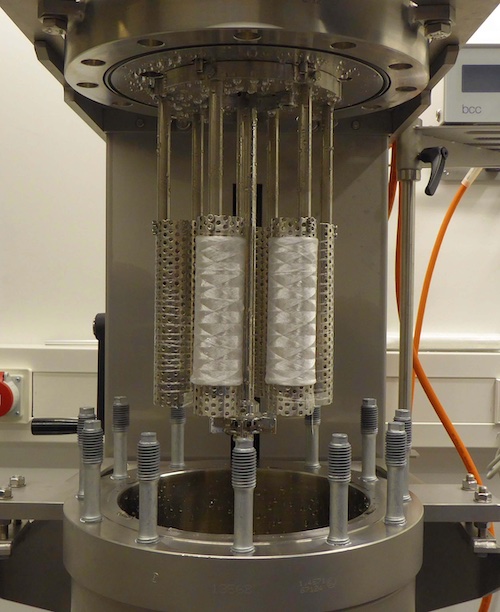
The HPAT method is based on thermo-oxidative aging under elevated oxygen pressure. The increased oxygen availability significantly accelerates polymer oxidation, allowing considerably shorter aging times than conventional oven aging, even at moderate test temperatures. This approach enables the simulation of service-related aging conditions below critical temperature thresholds while substantially reducing the overall test duration.
As part of the research project, the Barrier Textiles Research Team at the DITF established the materials science and process engineering foundations for applying the HPAT method to technical textiles. This included the development of analytical methods for characterizing polymer degradation as well as investigating the relationships between material composition, fiber and textile structure, and aging behavior. The objective was to establish HPAT as a reliable and validated method for accelerated service life testing of technical textiles while identifying the material parameters required for model-based service life prediction. The findings were validated through comparative long-term aging tests conducted in a conventional laboratory oven.
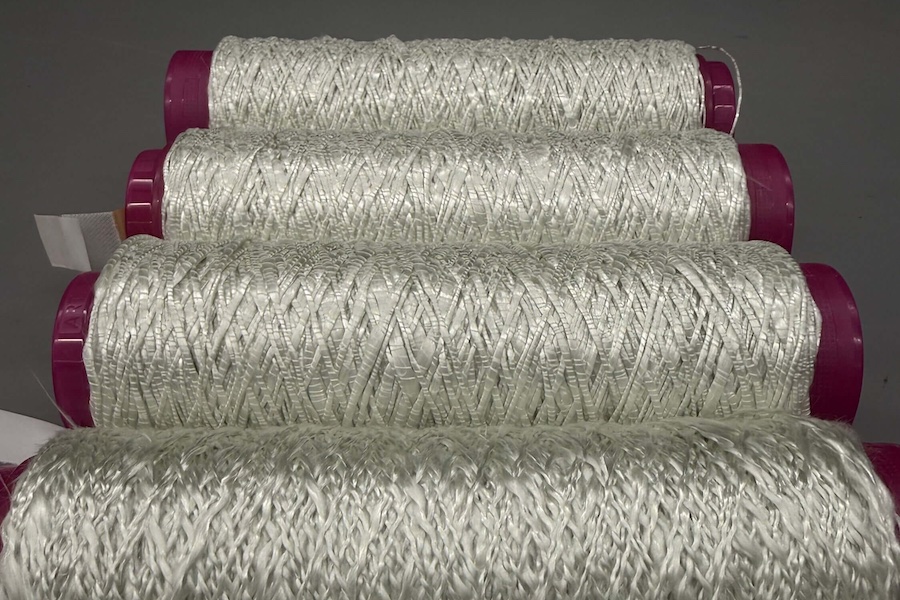
To investigate textile-specific factors influencing aging behavior, polypropylene yarns with a constant yarn diameter were first produced, while systematically varying the type and concentration of stabilizers. The yarns were subjected to thermo-oxidative aging under both high-pressure autoclave and conventional oven conditions and subsequently characterized with respect to their mechanical properties and degradation behavior. Based on these investigations, the influence of oxygen pressure on the acceleration factor was determined, and the suitability of the High-Pressure Autoclave Test (HPAT) for realistic yet significantly accelerated service life assessment of technical textiles was evaluated.
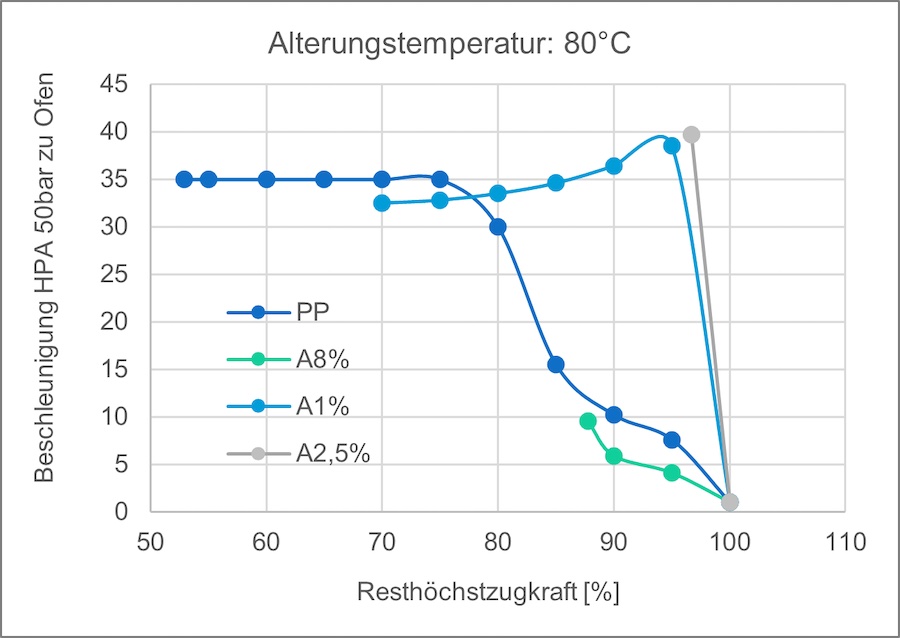
For this study, polypropylene (PP) yarns were produced from seven differently stabilized compounds. The stabilizer formulations consisted of the antioxidants Irganox® 3114 (hindered phenolic), Irgafos® 168 (phosphite), and either Irganox® PS 802 (thioester) or Chimassorb® 119 (HALS), each incorporated at three different concentrations. The yarns were comparatively aged at 80°C for up to six weeks in a high-pressure autoclave under water at an oxygen pressure of 50 bar, and for up to 480 days in a dry-air oven. The development and validation of the test method were based on these PP yarns. The high-pressure autoclave tests showed that the tensile strength decreased to 80% of its initial value within 10–30 days, and to 50% within 14–46 days, depending on the stabilizer formulation. For the samples stabilized with Irganox® PS 802, direct comparison with conventional oven aging was possible.
The resulting acceleration factors were found to depend on both the material composition and the selected failure criterion. Although no universal acceleration factor could be established, values in the range of 32–35 were determined for degradation levels below 80% residual tensile strength. Within the parameter space defined by oxygen pressure, temperature, and time to failure, one comparative data point was generated for each of the seven compounds using two failure criteria. To extend this dataset into a parameter-dependent failure surface capable of predicting service life both within and beyond the experimentally covered parameter range, additional measurements at lower temperatures and lower oxygen pressures in the high-pressure autoclave are required.
The project advisory committee included representatives from all relevant industrial sectors, ranging from masterbatch manufacturers to end users of stabilized polypropylene products. The committee considers the results achieved to be pioneering and sees significant potential for their further industrial implementation.
A follow-up project is planned in the near future to further develop the findings generated through this fundamental research and translate them into practical industrial applications.
The IGF research project 01IF22986N, “High-Pressure Autoclave Test (HPAT) for Technical Textiles”, was funded under the Industrial Collective Research (IGF) program by the German Federal Ministry for Economic Affairs and Energy (BMWi) on the basis of a resolution of the German Bundestag (Federal Parliament).