[pageLogInLogOut]

#Research & Development

Cleanzone Award 2024 goes to DITF and DASTEX
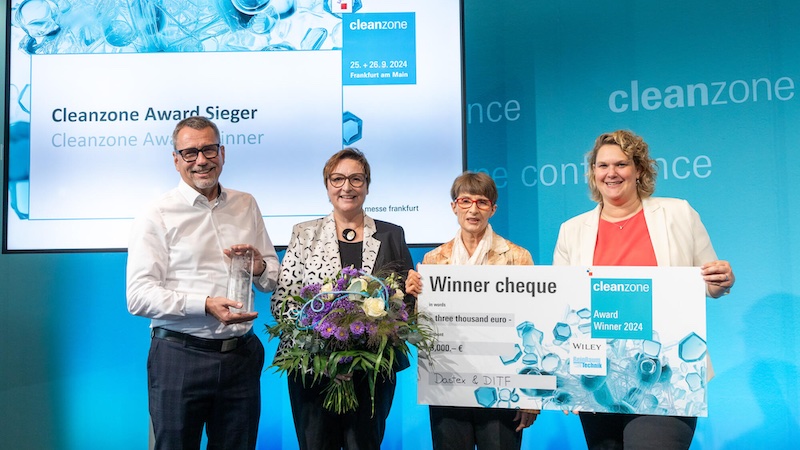
The Cleanzone, the trade fair for cleanroom and purity technology, hygiene and contamination control, took place in Frankfurt am Main on September 25 and 26, 2024. The Cleanzone Award is presented at the trade fair to recognize groundbreaking advances in innovation, automation, sustainability and efficiency in the field of cleanroom technology. This year, the award went to the German Institutes of Textile and Fiber Research Denkendorf (DITF) and the Dastex Group GmbH for the development of a test method for cleanroom garments - the ReBa2.
The Award-Winners (from left): Carsten Moschner (CMC3), Evi Held-Föhn (DITF), Gabriele Schmeer-Lioe (DITF), Alina Kopp (Dastex). Photo: Messe Frankfurt Exhibition GmbH / Jochen Günther © 2024


With the Realistic Bacterial Barrier (ReBa2) test method, the DITF offer a new biological method for determining the bacterial penetration for cleanroom garment textiles. Particularly in the manufacturing of sterile pharmaceuticals, bacteria, skin flakes and fiber particles that can originate from persons and their clothing pose a risk to the products manufactured in the cleanroom. Special cleanroom garments have the task of minimizing this risk. To assess the barrier function, the “bacterial penetration” is determined, among other properties. This provides information on how many bacteria from the human skin flora pass through the cleanroom garments to the outside when worn.

The ReBa2 test method largely reproduces the situation when wearing cleanroom garments and thus enables a meaningful determination of the bacterial penetration. It is also possible to consider numerous test scenarios. In addition to the influence of intermediate garments worn under the cleanroom garments, the sweating process or the pre-wetting of the cleanroom garments by liquid splashes in the manufacturing process or by disinfectants can also be tested. The method was developed at the DITF in collaboration with the Dastex Group GmbH.

More News from Deutsche Institute für Textil- und Faserforschung Denkendorf

#Research & Development

More safety and comfort for protective clothing thanks to auxetic fabrics

When everyday materials are pulled, they stretch or elongate in the direction of the pull and become narrower in cross-section. We can also observe this property in two-dimensional textiles. Auxetic structures behave differently here. They have the striking property of not changing under tensile stress or even increasing their width or thickness. These properties are advantageous, for example, in protective textiles or textile filter media. The DITF are researching auxetic fabrics for various applications.

#Research & Development

Panty liners prevent bacterial vaginosis

Worldwide, almost one third of women of childbearing age suffer from bacterial vaginosis. This is when the sensitive microbiome of the vagina becomes unbalanced. Such a disorder of the vaginal flora can cause urogenital infections, abscesses on the ovaries or fallopian tubes or premature births. This significantly increases the risk of infertility in women and of contracting a sexually transmitted disease or HIV.

#Research & Development

DITF send a signal for climate protection

The German Institutes of Textile and Fiber Research Denkendorf (DITF) have successfully implemented extensive investments in photovoltaic systems at their site in Denkendorf. The systems installed on the roofs of the buildings and covered parking lots have a total installed capacity of 840 kilowatt peak (kWp). The DITF invested 1.6 million euros in this with the support of the state of Baden-Württemberg. The system was ceremonially put into operation on September 17, 2025.

#Research & Development

4.2 million Euros for research into textile recycling

Around the world, used textiles are still rarely recycled and pile up into huge mountains of waste. A recent study by the Boston Consulting Group (BCG) drew attention to this problem. However, the low recycling rate is also due to the fact that only a small percentage of used textiles are actually suitable for recycling into high-quality materials and for demanding applications. The German Institutes of Textile and Fiber Research Denkendorf (DITF) are addressing this problem with their research.

More News on Research & Development

#Research & Development

Sustainable athletic wear made from bio-based Polyethylene

Conventional sports textiles made from petroleum-based synthetic fibres are to be replaced in the future by sustainable, bio-based, cooling textiles. Polyethylene, previously used mainly in the packaging industry, is thus qualified for use in textiles and, as a bio-based drop-in solution, offers a cost-effective, sustainable alternative for the future.

#Research & Development

Innovation center for textile circular economy inaugurated

Just over eight months after the foundation stone was laid, the new Innovation Center for Textile Circular Economy was officially inaugurated today at TITK Rudolstadt. Thuringia's Minister President Mario Voigt, TITK Director Benjamin Redlingshöfer, and other guests of honor cut the ribbon to the modern building complex and viewed the premises, which are now ready for occupancy. The “DICE – Demonstration and Innovation Center for Textile Circular Economy” is TITK's largest single investment to date. The Free State of Thuringia supported the total cost of €11.5 million with €8 million in GRW and FTI funding.

#Research & Development

Sustainable design of Geosynthetics and roof underlayments made from recyclates

Is it possible to recover plastic recyclates from previously unused waste streams in order to produce high-quality fibers and films? How can bio-based polymer fibers be manufactured so as to allow adjustable biodegradability? These are the questions being addressed by researchers from the Fraunhofer Cluster of Excellence Circular Plastics Economy CCPE in the Zirk-Tex project.

#Research & Development

India, ITA and innovation – enhanced cooperation in research, implementation and bilateral projects such as hydrogen mobility

The Indian Consul General, Dr Shuchita Kishore, visited the Institut für Textiltechnik (ITA) of RWTH Aachen University on 15 December to inspect the joint project between the ITA, the Indian Institute of Technology (IIT) Bombay and industrial partners from India and Germany and to tour the ITA.

Latest News

#Exhibitions & Events

VIATT 2026 announces inaugural lifestyle Trend Forum: Unified vision for S/S 2027 across fashion, home, and tech

The Vietnam International Trade Fair for Apparel, Textiles and Textile Technologies (VIATT) is set to host its first Trend Forum, offering a forward-looking, industry-wide perspective for Spring / Summer 2027. With the show scheduled from 26 – 28 February 2026 at the Saigon Exhibition and Convention Center (SECC), VIATT’s trend curators – NellyRodi™ Agency and MUSEATIVE – will provide comprehensive insights across the interconnected realms of Apparel Fabrics & Fashion, Home & Contract Textiles, and Technical Textiles & Technologies.

#Dyeing, Drying, Finishing

Precision jet dyeing moves towards industrial scale as Alchemie partners with Acatel

BTMA member Alchemie Technology, the pioneer of precision jet dyeing solutions based in Cambridge, UK, is partnering with Acatel, the Portuguese leader in sustainable textile manufacturing. The two companies will work together to validate and optimise Alchemie’s Endeavour system for knitted cellulosic fabrics.

#Dyeing, Drying, Finishing

Monforts customers make strong showing at Heimtextil 2026

Monforts dyeing and finishing technology customers from Pakistan had a formidable presence at the Heimtextil 2026 home and contract textiles exhibition which attracted over 48,000 visitors to Frankfurt in Germany this month (January 13-16).

#Associations

Industry associations warn against state-run EPR models in the EU

European industry associations, led by Euratex, have raised concerns over a growing trend in several EU Member States to introduce state-run Producer Responsibility Organisations (PROs) within Extended Producer Responsibility (EPR) schemes.

TOP