[pageLogInLogOut]

#Research & Development

Faster and cheaper carbon fibre production with CarboScreen

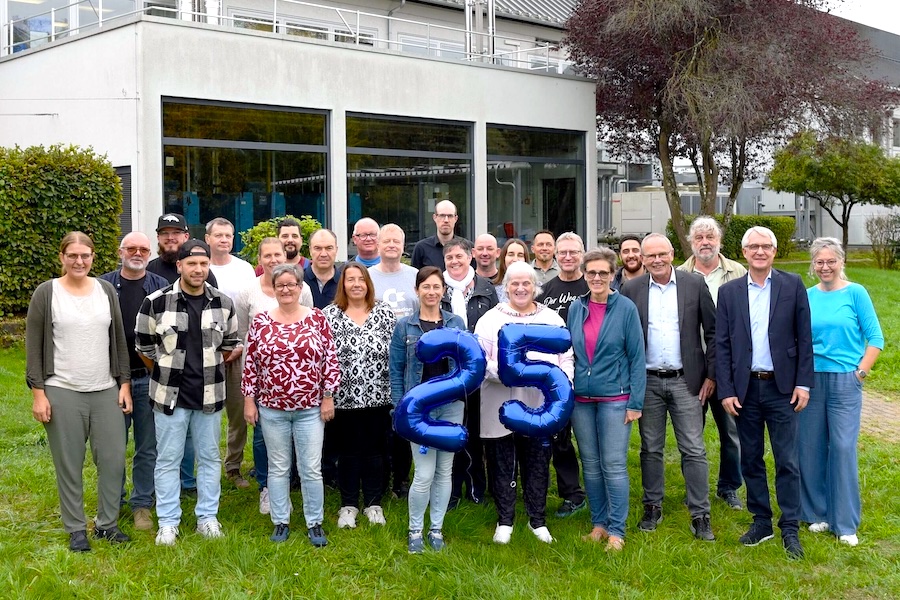
Prof. Dr Tae Jin Kang (Seoul National University), Dr Musa Akdere (CarboScreen), Dr Christian P. Schindler (ITMF), from left to right, source: ITMF
Faster and more cost-effective carbon fibre production - the technology of the start-up CarboScreen comes a good deal closer to this dream. The founders Dr. Musa Akdere, Felix Pohlkemper and Tim Röding from the Institut für Textiltechnik (ITA) of RWTH Aachen University are using sensor technology to monitor carbon fibre production, thereby doubling the production speed from the current 15 to 30 m/min in the medium term and increasing turnover by up to €37.5 million per year and system.

This ground-breaking development also impressed the jury at the ITMF at their Annual Conference in Keqiao, China, and was honoured with the ITMF StartUp Award 2023 on 6 November 2023.

Dr. Musa Akdere accepted the award on behalf of the CarboScreen founding team.

Further information:

Carbon fibres can only develop their full potential if they are not damaged during production and further processing. Two types of fibre damage occur more frequently during fibre production: Superficial or mechanical damage to the fibres or damage to the chemical structure.


Both types of damage cannot be optimally detected by current means or only become apparent after production, to name just two examples. This leads to higher production costs. In an emergency, faulty production can even lead to plant fires. For this reason, and to ensure good production quality, the system is run at 15 m/min below its production capacity for safety reasons. However, 30 m/min or more would be possible. With the sensor-based online monitoring of CarboScreen, the production capacity can be doubled to 30 /min. This would lead to higher production, resulting in lower manufacturing costs and wider use of carbon fibres in mass markets such as automotive, aerospace and wind energy.



More News from Institut für Textiltechnik of RWTH Aachen University (ITA)

#Research & Development

Kick-off for the Textile Production of the Future: Establishment of a Textile Technology and Development Centre in Mönchengladbach, Germany

The Institut für Textiltechnik (ITA) of RWTH Aachen University, together with its partners, is pleased to announce that it has received approval for its joint initiative, ‘Textile Factory 7.0’. The goal of the project is the establishment of a technology and development centre for the textile industry in Mönchengladbach.

#Research & Development

Exchange data between textile companies openly, securely and cost-effectively without a central platform – ITA makes it possible

The Institut für Textiltechnik (ITA) of RWTH Aachen University has launched a new demonstrator for an open and secure data space in the textile industry at the Digital Innovation Centre Europe (DICE). For the first time, the demonstrator shows directly and clearly how companies can share their data securely with each other without the need for a central platform. Data exchange is based on shared, freely usable technical foundations.

#Research & Development

Sustainable athletic wear made from bio-based Polyethylene

Conventional sports textiles made from petroleum-based synthetic fibres are to be replaced in the future by sustainable, bio-based, cooling textiles. Polyethylene, previously used mainly in the packaging industry, is thus qualified for use in textiles and, as a bio-based drop-in solution, offers a cost-effective, sustainable alternative for the future.

#Research & Development

India, ITA and innovation – enhanced cooperation in research, implementation and bilateral projects such as hydrogen mobility

The Indian Consul General, Dr Shuchita Kishore, visited the Institut für Textiltechnik (ITA) of RWTH Aachen University on 15 December to inspect the joint project between the ITA, the Indian Institute of Technology (IIT) Bombay and industrial partners from India and Germany and to tour the ITA.

More News on Research & Development

#Research & Development

Bio-based fibers with good flame retardancy

Fibers made from bio-based plastics reduce dependence on fossil raw materials and promote the circular economy. The covalent bonding of flame-retardant additives can open the way for these fibers to enter the mass market.

#Research & Development

Innovation center for textile circular economy inaugurated

Just over eight months after the foundation stone was laid, the new Innovation Center for Textile Circular Economy was officially inaugurated today at TITK Rudolstadt. Thuringia's Minister President Mario Voigt, TITK Director Benjamin Redlingshöfer, and other guests of honor cut the ribbon to the modern building complex and viewed the premises, which are now ready for occupancy. The “DICE – Demonstration and Innovation Center for Textile Circular Economy” is TITK's largest single investment to date. The Free State of Thuringia supported the total cost of €11.5 million with €8 million in GRW and FTI funding.

#Research & Development

Sustainable design of Geosynthetics and roof underlayments made from recyclates

Is it possible to recover plastic recyclates from previously unused waste streams in order to produce high-quality fibers and films? How can bio-based polymer fibers be manufactured so as to allow adjustable biodegradability? These are the questions being addressed by researchers from the Fraunhofer Cluster of Excellence Circular Plastics Economy CCPE in the Zirk-Tex project.

#Research & Development

More safety and comfort for protective clothing thanks to auxetic fabrics

When everyday materials are pulled, they stretch or elongate in the direction of the pull and become narrower in cross-section. We can also observe this property in two-dimensional textiles. Auxetic structures behave differently here. They have the striking property of not changing under tensile stress or even increasing their width or thickness. These properties are advantageous, for example, in protective textiles or textile filter media. The DITF are researching auxetic fabrics for various applications.

Latest News

#Technical Textiles

Carrington Textiles and Pincroft unite defence expertise at Enforce Tac

Carrington Textiles and Pincroft return to Enforce Tac for the third time, presenting a co-branded stand that brings together textile manufacturing and specialist finishing under one roof.

#Functional Fabrics

“Action helps us change what we do!”

DAY 0 takes place deliberately before PERFORMANCE DAYS begins. It is conceived as a space for reflection, dialogue and active engagement — a moment to pause before the fair, rethink established systems and address sustainability not as a trend, but as a fundamental transformation challenge. Under the guiding metaphor “Turn the Tap Off”, DAY 0 focuses on root causes rather than symptoms, systemic change rather than isolated solutions, and collective responsibility rather than individual silos.

#Textiles & Apparel / Garment

Pets in fashion: functional and sustainable textiles find new market at Intertextile Apparel

China’s pet economy is booming, especially amongst younger generations, and pet apparel – from designer outfits to functional garments – was a RMB 3.5 billion (over USD 500 million) market in 2024, growing more than 20% annually¹. To help exhibitors harness this trend, Intertextile Shanghai Apparel Fabrics – Spring Edition 2026 will launch the Pet Boutique, presenting a range of innovative, sustainable materials that prioritise both functionality and comfort for pets.

#Sustainability

VAUDE eliminates PFAS from all products

PFAS (per- and polyfluoroalkyl substances) are now detectable worldwide – in drinking water, soil and the human body. These so-called “forever chemicals” are considered hazardous to health and potentially carcinogenic, as they do not break down and remain in the environment permanently. Despite these risks, PFAS are still used in a wide range of products. More than 15 years ago, VAUDE made a strategic decision to gradually eliminate PFAS from all product categories.

TOP