[pageLogInLogOut]

#Research & Development

Evonik and LIKAT discover new type of hydroformylation

© 2022 Evonik
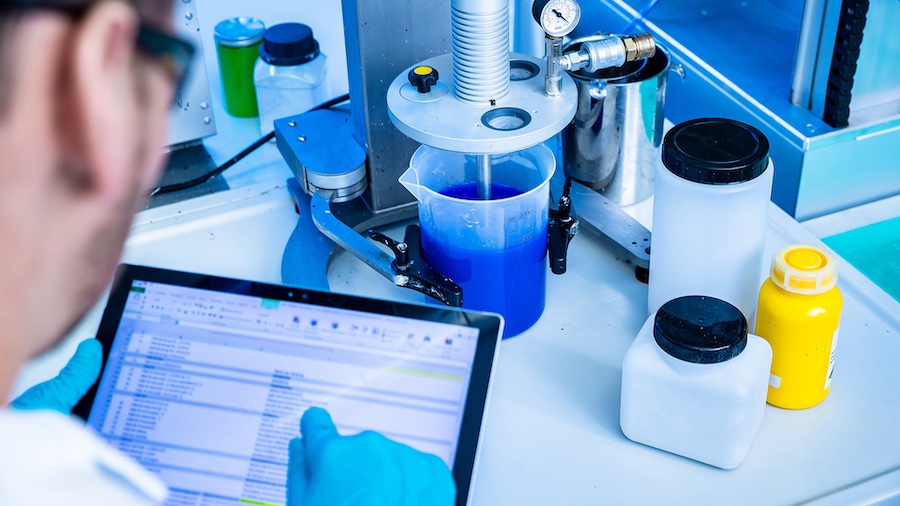
A research team involving Evonik and the Leibniz Institute for Catalysis (LIKAT) has made another breakthrough in the field of hydroformylation. Hydroformylation is one of the most important reactions in industrial organic chemistry. Unsaturated compounds are converted into aldehydes and alcohols using synthesis gas.
  • A research team involving Evonik and the Leibniz Institute for Catalysis has made another breakthrough in the field of hydroformylation.
  • Contrary to accepted doctrine, the reaction also works at low pressures with a stable catalyst
  • Discovery opens way to cost-effective and environmentally friendly production of aldehydes and alcohols

Special recognition through publication in renowned journal Science

Until recently, the scientific consensus was that this reaction, if catalyzed with cobalt, could only be carried out under high pressure conditions without the catalyst decomposing. This was disproved by Professor Dr. Robert Franke, head of hydroformylation research at Evonik, together with research partners from LIKAT, Dr. Baoxin Zhang and Dr. Christoph Kubis. "With this discovery, we have identified new process options for hydroformylation," says Franke, who is also a professor of chemistry at Ruhr University in Bochum. "In the future, it may be possible to make this large-scale reaction much more economical and environmentally friendly. Developing these processes will be our task for the next few years."

The researchers succeeded in demonstrating, for the first time, that cobalt carbonyls - very inexpensive compounds for the catalysis of hydroformylation - are active and stable even at low pressures. The key to this discovery was the development of special spectroscopic measurement methods and associated mathematical tools for data evaluation.

High-pressure processes that use cobalt carbonyls as catalysts could be replaced in the future by new processes with lower pressures. These new processes would then be more cost-effective, energy-efficient and thus more sustainable. At Evonik, this would have an impact on the production of long-chain alcohols such as the oxo alcohol isononanol (INA), which is used, among other things, to manufacture plasticizers.


Due to the particular importance of this discovery, the renowned journal Science published the results of the project. This is Professor Dr. Robert Franke's second appearance in Science on carbonylation reactions. In 2020, Franke succeeded in a so-called 'dream reaction': the direct carbonylation of 1,3-butadiene. This discovery was also worthy of publication in the journal.


Link to the article:

https://www.science.org/stoken/author-tokens/ST-725/full


More News from TEXDATA International

#Recycling / Circular Economy

textile.4U publishes special edition “Top 100 Textile Recycling Companies 2025”

With a comprehensive 176-page special edition, textile.4U is dedicating its latest issue entirely to one of the most dynamic and influential topics in today’s textile industry: textile recycling. The new issue, published exclusively in high-quality print, presents the Top 100 textile recycling companies researched and selected by TexData – organizations that already play a key role in the transition to circular textiles or are expected to have a significant impact in the near future.

#Recycling / Circular Economy

Responsible Textile Recovery Act of 2024 signed by Governor

Senator Josh Newman (D-Fullerton) is proud to announce that Senate Bill 707 (SB 707), the Responsible Textile Recovery Act of 2024, has been signed into law by the Governor of California, Gavin Newsom. This groundbreaking legislation establishes the country’s first Extended Producer Responsibility (EPR) textile recycling program, marking a significant step forward in the state’s efforts to combat waste and promote sustainability.

#Textiles & Apparel / Garment

Modtissimo promotes sustainability with 28 coordinates in the Green Circle

Modtissimo is proving more and more to be a textile and clothing show that delivers the latest innovations in the area of sustainability, with the iTechStyle Green Circle being the main showcase for companies' creations. In this 60+4 edition, taking place on 12 and 13 September, 28 coordinates will be exhibited in a section organised by CITEVE and curated by Paulo Gomes.

#Europe

The EU and Egypt team up to mobilise private sector investments at Investment Conference and sign a Memorandum of Understanding underpinning €1 billion in macro-financial assistance for Egypt

At the EU-Egypt Investment Conference, co-organised by the EU and the Government of Egypt on 29-30 June, the EU and Egypt are teaming up to intensify private sector investments in Egypt. They are also signing a Memorandum of Understanding (MoU) for the disbursement to Egypt of up to €1 billion in Macro-Financial Assistance.

More News on Research & Development

#Research & Development

The region of renewable raw materials: Central German Alliance for Bioplastics

The development of sustainable plastic solutions is rapidly gaining importance in light of global environ- mental pollution, dwindling fossil resources and ambitious climate protection targets. As part of the re- gional alliance RUBIO, which brings together 18 partners from central Germany and the Berlin-Branden- burg area, the bio-based and biodegradable plastic polybutylene succinate (PBS) was comprehensively investigated, starting with the raw material, through the manufacturing process, to industrial application.

#Nonwoven machines

Cooperation in the field of meltblown laboratory technology

The Nonwoven Institute (NWI) at North Carolina State University and Oerlikon Nonwoven will be collaborating in the field of meltblown laboratory technology in the future. This was announced by Professor Raoul Farer, Executive Deputy Director of the NWI and Professor at the Wilson College of Textiles at North Carolina State University, and Dr. Ingo Mählmann, Sales Director Nonwoven at Oerlikon Neumag, during this year's ITMA Asia and CITME in Singapore.

#Recycling / Circular Economy

European research project addresses textile waste through integrated recycling technologies

A major European research initiative coordinated by Fraunhofer UMSICHT has been launched to develop integrated solutions for textile waste recycling. The AUTOLOOP project aims to create a comprehensive system that could process 1.24 million tonnes of textile waste annually by 2050, whilst potentially creating over 130,000 green jobs across the EU. This project aims to develop, test and integrate automated sorting, tracing, and closed-loop recycling technologies for polyester-based textiles (NRT), addressing the pressing challenge of textile waste management.

#Research & Development

Feasibility study shows potential to convert textile waste into PHB bioplastic

Textile waste could serve as a valuable source of raw materials for sustainable plastics in the future, according to the joint TexPHB feasibility study conducted by the Fraunhofer Institute for Applied Polymer Research IAP, Beneficial Design Institute GmbH and matterr GmbH. The study will be presented to the public for the first time at a network meeting on 25 November 2025 at the State Chancellery in Potsdam.

Latest News

#Recycling / Circular Economy

Advanced Recycling Conference 2025 fuels innovation across key waste streams

The Advanced Recycling Conference (ARC) 2025 brought together nearly 220 experts from 28 countries to spotlight pioneering advancements and foster industry collaboration in recycling across diverse waste streams including plastics, textiles, automotive and other materials.

#Dyeing, Drying, Finishing

Navis TubeTex announces U.S. partnership with Icomatex

Navis TubeTex, a global leader in advanced dyeing and finishing machinery solutions, is pleased to announce a new partnership with Icomatex (www.icomatex.com), a respected European manufacturer of high-quality stenters and textile finishing equipment. Under this agreement, Navis TubeTex will exclusively represent the Icomatex stenter line in the United States.

#Recycling / Circular Economy

ADVANSA launches ADVA®tex: A new step toward textile-to-textile recycling

ADVANSA has introduced ADVA®tex, a new filling fibre made entirely from recycled pre-consumer textile waste, positioning the material as a significant step forward in textile-to-textile (T2T) recycling. The fibre is designed for use in duvets, pillows, mattresses, and furniture applications and is available in three versions.

#Knitting & Hosiery

KARL MAYER celebrates 35 years of EL pattern drive

KARL MAYER is celebrating an anniversary this year: on 30 November 1990, the first warp knitting machine with electronic guide bar control, the KS 4 EL, was delivered – another milestone for patterning. As early as 1980, the SU gearbox with the MRS42SU had initiated the transition from mechanical chains to digital data.

TOP