[pageLogInLogOut]

#Research & Development

Borealis Innovation Award 2022 for the best HTL final papers
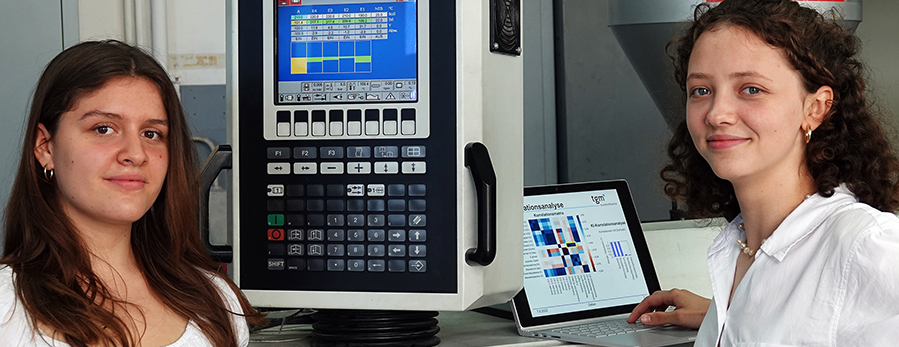
Photo: Winners - Recording of the process parameters on a processing machine. (fltr: Klara Hummer, Marie Dekan) © GFKT
Austria‘s industry is setting the pace, in many respects. In this context, young technicians who are shaping the future of the industry with their innovative ideas, already play a major role. To support these young talents, the best final papers of Austrian higher technical secondary school (HTLs) graduates were honoured at the 17th Borealis Innovation Award ceremony.

Measured in terms of value added, the manufacturing sector is the largest industry in Austria; its innovation potential, which is reflected in the approximately 1500 patents granted annually, is on a high level. An important factor contributing to this success are the graduates of the Austrian HTLs. Therefore, each year Borealis awards the best HTL final papers in the field of plastics and environmental technology at the TGM Vienna to promote young talent.

Modern technologies thanks to innovative solutions

While the automation of processes and the ongoing digital transformation ("digitalisation") play a major role in the public perception, modern technologies also require innovative materials. This is reflected in the final papers awarded this year, which dealt with topics such as process monitoring, processing optimisation, and flame-resistance of plastics in e-mobility.

Marie Dekan and Klara Hummer researched the use of artificial intelligence to monitor the quality of manufacturing processes in plastics manufacturing. This innovative approach was awarded with the first place by an expert jury.

The runners-up, Felix Petutschnig and Xaver Rossnagl, were honoured for their paper on the intrinsic reinforcement of polyethylene. Their research aims to facilitate the production of plastic components that have the same mechanical properties as steel.

Teodora Aleksic, Carina Bachmayer and Marko Cilek improved the safety of electric vehicles by developing a fireproof battery compartment, for which they achieved third place.

Addressing challenges together

The exceptional quality of the award-winning papers is reflected in the topicality of the subject matters, amongst other things. “The close link to current economic issues is what makes our HTL graduates’ final papers stand out,” Klemens Reitinger, head of the TGM department, explains. “It is thanks to the close relations between academia and industry that such projects can be carried out successfully and fully in line with current trends.”

This close cooperation is also reflected in Borealis' support for education programmes, and in the awards presented to students, honouring their academic achievements and innovation. Markus Horcher, Director Sustainability & Public Affairs at Borealis, put an emphasis on this fact during the award ceremony: “Our society’s path into the future is set by global, social and ecological challenges which can only be met with cutting-edge compound material solutions and technologies.”
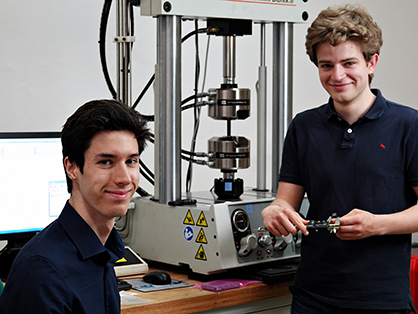
Poto: Runners-up - Determination of the mechanical properties. (fltr: Xaver Roßnagl, Felix Petutschnig) © GFKT


Borealis sees the big challenges facing our society when dealing with the consequences of climate change, and at the same time meeting the increasing resource requirements of a growing global population. Horcher adds: “In line with these trends, we at Borealis are focusing on the comprehensive expansion of a sustainable circular economy, as well as on delivering innovations to achieve climate neutrality. To succeed in finding the right solutions to these challenges, we require young technicians with high commitment; this is why Borealis makes it a priority to support them.”

The commitment to a close cooperation between the TGM and the Austrian plastics industry was further illustrated by the large number of participants. Almost 150 representatives from commerce and industry attended the award ceremony in the ballroom of the Austrian Trade Association at the Palais Eschenbach.


Award Winners of the Borealis Innovation Award 2022

Winners

Topic: Process capability analysis through artificial intelligence

Project team: Marie Dekan and Klara Hummer

Partner company: Gabriel-Chemie GmbH

Summary:

In industrial production, the quality inspection of products often takes place at a later stage than the manufacturing process itself. If defective parts are discovered during these checks, a large number of products often have to be discarded. This problem could be remedied by an artificial intelligence (AI)-based system that is able to predict the quality of products in real time based on production parameters.

In their paper, Marie Dekan and Klara Hummer investigated the suitability of so-called neural networks for describing production processes in plastics technology. Their results showed that these AI models can identify important influencing variables and thus help reduce the reject rate.


Runners-up

Topic: Self-reinforcement in polyethylene through shish-kebab structures

Project team: Felix Petutschnig and Xaver Rossnagl

Partner company: Laboratory for Plastics Technology Ges. m.b.H.

Summary:

High-strength components made of plastics seem rather unusual to many people, as plastic is commonly associated with products that are not very robust. This makes it all the more surprising that Felix Petutschnig's and Xaver Rossnagl's made it their goal to produce high-strength plastic products that can compete with steel.

For this purpose, a standard plastic (polyethylene) exhibiting distinct crystal structures due to a special processing method, using high pressure and orientation, was chosen. These structures, which are called “shish-kebab” because of their appearance, produce extraordinarily good mechanical properties.

Initial results have already been promising. By modifying the molecular lengths, the team was able triple material strength. With their work, the two plastics engineers hope to pave the way for the production of lighter yet stronger components in the future.
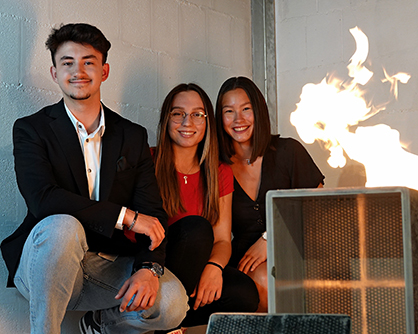
Photo: 3rd place - Testing the fire resistance of the battery case. (fltr: Marko Cilek, Teodora Aleksic, Carina Bachmayer) © GFKT


3rd place

Topic: Flame-retardant lightweight structures for battery compartments

Project team: Teodora Aleksic, Carina Bachmayer, Marko Cilek

Partner company: State Research Institute for Mechanical Engineering

Summary:

While electric mobility has seen a major upswing for some years now, fire incidents involving battery systems regularly show the potential hazards of this technology. Electric motorbikes from MotoE, for example, caught fire several times while charging the lithium batteries; similarly, vehicle fires at several well-known car manufacturers have also triggered a discussion about the safety of electric vehicles.

For this reason, Teodora Aleksic, Carina Bachmayer and Marko Cilek designed a flame-retardant battery compartment that is particularly light and intended for racing. The specially developed plastics and the lightweight components produced using 3D printing ensure low mass, while still delivering a high load-bearing capacity. The result is an energy-efficient battery compartment with enhanced fire resistance, which is already being tested in racing.




More News from TEXDATA International

#Texprocess 2026

Texprocess 2026: Automation, digitalisation and AI reshape textile processing

Investment decisions in textile processing have become increasingly complex. Rising energy prices, labour shortages and geopolitical uncertainties are forcing companies to prioritise technologies that deliver measurable improvements in efficiency and process stability. This applies not only to apparel production, but also to the processing of technical textiles and high-performance materials. Modernisation projects are therefore being evaluated more selectively – but the pressure to upgrade production systems continues to grow. Texprocess 2026 reflects this tension between cautious investment behaviour and increasing technological demand.

#Techtextil 2026

Textile Chemicals & Dyes: Innovation in Textile Chemistry moves into focus at Techtextil 2026

From PFAS-free finishes and water-saving dyeing technologies to advanced coatings and recycling-compatible formulations, innovation in textile chemistry is accelerating across the industry. Reflecting this development, Techtextil 2026 introduces Textile Chemicals & Dyes as a dedicated product segment, highlighting the growing role of chemical solutions in shaping the next generation of technical textiles.

#Recycling / Circular Economy

textile.4U publishes special edition “Top 100 Textile Recycling Companies 2025”

With a comprehensive 176-page special edition, textile.4U is dedicating its latest issue entirely to one of the most dynamic and influential topics in today’s textile industry: textile recycling. The new issue, published exclusively in high-quality print, presents the Top 100 textile recycling companies researched and selected by TexData – organizations that already play a key role in the transition to circular textiles or are expected to have a significant impact in the near future.

#Recycling / Circular Economy

Responsible Textile Recovery Act of 2024 signed by Governor

Senator Josh Newman (D-Fullerton) is proud to announce that Senate Bill 707 (SB 707), the Responsible Textile Recovery Act of 2024, has been signed into law by the Governor of California, Gavin Newsom. This groundbreaking legislation establishes the country’s first Extended Producer Responsibility (EPR) textile recycling program, marking a significant step forward in the state’s efforts to combat waste and promote sustainability.

More News on Research & Development

#Techtextil 2026

STFI presents concepts for the textile circular economy and solutions for a healthy and safe life at Techtextil

Sächsisches Textilforschungsinstitut e.V. (STFI) has been supporting companies in developing marketable innovations for over 30 years. With a clear focus on sustainability, the environment, health and protection, the STFI offers future-oriented research, textile testing for tailor-made solutions and certification of per- sonal protective equipment. At Techtextil 2026, the institute will present ideas for the textile circular econ- omy and showcase solutions for healthy and safe living.

#Techtextil 2026

Cetex: Textile innovations “Made in Saxony” at Techtextil

This year, the Cetex Institut gGmbH is once again not only exhibiting but also organising a joint booth at Techtextil. Together with co-operation partners, textile innovations “Made in Saxony” will be presented on almost 85 m². The spectrum covers everything from textile machine construction and the manufacture of technical textiles to measuring and testing technology, with research and development also having its place.

#Composites

More affordable, environmentally friendly hydrogen pressure tanks at ITA-JEC booth

As a highlight of the JEC, the Institut für Textiltechnik (ITA) of RWTH Aachen University will be presenting hydrogen pressure tanks manufactured using multifilament winding processes at the NRW joint booth in Hall 5, Stand G65.

#Research & Development

Pioneer of the first hour: Michael Carus steps down after more than 30 years from nova-Institute’s Management

After more than three decades at the helm, founder and CEO Michael Carus is set to step down as head of the Renewable Carbon division on 1 March 2026. Lars Börger as the new CEO, will take over this key position of the nova-Institute together with COO Linda Engel, while Carus will remain with the research and consulting company as a senior advisor and shareholder. This change takes place after a one-year transition phase, as planned.

Latest News

#Europe

Commission presents proposal for EU Inc. - unlocking the full potential of the Single Market for Europe's entrepreneurs

Today, the European Commission presented its proposal for EU Inc., a new single set of corporate rules, building the cornerstone and starting point for the EU's 28th regime. EU Inc. is an optional, digital-by-default European corporate framework. It will make it easier for businesses to start, operate and grow across the EU – incentivising them to stay in Europe, and encourage those who once looked elsewhere to return.

#Man-Made Fibers

OnceMore® from Södra brings end-to-end traceability for circular Man-made Cellulosic Fibers (MMCF) using TextileGenesis

OnceMore® from Södra, the world’s first large-scale process for recycling blended fabrics into high‐quality dissolving pulp, will begin using TextileGenesis, a Lectra company, to strengthen traceability from raw material to retail across the value chain. OnceMore® produces dissolving pulp made from blended textile waste and wood sourced from responsibly managed Swedish forests. By integrating TextileGenesis, OnceMore® supports the growing need for verified data and secure, transparent tracking throughout increasingly complex supply chain.

#Sustainability

Experts publish APAC policy priorities

Cascale today announced the publication of its APAC Policy Priorities Paper, developed by the Asia-Pacific (APAC) Policy Member Expert Team (MET) to identify key regional sustainability challenges and provide practical, aligned recommendations for policymakers and industry stakeholders across Asia-Pacific.

#Spinning

Temco launches a new DTY all-in-one solution

Temco introduces the DTY All-in-One Solution – a fully harmonized set of components engineered to give customers a highly stable, low maintenance and reproducible process environment. The solution reduces interruptions, extends component lifetimes and supports consistent yarn quality across all machine positions. All-in-One Solution – a fully harmonized set of components engineered to provide maintenance and reproducible process environment.

TOP