[pageLogInLogOut]

#Research & Development

Dr.-Ing. Larissa Born receives the Manfred Hirschvogel Prize
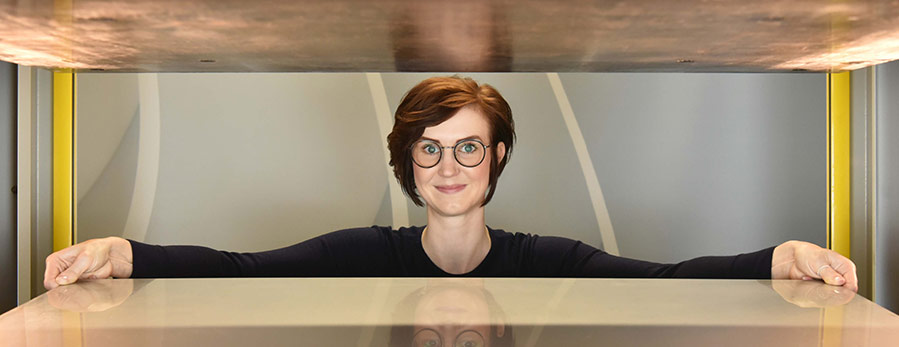
Prize winner Dr.-Ing. Larissa Born inserting the mirror plates (tool for test specimen production) into the hot press ©DITF Denkendorf
PhD student of ITFT at the University of Stuttgart awarded for her outstanding doctoral thesis

On 2nd July 2021, during the graduation ceremony for Master's students from the mechanical engineering faculties at the University of Stuttgart, Dr.-Ing. Larissa Born, research associate at the Institute of Textile and Fiber Technologies (ITFT), was awarded the Manfred Hirschvogel Prize 2021. The prize, endowed with 5,000 euros, is awarded annually at all TU9 universities – the nine leading technical universities in Germany – for the best dissertation in the field of mechanical engineering. The award-winning doctoral thesis is entitled "Principles for the layout and design of a hybrid material to be used in exterior, adaptive facade components made of fiber-reinforced plastic". Dr.-Ing. Marc Hirschvogel, Chairman of the Board of Trustees of the Frank Hirschvogel Foundation, especially highlighted the innovative approach and the scientific depth of the thesis during the award ceremony.

Since her student days, Larissa Born has been interested in fibre composites and their potential for a wide range of innovative applications. As part of her final theses during her studies as well as in her subsequent professional positions, she conducted intensive research on various material- and process-specific issues in context of fibre-reinforced composites. Since the beginning of her work at the ITFT, she has supervised numerous research projects on the development of adaptive fibre-reinforced composite components for shading systems with her textile-technological expertise. Within this research activity, she developed the topic of her dissertation: "Principles for the layout and design of a hybrid material to be used in exterior, adaptive facade components made of fiber-reinforced plastic".

With her doctoral thesis, Larissa Born provides a basic methodology for the development of adaptive fibre-reinforced plastics and exemplarily applied it to a hybrid material made of glass-fibre reinforced plastic, elastomer and thermoplastic polyurethane. Locally flexible areas (hinges) are integrated between stiff component areas by adapting the material set-up. Furthermore, to be able to analyse the adaptive material properties, she developed a new test method that allows a test specimen to be bent by up to 180°. The novel hybrid material allows a continuous load of 5,000 bending cycles by 180° with only marginal loss of tensile strength. A data base including a regression model to predict and adjust the mechanical properties of a hinge component is the result of the analyses performed within the thesis.


The hybrid material has already found application in different demonstrators, which were awarded the AVK Innovation Award (Flectofold) and the Materialica Gold Award (Flexafold). "With her work, Larissa Born has succeeded in establishing a completely new, material-technical basis for the development of adaptive fibre-reinforced plastics," lauded Prof. Dr.-Ing. Götz T. Gresser, doctoral supervisor and head of ITFT, at the award ceremony. "The application is not limited to the architectural context, but can also be transferred to other fields such as automotive and aviation. In this way, mechanical, high-maintenance joints can be replaced by low-wear, compliant mechanisms."
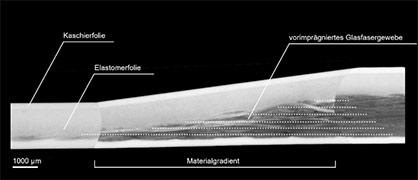
Cross-section (micrograph) of the transition from the flexible joint to the rigid component area in the joint component made of hybrid material ©University of Stuttgart (ITFT) L. Born


Larissa Born's remarkable professional career started at Reutlingen University in the Textile Technology/Management programme. As part of her bachelor's thesis, she developed flectofin®, the first adaptive façade shading component made of fibre-reinforced composites. This became the starting point for subsequent developments in this field, which she has accompanied and driven forward as a research associate at the ITFT since 2014, after working at the BMW Group and the Bremen Fibre Institute, the ITV Denkendorf and the Fraunhofer PYCO facility. The large-scale demonstrators Flectofold and ITECH Research Demonstrator 2018-19 were important milestones on this path.

After having finished her doctorate, Larissa Born will continue her research work at the ITFT as deputy director of the institute. The aim now is to deepen the existing research field together with Prof. Gresser and to open up new research topics in the field of fibre-reinforced composites. One important issue for Larissa Born is the promotion and support of young researchers and future doctoral students. Her diverse experience and expertise should inspire others to pursue a scientific career and support them on their way.




More News from TEXDATA International

#People

Happy Holidays!

Dear reader, the year 2025 is drawing to a close. We are entering what we hope will be a peaceful holiday season, spending time with our families and taking a moment to pause and reflect. We hope we have been able to support you once again this year with relevant news and articles, and we look forward to surprising you with many innovations in the coming year. Enjoy the festive season, stay healthy, and we wish you a happy and joyful holiday season.

#Recycling / Circular Economy

textile.4U publishes special edition “Top 100 Textile Recycling Companies 2025”

With a comprehensive 176-page special edition, textile.4U is dedicating its latest issue entirely to one of the most dynamic and influential topics in today’s textile industry: textile recycling. The new issue, published exclusively in high-quality print, presents the Top 100 textile recycling companies researched and selected by TexData – organizations that already play a key role in the transition to circular textiles or are expected to have a significant impact in the near future.

#Recycling / Circular Economy

Responsible Textile Recovery Act of 2024 signed by Governor

Senator Josh Newman (D-Fullerton) is proud to announce that Senate Bill 707 (SB 707), the Responsible Textile Recovery Act of 2024, has been signed into law by the Governor of California, Gavin Newsom. This groundbreaking legislation establishes the country’s first Extended Producer Responsibility (EPR) textile recycling program, marking a significant step forward in the state’s efforts to combat waste and promote sustainability.

#Textiles & Apparel / Garment

Modtissimo promotes sustainability with 28 coordinates in the Green Circle

Modtissimo is proving more and more to be a textile and clothing show that delivers the latest innovations in the area of sustainability, with the iTechStyle Green Circle being the main showcase for companies' creations. In this 60+4 edition, taking place on 12 and 13 September, 28 coordinates will be exhibited in a section organised by CITEVE and curated by Paulo Gomes.

More News on Research & Development

#Research & Development

More safety and comfort for protective clothing thanks to auxetic fabrics

When everyday materials are pulled, they stretch or elongate in the direction of the pull and become narrower in cross-section. We can also observe this property in two-dimensional textiles. Auxetic structures behave differently here. They have the striking property of not changing under tensile stress or even increasing their width or thickness. These properties are advantageous, for example, in protective textiles or textile filter media. The DITF are researching auxetic fabrics for various applications.

#Research & Development

Fraunhofer CCPE presents the “Monomaterial Design Set” – Innovative solutions for circular product design

Composite materials made from different types of plastic often extend the lifetime of products but make recycling more difficult in the circular economy. That is why Fraunhofer CCPE has developed the “Monomaterial Design Set”. This new approach helps to reduce the variety of plastics used in durable products and offers circular solutions for designers and product developers.

#Research & Development

How innovations drive BASF’s success

“Innovation has always been part of BASF’s DNA. Especially in these volatile times, it is crucial to leverage our innovative strength to develop competitive solutions that differentiate us as a company in our markets and give us a competitive edge,” said Dr. Stephan Kothrade, Member of the Board of Executive Directors of BASF and Chief Technology Officer, at the company’s Research Press Briefing held today. To achieve this, BASF implemented its “Winning Ways” strategy about a year ago with the clear goal of becoming the preferred chemical company to enable its customers’ green transformation.

#Research & Development

Small tolerances, big impact and a recyclable alternative to elastane

ITA Master's student Janne Warnecke investigated tension differences over the fabric width in the weaving process and thereby contributed to quality assurance; ITA Bachelor's student Jasmin Roos found a basis for the development of recyclable yarns and textiles. For these developments, they were awarded the Walter Reiners Foundation's Promotion and Sustainability Prizes on 27 November. Peter D. Dornier, Chairman of the Walter Reiners Foundation, presented the awards at the Aachen-Dresden-Denkendorf International Textile Conference (ADD-ITC) in Aachen, Germany.

Latest News

#Weaving

Lindauer Dornier announces leadership transition in weaving machine business

After more than ten successful years at Lindauer DORNIER GmbH, Mr Wolfgang Schöffl will leave the family-owned company at the end of the year to enter well-deserved retirement.

#Heimtextil 2026

Texpertise Focus AI: Messe Frankfurt puts Artificial Intelligence centre stage at its international textile and apparel trade fairs

Under the banner 'Texpertise Focus AI, Messe Frankfurt will place a strong emphasis on Artificial Intelligence (AI) across its international textile and apparel trade fairs from 2026 onwards, setting a future-shaping signal for the industry. The initiative highlights the responsible use of AI along the entire textile value chain, from fibre production to the point of sale. The programme will launch at Heimtextil in Frankfurt in January 2026.

#Technical Textiles

Autoneum and Polestar set new benchmarks for passenger experience and sustainability

As the global market leader in sustainable acoustic and thermal management, Autoneum is a key supplier of interior and exterior components for the highly anticipated Polestar 5 model. The successful collaboration between Autoneum and Polestar marks a significant milestone in sustainable automotive engineering: the electric grand tourer sports car features several innovations in lightweight, fully recyclable polyester-based components that ensure a superior driving experience. Polestar 5 was revealed at the IAA Mobility 2025 in Munich and is available in 24 markets.

#Natural Fibers

Cashmere producers stress the importance of The Good Cashmere Standard®

At the invitation of the Aid by Trade Foundation (AbTF), over 70 experts from the cashmere production and supply chain, as well as other specialists, met at the GCS Unit Meeting in Shanghai, China to discuss the progress and new objectives of The Good Cashmere Standard (GCS). The meeting focused on implementation and verification of the standard, important aspects of animal welfare and the importance of the standard in the global textile market.

TOP