[pageLogInLogOut]

#Research & Development

New series of DIN standards enables comparability of spacer fabrics

Until now, spacer fabrics have not been tested according to separate test procedures. This meant that important characteristics were not taken into account in the tests.

The first national test standard for spacer fabrics has now been developed under the direction of the Institut für Textiltechnik of RWTH Aachen University, short ITA, in the joint project NormATex (Standardization for Spacer Fabrics), which is publicly funded by the Federal Ministry for Economic Affairs and Energy, short BMWi, within the WIPANO guideline.
© 2020 ITA
© 2020 ITA

Spacer fabrics are textile structures consisting of two textile cover surfaces and at least one spacer thread system. The cover surfaces are kept apart at a certain distance by the spacer thread. This structure gives spacer fabrics special properties that make them a substitute material for other, non-textile materials. As a result of their special properties, spacer fabrics differ from conventional, flat fabrics.

Up to now, spacer fabrics have been tested according to standards for flat fabrics or other, non-textile materials. However, these standards do not take into account the special requirements for testing spacer fabrics. Therefore, objective comparisons between spacer fabrics and each other or with conventional flat fabrics or non-textile materials cannot be made in all areas of application.

In the documents of this series of standards the special properties of spacer fabrics are given special consideration. This ensures the standardized testing of these properties and thus objective comparisons between

1. spacer textiles among themselves,

2. spacer fabrics and flat 2D-textiles and

3. spacer fabrics and non-textile materials

will be enabled.


© 2020 BMWi
© 2020 BMWi


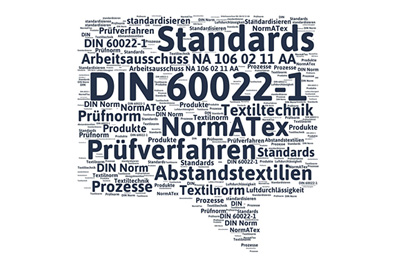
The developed standardization document DIN 60022-1, Spacer textiles - Terms and definition, sample preparation, is the first standard of the new series of standards and contains specifications for the consistent marking and sample preparation of spacer fabrics. The document was prepared by the working committee NA 106 02 11 AA "Test equipment and test methods for spacer textiles" in the DIN Textile and Textile Machinery Standards Committee under the chairmanship of ITA employee Christoph Peiner.

Besides, documents on further standardized test methods for air permeability and thickness of spacer fabrics are planned. In addition, a publicly funded follow-up project focusing on further test procedures is planned. Please contact Christoph Peiner, e-mail christoph.peiner@ita.rwth-aachen.de, if you are interested in testing spacer fabrics and the standardised test procedures.

Acknowledgement : this project was funded by the Federal Ministry for Economic Affairs and Energy, short BMWi 

Further information about the DIN working committee and the partners involved can be found here:

• DIN Standards Committee Textiles and Textile Machinery 

NA 106-02-11 Test methods and test devices for spacer textiles:

https://www.din.de/en/getting-involved/standards-committees/textilnorm/national-committees/wdc-grem:din21:296431533?destinationLanguage=&sourceLanguage=

• Müller Textil GmbH:

https://www.mullertextiles.com/

• Essedea GmbH & Co. KG:

https://www.essedea.de/en/

• Imat-uve:

https://www.imat-uve.de/en/home.html

• Frank PTI:

https://www.frankpti.com/startseite-cat225.html

• HK-Konstruktion

http://www.hk-konstruktion.de/

• t+h ingema ingenieurgesellschaft mbh:

http://www.ingema.de/en/


More News from Institut für Textiltechnik of RWTH Aachen University (ITA)

#Research & Development

Small tolerances, big impact and a recyclable alternative to elastane

ITA Master's student Janne Warnecke investigated tension differences over the fabric width in the weaving process and thereby contributed to quality assurance; ITA Bachelor's student Jasmin Roos found a basis for the development of recyclable yarns and textiles. For these developments, they were awarded the Walter Reiners Foundation's Promotion and Sustainability Prizes on 27 November. Peter D. Dornier, Chairman of the Walter Reiners Foundation, presented the awards at the Aachen-Dresden-Denkendorf International Textile Conference (ADD-ITC) in Aachen, Germany.

#Research & Development

IRG Polymer Recycling wraps up productive 2025 project cycle

The Industry Research Group (IRG) Polymer Recycling has completed another successful project year. Last week, partners from across the textile value chain met at the Institute for Textile Technology (ITA) at RWTH Aachen University for the full-term project meeting.

#Research & Development

Aachen Summer School: Strengthening German-Korean cooperation in 4D and robotics

The Aachen Summer School has established itself as an important platform for promoting cooperation between RWTH Aachen University and Seoul National University. The focus is on practice-oriented research projects in the field of 4D and robotics technologies, which have been successfully implemented for years at the Institut für Textiltechnik of RWTH Aachen University.

#Research & Development

ITA postdoc Dr Leonie Beek is revolutionising oil filtration with a bionic textile

On various biological surfaces, oil is adsorbed from water surfaces and transported along the leaf. In her dissertation, ITA Postdoc Dr Leonie Beek transferred this effect to a technical textile using her Bionic Oil Absorber (BOA), which can remove up to 4 litres of diesel per hour from water at technological readiness level 4. For this development, Dr Beek was awarded the Paul Schlack Prize 2025 for her dissertation ‘Bionic textiles for oil-water separation modelled on superhydrophobic biological surfaces’ on 10 September 2025. The award ceremony took place during the opening event of the Dornbirn GFC Global Fiber Congress in Austria.

More News on Research & Development

#Research & Development

Fraunhofer CCPE presents the “Monomaterial Design Set” – Innovative solutions for circular product design

Composite materials made from different types of plastic often extend the lifetime of products but make recycling more difficult in the circular economy. That is why Fraunhofer CCPE has developed the “Monomaterial Design Set”. This new approach helps to reduce the variety of plastics used in durable products and offers circular solutions for designers and product developers.

#Research & Development

How innovations drive BASF’s success

“Innovation has always been part of BASF’s DNA. Especially in these volatile times, it is crucial to leverage our innovative strength to develop competitive solutions that differentiate us as a company in our markets and give us a competitive edge,” said Dr. Stephan Kothrade, Member of the Board of Executive Directors of BASF and Chief Technology Officer, at the company’s Research Press Briefing held today. To achieve this, BASF implemented its “Winning Ways” strategy about a year ago with the clear goal of becoming the preferred chemical company to enable its customers’ green transformation.

#Associations

Young researchers recognised for cutting-edge work in recycling, fibre technology and textile mechanics

At the Aachen-Dresden-Denkendorf International Textile Conference held in Aachen at the end of November, Peter D. Dornier, Chairman of the Walter Reiners Foundation of the VDMA, honoured five successful young engineers. Promotion and sustainability prizes were awarded in the categories bachelor/project theses and diploma/master theses. Academic theses that develop solutions for resource-saving products and technologies, for example, are eligible for the sustainability awards.

#Research & Development

The region of renewable raw materials: Central German Alliance for Bioplastics

The development of sustainable plastic solutions is rapidly gaining importance in light of global environ- mental pollution, dwindling fossil resources and ambitious climate protection targets. As part of the re- gional alliance RUBIO, which brings together 18 partners from central Germany and the Berlin-Branden- burg area, the bio-based and biodegradable plastic polybutylene succinate (PBS) was comprehensively investigated, starting with the raw material, through the manufacturing process, to industrial application.

Latest News

#Spinning

First PA66 spinning plant with EvoQuench successfully commissioned

With the successful commissioning of a multi-digit PA66 spinning line for microfiber yarns, Chinese textile company Shandong Nanshan Fashion Technology Co., Ltd. has added yarn production to its textile value chain.

#Knitting & Hosiery

SHIMA SEIKI returns to ShanghaiTex

Leading flat knitting solutions provider SHIMA SEIKI MFG., LTD. of Wakayama, Japan, together with its Hong Kong and Chinese market subsidiary SHIMA SEIKI (HONG KONG) LTD., will exhibit at the ShanghaiTex 2025 exhibition (Booth No.: Hall N3, Booth A20) held in Shanghai, China this month. This marks the return of SHIMA SEIKI to ShanghaiTex after a 14-year hiatus, its last exhibit at the show having been in 2011.

#Man-Made Fibers

arena introduces renewable LYCRA® EcoMade fiber in its latest swimwear collection

Italian swimwear specialist arena has unveiled a new collection that brings sustainability and performance even closer together. Launched on December 4, the line features swimsuits made from recycled nylon and renewable LYCRA® EcoMade fiber — the first time the bio-based spandex has been used commercially in swimwear.

#Spinning

Saurer Technologies Twisting Solutions at ICFE 2026

Saurer Technologies Twisting Solutions, a global leader in textile machinery innovation, will be present at the International Carpet and Flooring Expo ICFE 2026. Join us January 6–9 at the Istanbul Expo Center, Türkiye, as industry leaders, manufacturers, and innovators gather to explore the latest breakthroughs in carpet and flooring technology. Let’s meet at the new established global Center of the Carpet Sector in hall 3, booth 300!

TOP