[pageLogInLogOut]

#Research & Development

Making trains and airplanes recyclable

Novel flame-retardant and recyclable fiber-reinforced composite
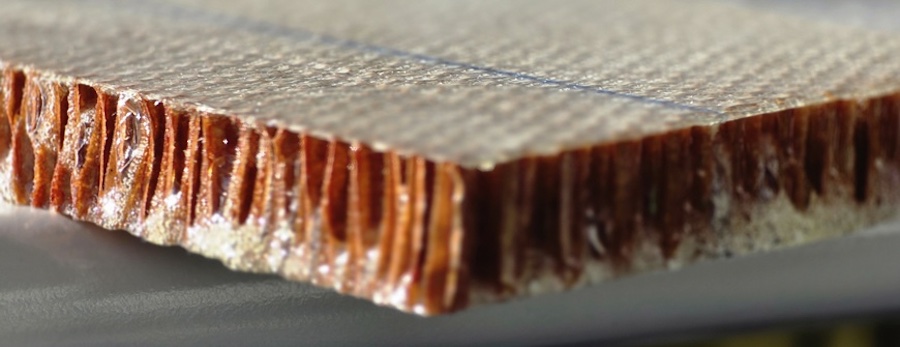
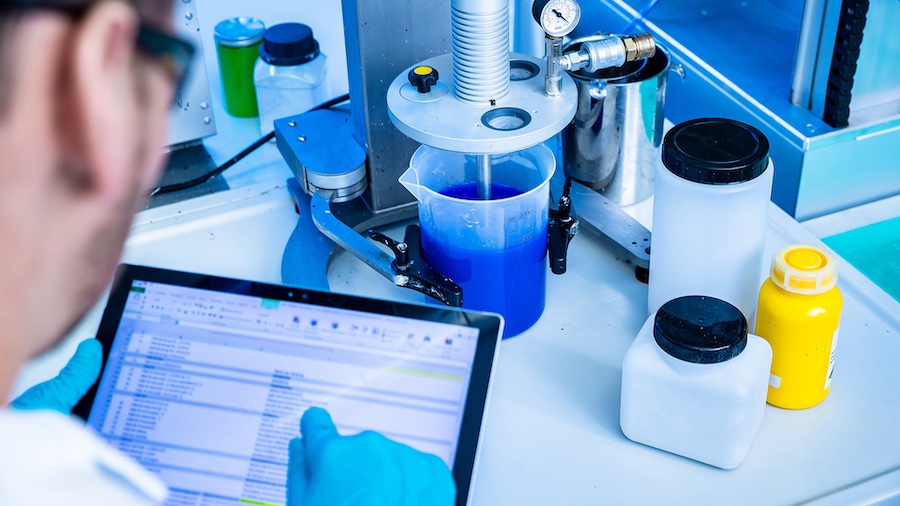
The composite made of epoxy and glass fibers not only protects against flames but can also be fully recycled. Image: Empa
Airplanes and passenger trains must meet strict safety requirements, including fire safety standards. This calls for materials that are flame-retardant, lightweight, robust, and scalable. Empa researchers, in collaboration with their industry partner Elantas, have now succeeded for the first time in making such a material – a composite – fully recyclable.


“No flying machine will ever fly from New York to Paris,” aviation pioneer Orville Wright once said. What even the visionary Wright brothers considered impossible is now a reality – thanks in part to new materials that make modern aircraft and engines possible in the first place. In the more than 100 years since the Wrights’ first flight attempts, aviation has not only become more powerful but, fortunately, also significantly safer. The materials used in aircraft construction must meet the strictest safety requirements, including fire safety standards. At the same time, they must be lightweight and mechanically robust – and, increasingly, recyclable as well.

“Bringing all these properties together under one roof is a challenge,” explains Empa researcher Sabyasachi Gaan from the Advanced Fibers laboratory. “For example, when you make a material flame-retardant, you always end up altering its other properties as well.” Gaan and his team, together with their industry partner Elantas – part of the German specialty chemicals group ALTANA – took on this challenge in a project supported by Innosuisse. Their focus was on a specific composite material used in the interior construction of airplanes and trains, such as for the floor of the passenger cabin.

Making epoxy more sustainable

The material is a multilayered “sandwich.” At the center is a honeycomb structure made of aramid, a heat-resistant polymer. This stable, lightweight core is covered on top and bottom with several flat-woven layers of glass or carbon fibers. Epoxy resin serves as the binder, as it does in many composite materials. Normally, this polymer cannot be recycled either chemically or thermally – in other words, it can neither be melted nor dissolved. “Composites containing epoxy currently end up in landfills or are incinerated,” says Gaan.

This is exactly where the Empa researchers have an ace up their sleeves. They have developed an additive for epoxy resin that makes the material flame-retardant – and recyclable at the same time. If epoxy is mixed with this phosphorus-containing molecule during production, it can be softened and reshaped under certain conditions after curing – a process known as thermomechanical recycling, which was previously impossible for epoxy.

All components recovered

In the Innosuisse project, the partners pursued a different goal: the complete recycling of the composite material. With the right solvent and a little heat, the “sandwich” can be broken down again into its individual components: the honeycomb structure and the woven fibers. Aramid honeycombs in particular – but also carbon fibers – are relatively expensive. Recycling them is therefore also economically attractive. “In principle, it’s also possible to recover the epoxy resin itself from the solution. We plan to tackle that in future projects,” says Gaan.

The recyclable epoxy resin was developed at Empa. Together with Elantas, the researchers have now explored its potential for industrial application for the first time. “Our material complies with fire safety regulations and achieves nearly the same advantageous mechanical properties as conventional epoxy,” says Gaan. “But for the first time, it allows for complete recycling of the composite material.”

The partners are satisfied with how the project is progressing. The next step is to further scale up production and recycling. “For the aerospace industry, it is crucial to combine fire protection, lightweight construction, and recyclability. This epoxy composite system demonstrates that this is now possible for the first time,” says Fiorenzo Lenzi, Head of the Aerospace/Ballistic Product Line at Elantas.

At the same time, Sabyasachi Gaan and his team are already researching additional applications for the recyclable, flame-retardant plastic, such as in the energy sector and the construction industry. The scientist emphasizes that the fact a material has come this far is also thanks to basic research. “Before we can work on the applications, we need to have a very good understanding of the material’s properties.” The Wright brothers would likely agree with him. For, as Wilbur Wright wrote in a 1900 letter to the engineer Octave Chanute, “It is possible to fly without motors, but not without knowledge and skill.”


More News from EMPA

More News on Research & Development

#Research & Development

From smart jackets to laser technology: Mona Neubaur explores Textile Factory 7.0

As part of her summer tour, North Rhine-Westphalia’s Minister for Economic Affairs and Climate Action, Mona Neubaur, visited Textilfabrik 7.0 in Mönchengladbach to experience the project’s innovations first-hand. Under the motto “smart and clean”, the visit focused on innovative technologies and sustainable alternatives for textile production - from smart jackets to the decolourisation of textiles using fungal cultures.

#Research & Development

MELANGE starts with a co-creative design workshop at Aalto University to shape the visual identity of this new project transforming colouration in textiles

Over the next three years, MELANGE will lower the environmental impact of interior textile production by moving colour design to the beginning of the manufacturing process. This Horizon Europe project officially started on 1 August 2026, and will be publicly launched on 27 August 2026.

#Research & Development

Outdoor Industry Association completes Clean Heat CoLab initiative

The Outdoor Industry Association (OIA) has completed its multi-year Clean Heat CoLab initiative, bringing together outdoor brands and technology experts to accelerate the adoption of electrified process heating in textile manufacturing. The collaboration focused on reducing emissions from thermal processes such as dyeing, washing and finishing, which remain among the most carbon-intensive stages of textile production.

#Research & Development

Europe is committed to recycling end-of-life wind turbine blades

Starting in 2026, Europe’s wind energy industry has committed itself to ensuring that wind turbine blades do not end up in landfills once they reach the end of their service life. The EU-funded research project REWIND is exploring ways to reuse this composite waste. The German Institutes of Textile and Fiber Research Denkendorf (DITF) are one of 13 project partners from seven countries.

Latest News

#Raw Materials

Cotton Brazil Dialogues 2026 concludes with 50 international participants immersed in Brazilian cotton production

The Cotton Brazil Dialogues concludes its 2026 edition after a series of technical visits to farms, cotton gins and reference centers, as well as workshops focused on Brazilian cotton production. A total of 50 participants from 14 countries took part in the field trips. The initiative is led by the Brazilian Association of Cotton Growers (Abrapa) and the National Association of Cotton Exporters (Anea), with support from the Brazilian Trade and Investment Promotion Agency (ApexBrasil).

#Composites

WHILL selects Teijin’s tough, lightweight Carbon Fiber Composite for new last-mile mobility

Teijin Limited announced today that WHILL Inc., a global leader in inclusive mobility technology, has selected Sereebo® P CFP series, a carbon fiber-reinforced thermoplastic (CFRTP) material, for key structural components of the upcoming WHILL Model C Lite. Sereebo® P CFP series provides high strength, light weight, design flexibility and system cost advantages to the Model C Lite, which is a battery powered, single-seat, last-mile device. This new model combines maneuverability with light weight and one-handed folding to ensure ease of handling and operation.

#Textile chemistry

ZymoChem secures $4 million in renewed federal funding to advance U.S. biomanufacturing of critical materials and their supply chains

ZymoChem, the specialty chemicals company dedicated to bringing decarbonization, sustainability, and supply chain resiliency to the chemical industry through innovative biological manufacturing, today announced the resumption and expansion of its federal research portfolio. The company has been notified that previously paused work under a $5 million U.S. Department of Energy (DOE) program is officially back on, to be joined by continuing collaborations with three of the nation's premier national laboratories.

#Technical Textiles

RDJ 6/2 in E 32: Finesse in Motion

The appearance of sports and casual shoes is as diverse as their applications, ranging from sporty to stylish and from functional to fashionably practical. In particular, spacer fabrics produced on highly flexible KARL MAYER double needle bar raschel machines with Jacquard technology are in high demand for manufacturing these trendy shoes. These efficient production machines enable attractive designs with integrated multifunctional zones on one or both fabric surfaces, such as breathable mesh structures. Flexible in size and positioning, these features enhance both aesthetics and wearing comfort.

TOP