[pageLogInLogOut]

#Research & Development

A wound dressing that kills bacteria
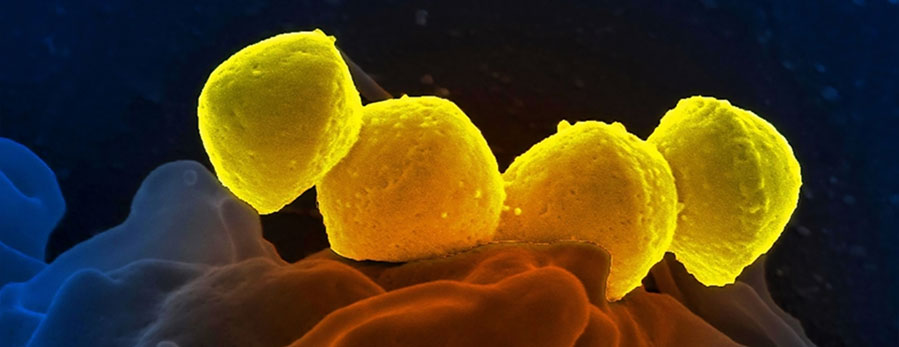
Bacteria that are resistant to antibiotics can lead to severe, hard-to-treat wound infections. Image: CDC on Unsplash
In order to combat bacterial wound infections, Empa researchers have developed cellulose membranes equipped with antimicrobial peptides. Initial results show: The skin-friendly membranes made of plant-based materials kill bacteria very efficiently.

Antibacterial cellulose

If germs invade a wound, they can trigger a long-lasting infection that may fail to heal or even spread throughout the body, leading to life-threatening blood poisoning (sepsis). The problem of antibiotic resistance is becoming more and more widespread, particularly in complex wounds, as bacteria such as staphylococci have become resistant to what was once the miracle weapon of medicine. Empa researchers have therefore developed cellulose membranes, with which these infections can be eliminated early on.

The team led by Empa researcher Katharina Maniura from the Biointerfaces lab in St. Gallen produced fine membranes from cellulose using electrospinning technology. The cellulose fibers with a diameter of less than one micrometer were spun into a delicate multi-layered, three-dimensional fabric. The membranes became particularly flexible and at the same time stable after the researchers had added the polymer polyurethane to the spinning process.


Yoga for connective tissue cells: In the presence of functionalized cellulose, connective tissue cells, as hoped, attach themselves more effectively and spread on the surface. Image: Empa


In order to achieve an antibacterial effect, the researchers designed multifunctional peptides – which can bind to cellulose fibers and exhibit antimicrobial activity. Peptides have several advantage compared to larger proteins: They are easier to produce and more stable than proteins, which react more sensitively to the chemical conditions in a wound.

Skin-friendly Membranes

If the cellulose membranes are treated with such a peptide solution, the fiber scaffold will become saturated with peptides. In cell culture experiments, the researchers then showed that the peptide-containing membranes are well tolerated by human skin cells. However, the cellulose membranes were a death sentence for bacteria such as staphylococci, which are often found in poorly healing wounds. "In bacterial cultures, over 99.99 percent of the germs were killed by the peptide-containing membranes," says Maniura.

In future, the antimicrobial membranes will be equipped with additional functions. "The peptides might, for instance, be functionalized with binding sites that enable the controlled release of further therapeutic substances," says Maniura.



More News from TEXDATA International

#Texprocess 2026

Texprocess 2026: Automation, digitalisation and AI reshape textile processing

Investment decisions in textile processing have become increasingly complex. Rising energy prices, labour shortages and geopolitical uncertainties are forcing companies to prioritise technologies that deliver measurable improvements in efficiency and process stability. This applies not only to apparel production, but also to the processing of technical textiles and high-performance materials. Modernisation projects are therefore being evaluated more selectively – but the pressure to upgrade production systems continues to grow. Texprocess 2026 reflects this tension between cautious investment behaviour and increasing technological demand.

#Techtextil 2026

Textile Chemicals & Dyes: Innovation in Textile Chemistry moves into focus at Techtextil 2026

From PFAS-free finishes and water-saving dyeing technologies to advanced coatings and recycling-compatible formulations, innovation in textile chemistry is accelerating across the industry. Reflecting this development, Techtextil 2026 introduces Textile Chemicals & Dyes as a dedicated product segment, highlighting the growing role of chemical solutions in shaping the next generation of technical textiles.

#Recycling / Circular Economy

textile.4U publishes special edition “Top 100 Textile Recycling Companies 2025”

With a comprehensive 176-page special edition, textile.4U is dedicating its latest issue entirely to one of the most dynamic and influential topics in today’s textile industry: textile recycling. The new issue, published exclusively in high-quality print, presents the Top 100 textile recycling companies researched and selected by TexData – organizations that already play a key role in the transition to circular textiles or are expected to have a significant impact in the near future.

#Recycling / Circular Economy

Responsible Textile Recovery Act of 2024 signed by Governor

Senator Josh Newman (D-Fullerton) is proud to announce that Senate Bill 707 (SB 707), the Responsible Textile Recovery Act of 2024, has been signed into law by the Governor of California, Gavin Newsom. This groundbreaking legislation establishes the country’s first Extended Producer Responsibility (EPR) textile recycling program, marking a significant step forward in the state’s efforts to combat waste and promote sustainability.

More News on Research & Development

#Techtextil 2026

STFI presents concepts for the textile circular economy and solutions for a healthy and safe life at Techtextil

Sächsisches Textilforschungsinstitut e.V. (STFI) has been supporting companies in developing marketable innovations for over 30 years. With a clear focus on sustainability, the environment, health and protection, the STFI offers future-oriented research, textile testing for tailor-made solutions and certification of per- sonal protective equipment. At Techtextil 2026, the institute will present ideas for the textile circular econ- omy and showcase solutions for healthy and safe living.

#Techtextil 2026

Cetex: Textile innovations “Made in Saxony” at Techtextil

This year, the Cetex Institut gGmbH is once again not only exhibiting but also organising a joint booth at Techtextil. Together with co-operation partners, textile innovations “Made in Saxony” will be presented on almost 85 m². The spectrum covers everything from textile machine construction and the manufacture of technical textiles to measuring and testing technology, with research and development also having its place.

#Composites

More affordable, environmentally friendly hydrogen pressure tanks at ITA-JEC booth

As a highlight of the JEC, the Institut für Textiltechnik (ITA) of RWTH Aachen University will be presenting hydrogen pressure tanks manufactured using multifilament winding processes at the NRW joint booth in Hall 5, Stand G65.

#Research & Development

Pioneer of the first hour: Michael Carus steps down after more than 30 years from nova-Institute’s Management

After more than three decades at the helm, founder and CEO Michael Carus is set to step down as head of the Renewable Carbon division on 1 March 2026. Lars Börger as the new CEO, will take over this key position of the nova-Institute together with COO Linda Engel, while Carus will remain with the research and consulting company as a senior advisor and shareholder. This change takes place after a one-year transition phase, as planned.

Latest News

#Techtextil 2026

Gebr. Otto highlights versatility at Techtextil with regional supply chains, yarn innovations and new hygiene segment

At this year’s Techtextil, Gebr. Otto places its versatility at the center of its presentation. In addition to spinning, twisting and dyeing – traditionally focused on fine cotton – textile processors will also find a competent development partner for technical specialty solutions. The Dietenheim-based spinning mill has now built up a decade of experience in the production of technical yarns, particularly from aramids. A new hygiene segment has also been established, where yarns for medical and hygiene products are currently being produced. In the future, this department could also develop textile products for the food sector. Gebr. Otto will once again be present at the BW-i joint stand, booth D81, hall 12.1. What is wound onto the spool is determined by the customer: Gebr. Otto develops according to specific customer requirements and transforms its own ideas into yarn innovations.

#Europe

Commission presents proposal for EU Inc. - unlocking the full potential of the Single Market for Europe's entrepreneurs

Today, the European Commission presented its proposal for EU Inc., a new single set of corporate rules, building the cornerstone and starting point for the EU's 28th regime. EU Inc. is an optional, digital-by-default European corporate framework. It will make it easier for businesses to start, operate and grow across the EU – incentivising them to stay in Europe, and encourage those who once looked elsewhere to return.

#Man-Made Fibers

OnceMore® from Södra brings end-to-end traceability for circular Man-made Cellulosic Fibers (MMCF) using TextileGenesis

OnceMore® from Södra, the world’s first large-scale process for recycling blended fabrics into high‐quality dissolving pulp, will begin using TextileGenesis, a Lectra company, to strengthen traceability from raw material to retail across the value chain. OnceMore® produces dissolving pulp made from blended textile waste and wood sourced from responsibly managed Swedish forests. By integrating TextileGenesis, OnceMore® supports the growing need for verified data and secure, transparent tracking throughout increasingly complex supply chain.

#Sustainability

Experts publish APAC policy priorities

Cascale today announced the publication of its APAC Policy Priorities Paper, developed by the Asia-Pacific (APAC) Policy Member Expert Team (MET) to identify key regional sustainability challenges and provide practical, aligned recommendations for policymakers and industry stakeholders across Asia-Pacific.

TOP