[pageLogInLogOut]

#Recycling / Circular Economy

The world’s first 100% “fiber-to-fiber” biorecycled clothing unveiled by multi-brand consortium

CARBIOS, (Euronext Growth Paris : ALCRB), a pioneer in the development and industrialization of biological technologies to reinvent the life cycle of plastic and textiles, and its “fiber-to-fiber” consortium partners On, Patagonia, PUMA, Salomon, and PVH Corp., parent company of Calvin Klein, unveil the world’s first enzymatically recycled polyester garment made from 100% textile waste using CARBIOS’ pioneering biorecycling technology. This technological feat contributes to advancing textile circularity when, today, the majority of recycled polyester is made from PET bottles, and only 1% of fibers are recycled into new fibers.

The collective achievement marks an important milestone for the consortium’s ultimate aim of demonstrating fiber-to-fiber closed loop using CARBIOS’ biorecycling process at an industrial scale, and marks an important step forward for the textile industry’s shift towards a circular economy.
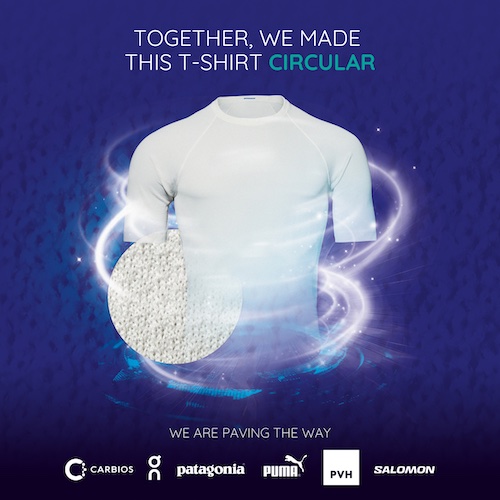
For the first time, a piece of clothing is made entirely from complex textile waste: mixed blends, treatments and dyes © 2024 CARBIOS


No ordinary t-shirt…

A plain, white T-shirt was a deliberate choice to showcase the technological achievement that made its production possible from mixed and colored textile waste. By using CARBIOS’ biorecycling technology, polyester is broken down using enzymes into its fundamental building blocks which are reformed to produce biorecycled polyester whose quality is on par with oil-based virgin polyester. Petroleum can now be replaced by textile waste as a raw material to produce polyester textiles, that will in turn become raw materials again, thus fueling a circular economy, with the added benefit of a lower carbon footprint and avoidance of landfill or incineration.

No ordinary journey…

The t-shirt’s production began with all consortium members (On, Patagonia, PUMA, PVH Corp. and Salomon) supplying rolls and production cutting scraps to CARBIOS in Clermont-Ferrand, France. This textile waste consisted of some mixed blends with cotton or elastane, as well as various treatments (such as durable water repellent) and dyes which render them complex to recycle using conventional methods. The collected waste was deconstructed into its original monomers, PTA[1] and MEG[2], using CARBIOS’ biorecycling technology at its pilot facility. The resulting monomers were then repolymerized, spun into yarn and woven into new fabric by external partners, demonstrating the seamless integration into existing manufacturing processes. The resulting sports t-shirt made from 100% textile waste meets the quality standards and sustainability objectives of the apparel brands present in the “fiber-to-fiber” consortium.
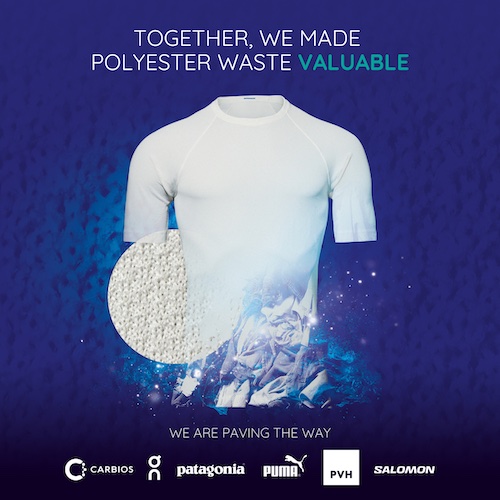
This 100% fiber-to-fiber t-shirt paves the way for true circularity in textiles © 2024 CARBIOS


CARBIOS’ demonstration plant in Clermont-Ferrand, France, has been up and running since 2021, and its first commercial plant, the world’s first industrial-scale enzymatic PET recycling plant, is currently under construction in Longlaville, France. In addition, CARBIOS recently announced several letters of intent with PET producers in Asia and Europe, confirming global interest in its biorecycling technology and advancing the international roll-out of its licensing model.

"It may look like an ordinary t-shirt, but make no mistake, the technology behind it is extraordinary! To achieve “fiber-to-fiber” recycling is a technological feat. CARBIOS couldn’t have done it alone, so thanks to the collaboration with our consortium partners, we have overcome many technical hurdles together to produce the world’s first enzymatically recycled t-shirt made entirely from biorecycled fibers", stated CARBIOS  CEO Emmanuel Ladent.

Begüm Kürkçü, Director of Sustainabililty, On, said:"We know that fiber-to-fiber recycling is a crucial step to drive our industry towards circularity, which is why we have dedicated energy and investment to researching this area. Achieving the proof-of-concept and creating the first T-shirt made out of 100% biorecycled fibers is an important milestone. Our engagement with CARBIOS and the other consortium members is an important step towards enabling the industry to game-changing circular technologies at scale."

"PUMA’s wish is to have 100% of our polyester coming from textile waste. Today’s announcement is an important milestone towards achieving this and making our industry more circular. We now need to work together to make sure we can scale up this technology to make the largest possible impact. We’re excited to be part of this breakthrough and setting new standards for fiber-to-fiber recycling", said Anne-Laure Descours, Chief Sourcing Officer at PUMA.

Guillaume Meyzenq, Chief Product Officer Softgoods, Salomon, said: "This T-shirt is the first tangible result of our ‘fiber to fiber’ consortium with CARBIOS, overcoming textile challenges to create a garment from enzymatically recycled waste with the same quality as virgin fibers. It builds on Salomon’s commitment to material circularity, following Index - the first recyclable running shoe, and highlights our dedication to reducing factory waste and our engagement to reduce by 30% our carbon footprint by 2030. This project, in collaboration with footwear and apparel Brand partners, reflects our shared leadership and vision for a more sustainable footwear and textile industry."


[1] Purified Terephthalic Acid

[2] Monoethylene Glycol


More News from CARBIOS

#Recycled_Fibers

CARBIOS and Wankai sign strategic PET biorecycling pact

CARBIOS (Euronext Growth Paris: ALCRB) and Wankai New Materials (“Wankai”), a listed subsidiary of Zhink Group, the 3rd largest PET producer in China and 4th worldwide, announce the signing of the definitive agreement establishing a strategic partnership for the industrial rollout of CARBIOS’s PET biorecycling technology in Asia. The first milestone will be the construction of a PET biorecycling plant in China.

#Recycled_Fibers

CARBIOS and Wankai plan 1 million tonnes of PET biorecycling capacity in Asia

CARBIOS and Wankai New Materials, a subsidiary of Zhink Group, are committed to the large-scale deployment of CARBIOS’ PET biorecycling technology in Asia, with the first step being the construction of a PET biorecycling plant in China.

#Recycling / Circular Economy

CARBIOS presents its 2025 half-year results and confirms its objective to build a PET biorecycling plant, with a revised timeline

CARBIOS (Euronext Growth Paris: ALCRB), a pioneer in the development and industrialization of biological technologies aimed at reinventing the lifecycle of plastics and textiles, today announces its 2025 half-year results and confirms its objective to build a PET biorecycling plant in Longlaville, with a revised timeline.

#Recycling / Circular Economy

CARBIOS enters the r-PET market for tire textile filaments

CARBIOS (Euronext Growth Paris: ALCRB) announces the signing of a multi-year commercial agreement with Indorama Ventures, the global leader in PET production. This agreement covers the supply of biorecycled monomers from its Longlaville plant, which will be transformed into r-PET filaments by Indorama Ventures and then integrated by Michelin into the manufacturing of its tires.

More News on Recycling / Circular Economy

#Recycling / Circular Economy

AI Circular Economy Conference 2026 fuels innovation at the intersection of AI and Circular Economy

The AI Circular Economy Conference 2026, organised by nova-Institute, brought together 116 participants from 15 countries in Cologne and online to explore the transformation of the chemical and materials industry supported and accelerated by artificial intelligence. During the two-day event, leading experts from industry, research, start-ups and the investment community discussed how AI can maximise the potential of renewable carbon creating efficient circular value chains. The conference featured 24 presentations and multiple panel discussions, highlighting the growing convergence of digital technologies and circular material systems. It demonstrated how artificial intelligence is progressing from the experimental stage to real industrial implementation within the circular economy.

#Recycled_Fibers

Circ deepens access to recycled fibers with Xinxiang Bailu Chemical Fiber Co., Ltd. partnership agreement

Circ®, a global leader in textile‑to‑textile recycling, today announced a new partnership agreement with Xinxiang Bailu Chemical Fiber Co., a Canopy Dark Green Shirt producer and one of the world’s leading producers of viscose filament. The agreement marks a significant step in Circ’s continued expansion in China and strengthens its position within the country’s rapidly evolving circular textile ecosystem; further supporting Circ’s ability to supply recycled fibers near existing fashion supply chains.

#Recycled_Fibers

Worn Again Technologies unveils the Accelerator

Worn Again Technologies unveils the Accelerator, the next major step towards commercialising its pioneering Textile-to-Fibre recycling process and proving the technical and economic feasibility of polycotton recycling.

#Recycling / Circular Economy

Textile‑to‑textile recycling leader Circulose joins Spinnova’s ecosystem to accelerate technology scale‑up

Textile‑to‑textile recycling leader Circulose joins Spinnova’s ecosystem (consortium) to help advance the scale‑up of Spinnova’s technology. Spinnova has actively sought partners to accelerate commercial scale‑up, and Circulose, as a key player in textile recycling, strengthens the ecosystem by providing a raw material that is in high demand across the industry.

Latest News

#INDEX 2026

EDANA unveils nominees for INDEX™26 Awards: Highlighting the next generation of nonwoven excellence

EDANA is proud to unveil the highly anticipated nominees for the INDEX™26 Awards, the nonwoven industry’s highest accolade for technical and sustainable excellence. Out of a record-breaking field of entries, these finalists represent the cutting edge of material science—from bio-based hygiene fibers and PFAS-free protective textiles to revolutionary water-filtration machinery. Each nominee has been selected by a jury of industry experts for their ability to solve critical global challenges, including the transition to a circular economy and the pursuit of enhanced consumer performance.

#Raw Materials

Lenzing Group positions bio‑based materials as a strategic asset for Europe’s economic security

The Lenzing Group, a leading supplier of regenerated cellulose fibers for the textile and nonwovens industries, hosted a high‑level roundtable in Brussels to discuss how bio‑based materials can strengthen Europe’s economic security and support the shift toward a fossil‑free future. Organized in cooperation with Euractiv, the event brought together representatives of the European Commission, the UK Mission to the EU, academia, civil society, and industry.

#Natural Fibers

Beyond Cotton: Natural Fibres in the Spotlight at the Bremen Cotton Conference - Branded by DNFI

Climate targets, fragile supply chains, and rising regulatory requirements are fundamentally changing the perspective of the textile industry - the focus is increasingly shifting toward the base material. Not only cotton, but natural fibres are gaining significant importance: they stand out not only because of their outstanding functional properties, but also because they make a valuable contribution to the bioeconomy and responsible product development.

#Textiles & Apparel / Garment

Coats to showcase innovative reinforcement and filler materials for leather goods and accessories at APLF 2026

Coats, a world-class Tier 2 manufacturer and trusted partner for the apparel and footwear industries, will be promoting four advanced materials from its ‘Lifestyle Solutions’ portfolio at APLF 2026 in Hong Kong in March. Each innovation has been specifically engineered to help luxury and premium brands elevate the craft, durability, sustainability and creative expression required in the manufacturing of handbags, purses, and other high-end designer accessories.

TOP