[pageLogInLogOut]

#Recycling / Circular Economy

CARBIOS and Zhink Group enter official discussions for long-term partnership to build PET biorecycling industrial capacities in China
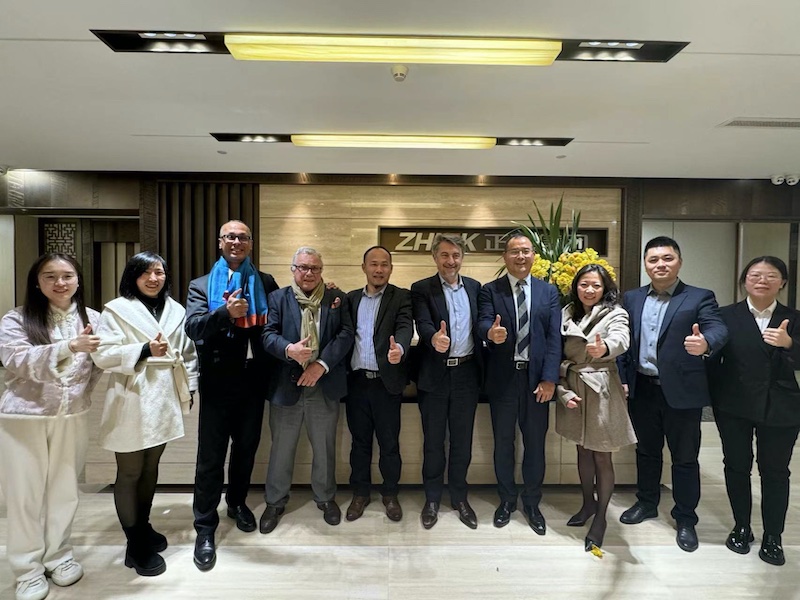
CARBIOS, (Euronext Growth Paris : ALCRB), a pioneer in the development and industrialization of biological technologies to reinvent the life cycle of plastic and textiles, and Zhink Group, one of China’s Top 500 Private Enterprises, specializing in two global industries, PET and textiles, announce today the signing of a joint Letter of Intent to build a biorecycling plant in China using CARBIOS’ revolutionary enzymatic depolymerization technology to serve the global market.
Emmanuel Ladent, CEO, CARBIOS (fifth from right) and Zhu GuoYang, President of Zhink Group (fourth from right) surrounded by their teams at Zhink Group’s Headquarters in Hangzhou © 2024 CARBIOS


This agreement officializes collaboration towards a long-term partnership in view of a first licensing contract to build a plant with a minimum annual processing capacity of 50k tons of prepared PET waste and would contribute to accelerating a circular economy for plastic and textiles. China, as the leading producer of PET in the world, is a key market for CARBIOS, and this agreement would establish a presence in this dominant market.

China: the world’s largest PET producer

With 67 million tons of PET produced annually, representing 61% of global production[1], China is the world's largest PET producer. With regional and global demand for recycled PET growing, China also has the potential to take the lead in recycled PET (r-PET) production. In 2021, 58% of the world’s r-PET was consumed in Asia (with 38% in China[2]) underscoring this region’s importance both as a major producer and consumer.

Furthermore, China is a key transformer of PET into resins and fibers used in numerous applications in the packaging and textile industries. Most notably, China is the primary country for transforming PET into fiber, representing 78% of all PET fiber transformation in the world[3].

Sustainability and the “dual carbon” policies are considered as main drivers for the Chinese PET recycling industry. Click here to refer to the Government Guidelines to establish a waste recycling system.[4] 

[1] HIS Markit 2021, Market Research Future 2021

[2] HIS Markit 2021, Market Research Future 2021

[3] HIS Markit 2021, Market Research Future 2021

[4] https://english.www.gov.cn/policies/latestreleases/202402/09/content_WS65c5ea15c6d0868f4e8e3e8a.html


Strategic partnership for Zhink and CARBIOS

For Zhink, the strategic focus is on the development of two global industries, PET and textiles, and to be a leader with sustainable competitiveness. Zhink is a major actor within the PET market with an annual production of 3 million tons of PET, serving domestic and global markets. CARBIOS has developed a revolutionary enzymatic depolymerization technology that enables efficient and solvent-free recycling of PET plastic and textile waste into virgin-like products. The initial agreement between the two groups would allow Zhink to increase its recycled PET capacities and meet its sustainable competitiveness objectives by offering r-PET from enzymatic recycling: a circular recycling solution that can process all types of PET waste including hard-to-recycle waste (such as opaque and colored bottles, multilayer food trays and textile waste) while reducing CO2 emissions by 57%[1] compared with virgin PET production. For CARBIOS, this agreement marks a significant step in the deployment of its technology worldwide and roll-out of its licensing model to achieve its ambition to become a leading technology provider in the recycling of PET by 2035. This Asia-based plant under license by Zhink would come in addition to the world’s first industrial-scale enzymatic PET recycling plant which is currently under construction in Longlaville, France.

[1] Database ecoinvent 3.8; French scenario, taking into account the detour of 50% of PET waste from conventional end-of-life. Virgin PET: 2.53 kg CO2/kg (cradle to gate)


A milestone for CARBIOS’ China market entry

The opening of official discussions with Zhink for a licensing agreement marks an important milestone in CARBIOS’ market entry into China. Since its inception, CARBIOS has proactively protected its innovations in all key regions of interest. With China considered as a major market, all of CARBIOS’ families of patents[1] own one or more titles in this country. For its PET biorecycling technology, CARBIOS currently has 28 titles in force in China covering both the industrial process and the enzymes used (including variants that will be used in the industrial process). 

[1] 1 innovation = 1 family of patents

"There is great momentum in China to accelerate the circular economy and meet its target of carbon neutrality by 2060. The technology developed by CARBIOS makes perfect sense in this context: capable of recycling all types of PET waste, it promotes a circular economy with high-quality products and significantly reduces the carbon footprint of industries. As a leader in PET production, Zhink is considered as a key partner for introducing our technology into China and will stimulate our international deployment," says Emmanuel Ladent, CEO of CARBIOS

"For Zhink, the strategic focus is on the development of two global industries, PET and textiles, and to be a leader in the industry with sustainable competitiveness. We are actively promoting our subsidiaries to develop our PET recycling portfolio and are very interested in CARBIOS’ revolutionary biorecycling technology to reduce carbon emissions", adds Zhu Guoyang, President of Zhink Group.

Tina Sejersgård Fanø, Executive Vice President, Planetary Health Biosolutions, Novonesis, comments: "With a 20-year presence in China and a solid R&D and manufacturing footprint in the region, Novonesis is keen to share its local know-how for the successful implementation of CARBIOS. Novonesis has a strong long-term partnership with CARBIOS, and an exclusive one for the production of its patented enzymes for PET biorecycling plants under license. We are ready to meet CARBIOS’ needs for future licensing projects in the region and beyond".



More News from CARBIOS

#Recycling / Circular Economy

Carbios confirms Longlaville plant in France following financing progress

Carbios has reaffirmed its plans to build its Longlaville plant in France within a project financing framework, targeting the start of production in the first half of 2028. The company also reports a solid cash position of around €60 million at the end of 2025 and has appointed Benoît Grenot as Deputy Chief Executive Officer to support the execution of its strategic projects.

#Recycled Fibers

CARBIOS and Wankai sign strategic PET biorecycling pact

CARBIOS (Euronext Growth Paris: ALCRB) and Wankai New Materials (“Wankai”), a listed subsidiary of Zhink Group, the 3rd largest PET producer in China and 4th worldwide, announce the signing of the definitive agreement establishing a strategic partnership for the industrial rollout of CARBIOS’s PET biorecycling technology in Asia. The first milestone will be the construction of a PET biorecycling plant in China.

#Recycled Fibers

CARBIOS and Wankai plan 1 million tonnes of PET biorecycling capacity in Asia

CARBIOS and Wankai New Materials, a subsidiary of Zhink Group, are committed to the large-scale deployment of CARBIOS’ PET biorecycling technology in Asia, with the first step being the construction of a PET biorecycling plant in China.

#Recycling / Circular Economy

CARBIOS presents its 2025 half-year results and confirms its objective to build a PET biorecycling plant, with a revised timeline

CARBIOS (Euronext Growth Paris: ALCRB), a pioneer in the development and industrialization of biological technologies aimed at reinventing the lifecycle of plastics and textiles, today announces its 2025 half-year results and confirms its objective to build a PET biorecycling plant in Longlaville, with a revised timeline.

More News on Recycling / Circular Economy

#Recycling / Circular Economy

Reju secures €135 Million in Dutch NIKI Funding for industrial-scale textile-to-textile regeneration hub at Chemelot Industrial Park, the Netherlands

Reju™, the progressive textile-to-textile regeneration company, has been awarded €135 million in funding under the Netherlands’ Nationale Investeringsregeling Klimaatprojecten Industrie (NIKI) program. The funding will support Reju’s planned industrial-scale Regeneration Hub at Chemelot Industrial Park in Sittard-Geleen, covering both the investment phase and ongoing operations, and represents a critical milestone on the path toward final investment decision.

#Recycling / Circular Economy

eeden is now a Canopy partner

eeden is committed to enable circular textiles by developing recycling technologies that turn textile waste into valuable raw materials. But the commitment goes further – eeden advocates for supply chain solutions that uphold responsible environmental and ethical standards, protecting global ecosystems including Ancient and Endangered Forests.

#Recycling / Circular Economy

Infinited Fiber Company’s environmental permit for Kemi advances to statutory appeal phase

Infinited Fiber has reached an important regulatory milestone in Finland, as the environmental permit process for a potential facility in Kemi has progressed to the statutory appeal phase.

#Recycling / Circular Economy

ABB and Syre partner to explore technologies for industrial-scale textile recycling

ABB has signed a Memorandum of Understanding (MoU) with Swedish textile impact company Syre to jointly explore technologies to support the development of Syre’s first textile-to-textile recycling plant in Vietnam. The agreement establishes a framework for collaboration to investigate how ABB’s automation, electrification and digital technologies could contribute to safe, efficient and scalable operations. It will also explore how these capabilities could further optimize process and quality control performance as Syre advances its ambition to produce circular polyester at industrial scale.

Latest News

#Raw Materials

New study shows low environmental impact by Cotton made in Africa Organic Cotton from Tanzania

Today, the Aid by Trade Foundation (AbTF) is announcing the results of a comprehensive life-cycle analysis (LCA) for cotton produced in Tanzania under the Cotton made in Africa Organic (CmiA Organic) standard. The study emphasises the small ecological footprint of CmiA Organic verified cotton. This can largely be traced back to the absence of synthetic pesticides, artificial fertilisers, and artificial irrigation. Consequently, CmiA Organic cotton can help the textile industry meet regulatory requirements as well as science-based targets. The results also show that the consequences of climate change threaten the livelihoods of these cotton farmers, even though the type of agriculture they practise barely contributes to climate change.

#Raw Materials

Better Cotton Initiative strengthens regenerative focus in standard update

The Better Cotton Initiative (BCI) has strengthened the regenerative focus of its field-level standard with the launch of a new version of its Principles & Criteria (P&C), which marks the next step in the organisation’s journey to becoming a regenerative standards system.

#Man-Made Fibers

Selenis and Kintra Fibers partner to scale 100% bio-based synthetic fiber technology

Selenis, a leading global specialty polyester manufacturer, today announced a strategic manufacturing partnership with materials science company Kintra Fibers to scale Kintra’s patented fiber-grade PBS resin - a 100% bio-based and biodegradable material designed for textile applications.

#Functional Fabrics

PERFORMANCE DAYS proves its relevance as the industry’s key meeting point

Held on March 18–19, 2026, PERFORMANCE DAYS once again confirmed its position as a leading international platform for functional textiles. A total of 3.366 trade visitors and around 560 exhibitors gathered in Munich, with the event already kicking off successfully on DAY 0, which received highly positive feedback for its interactive format. Despite challenging conditions caused by the public transport strike in Munich, the event saw strong attendance and a consistently high level of activity across both exhibition days.

TOP