[pageLogInLogOut]

#Recycling / Circular Economy

New material recovery facility opened in Banyuwangi under project STOP’s expansion program
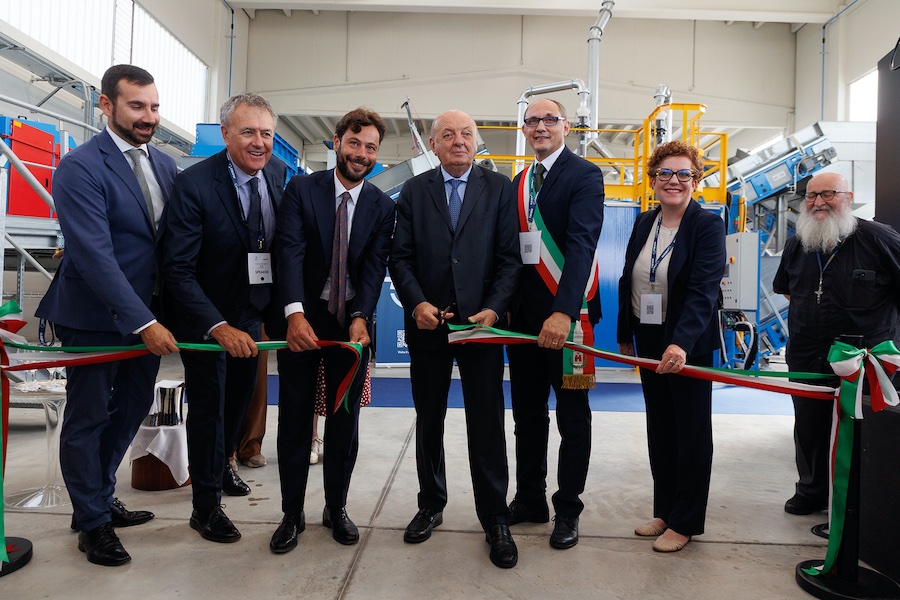
Government representatives and Project STOP Partners - From left to right: Ministry staff, Anton Wolfsberger - Vice President Global Packaging & Circular Economy at Borouge, Rofi Alhanif Assistant Deputy for Waste and Waste Management at Coordinating Ministry of Maritime and Investment, Laura Gonzales - Legal Resident Officer at USAID, Tomsi Tohir - Inspectorate General of the Ministry of Home Affairs, Rut Kruger Giverin – Ambassador of Norway in Indonesia, Abdullah Azwar Anas - Minister for Empowerment of State Apparatus for Bureaucratic Reform, Ipuk Fiestiandani - Banyuwangi Regent, Markus Horcher - Director Sustainability & Public Affairs at Borealis, Anthony Berthold Manager Project STOP at Borealis, Widharmika Agung - Partner at Systemiq
© Project STOP
On Saturday, 16 September 2023, Project STOP and Banyuwangi Regent, Ipuk Fiestiandani, inaugurated one of Indonesia’s largest Material Recovery Facilities (MRF) in Songgon Municipality. Built in collaboration with the regional government of Banyuwangi, the facility is a significant milestone towards establishing Indonesia’s premier regency-led circular waste management system.

• Inauguration of new material recovery facility (MRF) in Songgon Municipality, Banyuwangi, East Java represents a key milestone towards building Indonesia’s first Regency-led circular waste management system as part of the Project STOP Banyuwangi Hijau expansion plan.

• One of the largest of its kind in Indonesia to date, the new MRF will manage waste collection and sortation from households in the region, including materials to be recycled, with a daily capacity to process up to 84 tonnes of waste.

• The MRF will collect all waste, including 3,300 tonnes of plastic waste per year, at full scale by 2025.


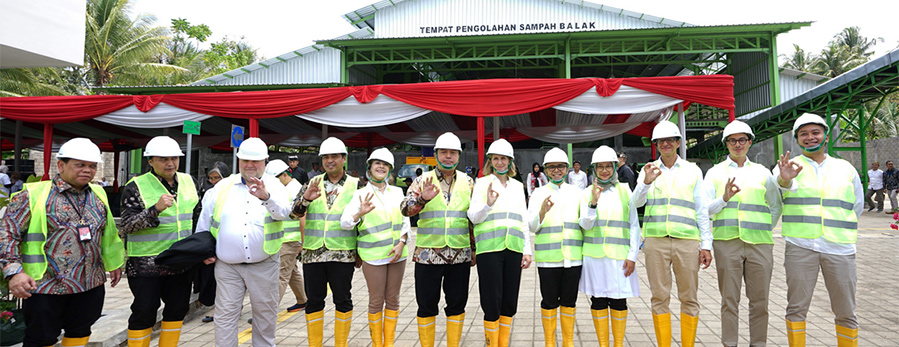
From left to right: Laura Gonzales - Legal Resident Officer at USAID, Tomsi Tohir - Inspectorate General of the Ministry of Home Affairs, Rut Kruger Giverin - Norway Ambassador for Indonesia, Markus Horcher - Director Sustainability & Public Affairs at Borealis, Abdullah Azwar Anas - Minister for Empowerment of State Apparatus for Bureaucratic Reform, Rofi Alhanif - Assistant Deputy for Waste and Waste Management at Coordinating Ministry of Maritime and Investment, of Waste and Widharmika Agung-Partner at Systemiq.<br />
© Project STOP
From left to right: Laura Gonzales - Legal Resident Officer at USAID, Tomsi Tohir - Inspectorate General of the Ministry of Home Affairs, Rut Kruger Giverin - Norway Ambassador for Indonesia, Markus Horcher - Director Sustainability & Public Affairs at Borealis, Abdullah Azwar Anas - Minister for Empowerment of State Apparatus for Bureaucratic Reform, Rofi Alhanif - Assistant Deputy for Waste and Waste Management at Coordinating Ministry of Maritime and Investment, of Waste and Widharmika Agung-Partner at Systemiq. © Project STOP


Key highlights:

• The MRF will manage waste collection and sortation as well as materials to be recycled from households in the region.

• Its daily processing capacity is up to 84 tonnes of waste.

• Anticipated to create approximately 200 jobs by 2025 and service over 250,000 residents.

• By 2025, the MRF aims to collect annually 23,000 tonnes of waste, including 3,300 tonnes of plastic.

Co-founded by Borealis and Systemiq, with broad support from National and Regional Governments, international institutions, academia and private sector, focuses on delivering measurable impact on the ground. Since its inception in 2017, it has steadily extended across the entire Banyuwangi Regency. The new MRF is part of its Banyuwangi Hijau expansion plan, aiming to positively impact the lives of up to 2 million individuals, across all Project STOP city and regional partnerships, create 1,000 full-time jobs and annually collect 230,000 tonnes of waste, including 25,000 tonnes of plastic.

“Plastic leakage to sea, land and air can be prevented by working closely with all stakeholders. Through the Project STOP Banyuwangi initiative, we work hand-in-hand to make tangible improvements to the health of the local environment and people living in Banyuwangi,” said Ipuk Fiestiandani, Banyuwangi Regent. “We hope this infrastructure can establish the implementation of a circular waste management system and become a benchmark to other regions in Indonesia.”


For the MRF’s construction, the Banyuwangi Regency Government allocated more than 1.5 hectares of land in the first phase of the Project in Banyuwangi. The circular waste system is designed to support the implementation of the Banyuwangi government’s Solid Waste Master Plan, co-developed by Banyuwangi Agencies, the Clean Oceans through Clean Communities (CLOCC) Program and Project STOP.

Waste collection worker & vehicle<br />
© Project STOP
Waste collection worker & vehicle © Project STOP


"Since we founded Project STOP together with Systemiq in 2017, we established waste management systems in Muncar, Pasuruan and Jembrana as first phase. Based on the learnings done in the first three cities, we will now expand the reach of Project STOP to the Banyuwangi region. Beyond that, we hope that Project STOP serves as inspiration and blueprint for other projects to accelerate the establishment of a circular economy and to avoid waste leakage into the environment,” commented Thomas Gangl, Borealis CEO.

“This second Project STOP Program in Banyuwangi underscores our enduring partnership with the Regency and other local government agencies, with increased impact and benefits for the local environment and population. We intend this to be a beacon for Regencies across the country and thank our funders and partners for their ongoing commitment,” said Ben Dixon, Head of Materials and Circular Economy at Systemiq.

Behavior Change Campaign volunteers explaining the importance of household waste separation<br />
© Project STOP
Behavior Change Campaign volunteers explaining the importance of household waste separation © Project STOP


The state-of-the-art MRF is equipped to handle both organic and inorganic waste. Organic waste will be processed into compost, while inorganic waste will be sorted and transferred to the recycling industry.

Project STOP Banyuwangi’s achievements can be largely attributed to its successful collaborations and close partnerships with various Indonesian government bodies, such as the Coordinating Ministry for Maritime and Investment Affairs (CMMAI), the National Ministry of Environment and Forestry (MoEF), the Banyuwangi regency government and Project STOP Strategic Partners including the Norwegian Government, Accenture, Borouge, USAID and Partnering for Green Growth and the Global Goals (P4G).




More News from TEXDATA International

#Techtextil 2026

Performance Apparels: Functional textiles drive innovation at Techtextil 2026

From high-performance fibres and advanced membranes to smart textiles and sustainable material concepts – functional apparel is becoming one of the most dynamic innovation fields in technical textiles. At Techtextil 2026, exhibitors demonstrate how new materials, finishing technologies and digital functions are shaping the next generation of protective, workwear and outdoor systems.

#Texprocess 2026

Texprocess 2026: Automation, digitalisation and AI reshape textile processing

Investment decisions in textile processing have become increasingly complex. Rising energy prices, labour shortages and geopolitical uncertainties are forcing companies to prioritise technologies that deliver measurable improvements in efficiency and process stability. This applies not only to apparel production, but also to the processing of technical textiles and high-performance materials. Modernisation projects are therefore being evaluated more selectively – but the pressure to upgrade production systems continues to grow. Texprocess 2026 reflects this tension between cautious investment behaviour and increasing technological demand.

#Techtextil 2026

Textile Chemicals & Dyes: Innovation in Textile Chemistry moves into focus at Techtextil 2026

From PFAS-free finishes and water-saving dyeing technologies to advanced coatings and recycling-compatible formulations, innovation in textile chemistry is accelerating across the industry. Reflecting this development, Techtextil 2026 introduces Textile Chemicals & Dyes as a dedicated product segment, highlighting the growing role of chemical solutions in shaping the next generation of technical textiles.

#Recycling / Circular Economy

textile.4U publishes special edition “Top 100 Textile Recycling Companies 2025”

With a comprehensive 176-page special edition, textile.4U is dedicating its latest issue entirely to one of the most dynamic and influential topics in today’s textile industry: textile recycling. The new issue, published exclusively in high-quality print, presents the Top 100 textile recycling companies researched and selected by TexData – organizations that already play a key role in the transition to circular textiles or are expected to have a significant impact in the near future.

More News on Recycling / Circular Economy

#Recycling / Circular Economy

Solving the Feedstock Gap: Unlocking Post-consumer Feedstocks for Textile-to-Textile Recycling in Europe

Fashion for Good launches Project FAE (Feedstock Activation Europe) to develop the sorting and pre-processing infrastructure needed to channel non-rewearable post-consumer textiles into textile-to-textile (T2T) recycling at scale. The project is a practical response to one of the most pressing problems in textile circularity: making post-consumer waste a viable, commercially competitive raw material for recyclers.

#Techtextil 2026

BASF at Techtextil 2026: Helping to shape the future of the textile industry with tangible solutions

At the leading international trade fair for technical textiles and nonwovens from April 21 to 24, 2026 at the Messe Frankfurt, BASF will present numerous solutions and new projects in the textile sector to customers and partners at booth B 68 in hall 11.0. The focus is on product innovations and future-oriented technologies.

#Recycled Fibers

RE&UP partners with Madewell and ISKO on textile-to-textile denim capsule

RE&UP Recycling Technologies is accelerating the shift toward a closed-loop textile economy through a collaboration with American denim brand Madewell and global fabric manufacturer ISKO. By transforming approximately 20,000 pairs of post-consumer jeans into recycled feedstock for a textile-to-textile denim capsule, RE&UP demonstrates the commercial viability of circular systems in the denim sector.

#Recycled Fibers

Syre and JEPLAN Announce Strategic Partnership to Accelerate Textile-to-Textile Recycling

JEPLAN, INC. the Japanese pioneer developing and operating chemical recycling technologies for circularity in packaging and textiles, and Syre, the textile impact company on a mission to hyperscale textile-to-textile recycling, announced today a strategic partnership. Together, the companies aim to extensively accelerate the timeline towards commercialization of next generation textile-to-textile polyester recycling technology.

Latest News

#Techtextil 2026

SAHM Winding Solutions and Vandewiele Automation present integrated automation solution for winding processes

For the first time at the Techtextil trade fair in Frankfurt am Main, Germany (21 - 26 April), SAHM Winding Solutions (Hallo 12.0. / Booth 95) and Vandewiele Automation will be showcasing their combined automation expertise for industrial winding processes. Under the motto “Combining Automation. Maximizing Flow”, the two companies will demonstrate how automated package handling and robot-assisted yarn knotting can be integrated into a continuous production flow.

#Recycled Fibers

UNIFI celebrates recycled and circular Innovation with ninth annual REPREVE® Champions of Sustainability Awards

Unifi, Inc. (NYSE: UFI), the makers of REPREVE® and one of the world’s leading innovators in recycled and synthetic yarns, today announced the winners of its ninth annual REPREVE Champions of Sustainability Awards, recognizing brands and mills that are advancing circularity and responsible manufacturing across the global textile industry.

#Man-Made Fibers

Teijin Frontier announces new Stretch Polyester yarn offering exceptional compatibility with high-performance Polyester materials

Teijin Frontier Co., Ltd. announced today that it has developed a new stretch polyester yarn that offers new opportunities to create comfortable, all- polyester fabrics for sports and outdoor wear. The new polyester yarn demonstrates exceptional compatibility with high-performance polyester materials. Further, Teijin Frontier’s proprietary polymer design and spinning technology impart excellent elasticity to the new yarn. In turn, this yarn adds stretchability and recovery to the advanced functionality and excellent texture of high-performance polyester materials.

#Man-Made Fibers

Lenzing commissions 14 MW power‑to‑heat facility, strengthening grid stability and heat management

The Lenzing Group has successfully commissioned a new power‑to‑heat (P2H) facility with an electrical capacity of 14 megawatts. The installation converts renewable electricity directly into process heat, is fully integrated into the existing heat network at the industrial site, and represents a key building block for a fossil‑free heat supply. As project partner, VERBUND was responsible for the energy‑market integration and will operate the facility for balancing energy marketing, enabling it to respond flexibly to short‑term fluctuations in the power grid.

TOP