[pageLogInLogOut]

#Recycling / Circular Economy

Researchers separate cotton from polyester in blended fabric
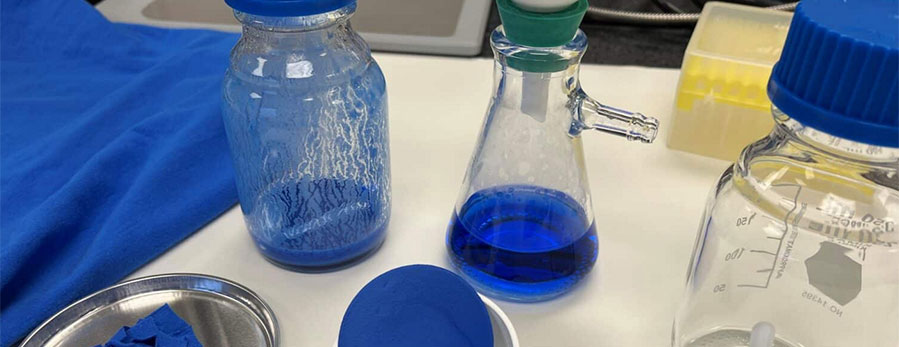
A cotton knit fabric dyed blue and washed 10 times to simulate worn garments is enzymatically degraded to a slurry of fine fibers and "blue glucose" syrup that are separated by filtration - both of these separated fractions have potential recycle value. Credit: Sonja Salmon.
In a new study, North Carolina State University researchers found they could separate blended cotton and polyester fabric using enzymes – nature’s tools for speeding chemical reactions. Ultimately, they hope their findings will lead to a more efficient way to recycle the fabric’s component materials, thereby reducing textile waste.

However, they also found the process need more steps if the blended fabric was dyed or treated with chemicals that increase wrinkle resistance.

“We can separate all of the cotton out of a cotton-polyester blend, meaning now we have clean polyester that can be recycled,” said the study’s corresponding author Sonja Salmon, associate professor of textile engineering, chemistry and science at NC State. “In a landfill, the polyester is not going to degrade, and the cotton might take several months or more to break down. Using our method, we can separate the cotton from polyester in less than 48 hours.”

According to the U.S. Environmental Protection Agency, consumers throw approximately 11 million tons of textile waste into U.S. landfills each year. Researchers wanted to develop a method of separating the cotton from the polyester so each component material could be recycled.

In the study, researchers used a “cocktail” of enzymes in a mildly acidic solution to chop up cellulose in cotton. Cellulose is the material that gives structure to plants’ cell walls. The idea is to chop up the cellulose so it will “fall out” out of the blended woven structure, leaving some tiny cotton fiber fragments remaining, along with glucose. Glucose is the biodegradable byproduct of degraded cellulose. Then, their process involves washing away the glucose and filtering out the cotton fiber fragments, leaving clean polyester.

“This is a mild process – the treatment is slightly acidic, like using vinegar,” Salmon said. “We also ran it at 50 degrees Celsius, which is like the temperature of a hot washing machine.

“It’s quite promising that we can separate the polyester to a clean level,” Salmon added. “We still have some more work to do to characterize the polyester’s properties, but we think they will be very good because the conditions are so mild. We’re just adding enzymes that ignore the polyester.”


They compared degradation of 100% cotton fabric to degradation of cotton and polyester blends, and also tested fabric that was dyed with red and blue reactive dyes and treated with durable press chemicals. In order to break down the dyed materials, the researchers had to increase the amount of time and enzymes used. For fabrics treated with durable press chemicals, they had to use a chemical pre-treatment before adding the enzymes.

“The dye that you choose has a big impact on the potential degradation of the fabric,” said the study’s lead author Jeannie Egan, a graduate student at NC State. “Also, we found the biggest obstacle so far is the wrinkle-resistant finish. The chemistry behind that creates a significant block for the enzyme to access the cellulose. Without pre-treating it, we achieved less than 10% degradation, but after, with two enzyme doses, we were able to fully degrade it, which was a really exciting result.”

Researchers said the polyester could be recycled, while the slurry of cotton fragments could be valuable as an additive for paper or useful addition to composite materials. They’re also investigating whether the glucose could be used to make biofuels.

“The slurry is made of residual cotton fragments that resist a very powerful enzymatic degradation,” Salmon said. “It has potential value as a strengthening agent. For the glucose syrup, we’re collaborating on a project to see if we can feed it into an anaerobic digester to make biofuel. We’d be taking waste and turning it into bioenergy, which would be much better than throwing it into a landfill.”

The study, “Enzymatic textile fiber separation for sustainable waste processing,” was published in Resources, Environment and Sustainability. Co-authors included Siyan Wang, Jialong Shen, Oliver Baars and Geoffrey Moxley. Funding was provided by the Environmental Research and Education Foundation, Kaneka Corporation and the Department of Textile Engineering, Chemistry and Science at NC State. 



More News from TEXDATA International

#Techtextil 2026

Textile Chemicals & Dyes: Innovation in Textile Chemistry moves into focus at Techtextil 2026

From PFAS-free finishes and water-saving dyeing technologies to advanced coatings and recycling-compatible formulations, innovation in textile chemistry is accelerating across the industry. Reflecting this development, Techtextil 2026 introduces Textile Chemicals & Dyes as a dedicated product segment, highlighting the growing role of chemical solutions in shaping the next generation of technical textiles.

#Recycling / Circular Economy

textile.4U publishes special edition “Top 100 Textile Recycling Companies 2025”

With a comprehensive 176-page special edition, textile.4U is dedicating its latest issue entirely to one of the most dynamic and influential topics in today’s textile industry: textile recycling. The new issue, published exclusively in high-quality print, presents the Top 100 textile recycling companies researched and selected by TexData – organizations that already play a key role in the transition to circular textiles or are expected to have a significant impact in the near future.

#Recycling / Circular Economy

Responsible Textile Recovery Act of 2024 signed by Governor

Senator Josh Newman (D-Fullerton) is proud to announce that Senate Bill 707 (SB 707), the Responsible Textile Recovery Act of 2024, has been signed into law by the Governor of California, Gavin Newsom. This groundbreaking legislation establishes the country’s first Extended Producer Responsibility (EPR) textile recycling program, marking a significant step forward in the state’s efforts to combat waste and promote sustainability.

#Textiles & Apparel / Garment

Modtissimo promotes sustainability with 28 coordinates in the Green Circle

Modtissimo is proving more and more to be a textile and clothing show that delivers the latest innovations in the area of sustainability, with the iTechStyle Green Circle being the main showcase for companies' creations. In this 60+4 edition, taking place on 12 and 13 September, 28 coordinates will be exhibited in a section organised by CITEVE and curated by Paulo Gomes.

More News on Recycling / Circular Economy

#Recycling / Circular Economy

AI Circular Economy Conference 2026 fuels innovation at the intersection of AI and Circular Economy

The AI Circular Economy Conference 2026, organised by nova-Institute, brought together 116 participants from 15 countries in Cologne and online to explore the transformation of the chemical and materials industry supported and accelerated by artificial intelligence. During the two-day event, leading experts from industry, research, start-ups and the investment community discussed how AI can maximise the potential of renewable carbon creating efficient circular value chains. The conference featured 24 presentations and multiple panel discussions, highlighting the growing convergence of digital technologies and circular material systems. It demonstrated how artificial intelligence is progressing from the experimental stage to real industrial implementation within the circular economy.

#Recycled_Fibers

Circ deepens access to recycled fibers with Xinxiang Bailu Chemical Fiber Co., Ltd. partnership agreement

Circ®, a global leader in textile‑to‑textile recycling, today announced a new partnership agreement with Xinxiang Bailu Chemical Fiber Co., a Canopy Dark Green Shirt producer and one of the world’s leading producers of viscose filament. The agreement marks a significant step in Circ’s continued expansion in China and strengthens its position within the country’s rapidly evolving circular textile ecosystem; further supporting Circ’s ability to supply recycled fibers near existing fashion supply chains.

#Recycled_Fibers

Worn Again Technologies unveils the Accelerator

Worn Again Technologies unveils the Accelerator, the next major step towards commercialising its pioneering Textile-to-Fibre recycling process and proving the technical and economic feasibility of polycotton recycling.

#Recycling / Circular Economy

Textile‑to‑textile recycling leader Circulose joins Spinnova’s ecosystem to accelerate technology scale‑up

Textile‑to‑textile recycling leader Circulose joins Spinnova’s ecosystem (consortium) to help advance the scale‑up of Spinnova’s technology. Spinnova has actively sought partners to accelerate commercial scale‑up, and Circulose, as a key player in textile recycling, strengthens the ecosystem by providing a raw material that is in high demand across the industry.

Latest News

#Techtextil 2026

DIENES at Techtextil 2026: Flexible pilot lines for bio-based fiber development

The growing relevance of bio-based materials in technical textiles is accompanied by increasing demands for reproducibility, high-quality data, and scalable process routes. Especially when working with cellulose and its derivatives, chitosan, lignin-based approaches, or bio-based PAN as a carbon-fiber precursor, R&D teams face variable feedstock quality, tighter process windows, and the need for reliable comparability across trials. This calls for flexible, data-driven experimental setups that can be reconfigured efficiently when recipes, solvents, and raw-material batches change.

#Texprocess 2026

Gunold showcases embroidery product range and services at Texprocess

At Texprocess 2026, GUNOLD will present numerous hands-on examples related to embroidery in Hall 8, Booth E20. The focus is on creative embroidery designs as well as the extensive product range of threads, nonwovens, and accessories for embroidery and embellishment. “Trade visitors can once again look forward to many new and creative embroidery designs. Of course, we will also showcase the matching products required to bring these ideas to life,” announces Marketing Manager Stephan Gunold.

#Nonwovens

EDANA and more than 70 industry organisations call for consistent exemptions in EU packaging regulation

EDANA, together with more than 70 industry associations and organisations, has issued a joint statement commenting on the European Commission’s Delegated Act under Article 29 of the Packaging and Packaging Waste Regulation (PPWR).

#Raw Materials

A Powerful Opening: Global thought leaders launch the International Cotton Conference Bremen

The International Cotton Conference Bremen will open on 25 March 2026 in the Parliament building of the Free Hanseatic City of Bremen with a keynote session of exceptional calibre. Distinguished international experts will set the stage for the conference by offering incisive perspectives on the most pressing challenges and the defining trends shaping the future of the global cotton trade. Their insights will span a broad spectrum — from geopolitically driven disruptions affecting global supply chains to the opportunities emerging from innovation-led agriculture capable of supporting a growing world population. Together, these opening keynotes will frame the dialogue of the conference, highlighting both the complexity of today’s market environment and the pathways toward a resilient and forward-looking cotton sector.

TOP