[pageLogInLogOut]

#Recycling / Circular Economy

Digital solutions for the circular economy
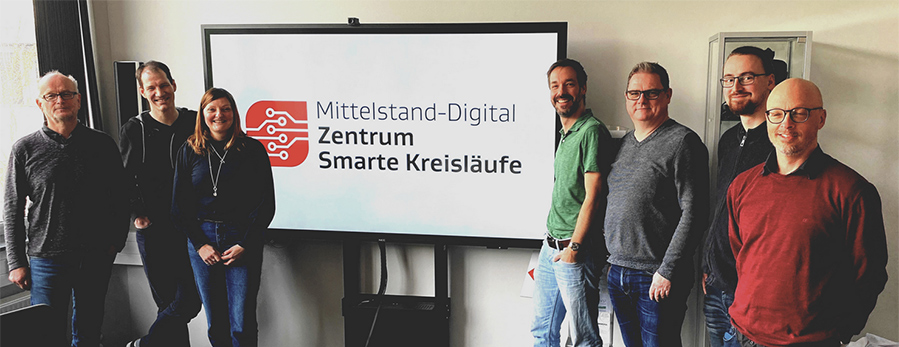
The team of the Mittelstand-Digital Center at DITF: Project Manager Alexander Artschwager, Dr. Heiko Matheis, Christine Schoch, Bastian Baesch, Christoph Riethmüller, Tobias Hecht, Dr. Michael Haupt (left to right). Photo: DITF
Small and medium-sized enterprises are facing big tasks: Production should be sustainable and allow for later recycling, work and qualification are increasingly taking place digitally, and supply chains must be fully traceable. The German Institutes of Textile and Fiber Research (DITF) support companies in the introduction of these future-relevant technologies.

Partners are ITA Institut für Textiltechnik of RWTH Aachen University, Sächsisches Textilforschungsinstitut in Chemnitz (STFI) and DER MITTELSTANDSVERBUND - ZGV. The Gesamtverband textil+mode management is in charge of management. In Denkendorf at the DITF, showcases about digital engineering with a focus on supply chain, circular economy and artificial intelligence can be experienced by all sectors.

To this end, a demonstrator is being set up to provide transparent proof along the entire supply chain from fiber to end customer. A quick check tool will then support SMEs in quickly assessing their supply chain risks and provide them with an initial overview of their ecological footprint.

The Mittelstand-Digital Zentrum Smarte Kreisläufe is part of Mittelstand-Digital.


What is Mittelstand-Digital?

Mittelstand-Digital offers guidance for small and medium-sized enterprises and the skilled crafts as they embrace the digital transformation, informs them about the opportunities and challenges of digitalization and provides financial support for digitalization projects. The Federal Ministry for Economic Affairs and Climate Action makes it possible for all of these services to be rendered free of charge.

For more information visit http://www.mittelstand-digital.de.

More News from Deutsche Institute für Textil- und Faserforschung Denkendorf

#Research & Development

More safety and comfort for protective clothing thanks to auxetic fabrics

When everyday materials are pulled, they stretch or elongate in the direction of the pull and become narrower in cross-section. We can also observe this property in two-dimensional textiles. Auxetic structures behave differently here. They have the striking property of not changing under tensile stress or even increasing their width or thickness. These properties are advantageous, for example, in protective textiles or textile filter media. The DITF are researching auxetic fabrics for various applications.

#Research & Development

Panty liners prevent bacterial vaginosis

Worldwide, almost one third of women of childbearing age suffer from bacterial vaginosis. This is when the sensitive microbiome of the vagina becomes unbalanced. Such a disorder of the vaginal flora can cause urogenital infections, abscesses on the ovaries or fallopian tubes or premature births. This significantly increases the risk of infertility in women and of contracting a sexually transmitted disease or HIV.

#Research & Development

DITF send a signal for climate protection

The German Institutes of Textile and Fiber Research Denkendorf (DITF) have successfully implemented extensive investments in photovoltaic systems at their site in Denkendorf. The systems installed on the roofs of the buildings and covered parking lots have a total installed capacity of 840 kilowatt peak (kWp). The DITF invested 1.6 million euros in this with the support of the state of Baden-Württemberg. The system was ceremonially put into operation on September 17, 2025.

#Research & Development

4.2 million Euros for research into textile recycling

Around the world, used textiles are still rarely recycled and pile up into huge mountains of waste. A recent study by the Boston Consulting Group (BCG) drew attention to this problem. However, the low recycling rate is also due to the fact that only a small percentage of used textiles are actually suitable for recycling into high-quality materials and for demanding applications. The German Institutes of Textile and Fiber Research Denkendorf (DITF) are addressing this problem with their research.

More News on Recycling / Circular Economy

#Recycled_Fibers

Reju announces site selection for French Regeneration Hub in Lacq advancing Europe’s circular textile infrastructure

Reju, the textile-to-textile regeneration company based in France, announces the site selection for an industrial sized Regeneration Hub, in Lacq, in the Pyrénées-Atlantiques, on the Induslacq platform. Reju, a Technip Energies owned company, is deepening its roots in France through the development of this new Regeneration Hub.

#Technical Textiles

Covestro showcases monomaterial concept in autonomous SUE People Mover

UE | STUDIOS has unveiled the fully autonomous electric minibus “Self-driving Urban E-Shuttle” (SUE), placing strong emphasis on sustainable material design. Developed within a project funded by the Federal Ministry for Economic Affairs and Energy (BMWE) and the European Union, the vehicle will begin public road testing this year. At the core of the concept is the consistent use of recyclable monomaterials to improve circularity at end of life.

#Recycled_Fibers

Circ announces New Fiber Club partners to accelerate commercial adoption of recycled textiles

Circ®, a global leader in textile‑to‑textile recycling, announced the scaling of its Fiber Club initiative. Building on the success of the inaugural program, Circ is bringing together a new group of brand partners: the lifestyle brand Madewell (under J.Crew Group), sustainable fashion brand Reformation, and European retailer C&A, alongside supply chain partners Lenzing and Linz Textil.

#Recycling / Circular Economy

Circulose restarts commercial-scale production at Ortviken plant in Sundsvall

Circulose today announced the restart of its commercial-scale production plant at Ortviken in Sundsvall, Sweden, marking a significant step in scaling next-generation materials for the global fashion industry. The company plans to resume production of CIRCULOSE®, a recycled pulp made entirely from discarded cotton textiles, in the fourth quarter of 2026.

Latest News

#Raw Materials

Esquel Group adds two new extra-long staple cotton varieties approved

Esquel Group’s Xinjiang Research & Development Center has successfully developed two new Sea Island cotton (Extra-Long-Staple cotton, ELS cotton) varieties named “Yuan Loong 37” and “Yuan Loong 42,” which have been officially approved and granted registration numbers. Both varieties have also obtained Plant Variety Rights certificates, marking another significant breakthrough for the Group in cotton breeding and commercial application.

#Weaving

Itema America acquires Palmetto Loom Reed, strengthening local manufacturing and service in the U.S.

Itema America, the U.S. subsidiary of Italy-based Itema Group, has acquired – through an Assets Purchase Agreement – Palmetto Loom Reed, a Greenville, South Carolina-based manufacturer of weaving reeds and one of the last remaining domestic producers of these precision components in the United States.

#Functional Fabrics

lululemon introduces Unrestricted Power™ — A new sensation for strength training

lululemon (NASDAQ: LULU) has unveiled Unrestricted Power™, a new innovation platform engineered for heavy lifts and demanding gym sessions. The assortment, which launches in North America, is backed by thousands of hours of research and development, providing secure support without compromising comfort and mobility, enabling a distraction-free fit built to match every move.

#Raw Materials

Aid by Trade Foundation reaches new milestones in supply chain transparency

The Aid by Trade Foundation (AbTF) is reaching new milestones as it leads the way towards greater physical traceability for Cotton made in Africa® (CmiA) cotton. With around 700 suppliers and producers in a total of 25 countries, the Aid by Trade Foundation has reached a new record number of partners who can trace CmiA cotton from the product back to its origin. This is more than double the previous year’s figure.

TOP