[pageLogInLogOut]

#Recycling / Circular Economy

Carbios doubles its number of granted patents in two years for its proprietary enzymatic technologies

Carbios (and its subsidiary Carbiolice) currently holds 336 titles worldwide divided into 53 patent families. In 2022, several titles protecting the proprietary PET-degrading enzymes were granted in countries of interest such as the United States and also in Asian countries including Indonesia, South Korea, China, Japan and India. Carbios has also obtained grants within its patent families protecting the biodegradable plastics production process, notably the masterbatch containing the enzyme or its production process.
  • At end 2022, Carbios has 336 titles worldwide divided into 53 patent families for its innovation in enzymatic recycling of PET plastics and fibers, and its PLA biodegradation technology
  • Carbios’ team of Intellectual Property experts is dedicated to protecting its innovations


Clermont-Ferrand, France, 1 March 2023 (6.45am CET). Carbios has doubled its number of issued patents since the last review published at the end of 2020[1].

“Over the past two years, we have mainly focused on strengthening the protection of our PET biorecycling process and its proprietary enzymes,” commented Lise LUCCHESI, Director of Intellectual Property at Carbios. “For the coming years, we will continue to consolidate the protection of this process, and that of our PLA biodegradation process, by filing new patent applications. We will also actively follow up on our filed patent applications in order to obtain granted patents.”

“Since the beginning of Carbios, the R&D and Intellectual Property departments have worked hand in hand to ensure maximum protection of our enzymes and processes,” commented Alain Marty, Chief Scientific Officer at Carbios. “These continued efforts to obtain extensive international protection are crucial to safeguard our innovations and ensure the industrial deployment of our technologies.”

Worldwide protection

Carbios is expanding its intellectual property portfolio in regions and countries where there is strong demand for its disruptive technologies (see Fig. 1), notably :

  • in Europe: 40 European titles, which could be granted in the 39 member states of the European Patent Organization
  • in North America: 41 titles in the United States and 23 in Canada
  • in Asia: 152 titles, including 37 in China, 27 in Japan and 24 in India


Carbios also has 14 patent applications that may be extended to other countries or regions of the world in the coming years.
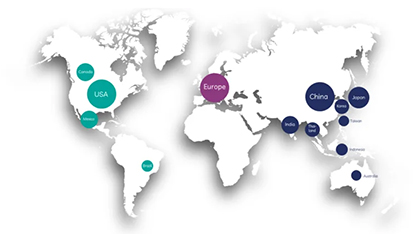


Fig 1. Carbios patent titles by geographic region © 2023 Carbios


“We are convinced that biological recycling is the most efficient and circular solution to degrade plastics,” stated Emmanuel LADENT, CEO of Carbios. “The protection of our enzymes and processes is at the heart of our work, and we have a dedicated Intellectual Property team within Carbios. From 2023, we will also focus our efforts on protecting innovation related to enzymatic degradation of other polymers.”

A dedicated Intellectual Property team

The Intellectual Property team at Carbios includes a Director (who is also a member of the Executive Committee) and two patent engineers specialized in the fields of biotechnology and polymer chemistry, one of whom is a representative before the European Patent Office. The team is supported by two external Intellectual Property consulting firms (Becker & Associés and Franck Tetaz Intellectual Property). Finally, an Intellectual Property Committee reports regularly to Carbios’ Board of Directors.
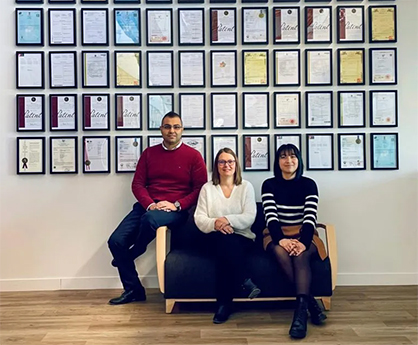
Fig 2. The Carbios Intellectual Property team in front of granted patents (l. to r. : Georges ZAKHIA, Lise LUCCHESI (Director) and Jade FESANCIEUX) © 2023 Carbios


[1] Cf. press release dated 14 January 2021



More News from TEXDATA International

#Texprocess 2026

Texprocess 2026: Automation, digitalisation and AI reshape textile processing

Investment decisions in textile processing have become increasingly complex. Rising energy prices, labour shortages and geopolitical uncertainties are forcing companies to prioritise technologies that deliver measurable improvements in efficiency and process stability. This applies not only to apparel production, but also to the processing of technical textiles and high-performance materials. Modernisation projects are therefore being evaluated more selectively – but the pressure to upgrade production systems continues to grow. Texprocess 2026 reflects this tension between cautious investment behaviour and increasing technological demand.

#Techtextil 2026

Textile Chemicals & Dyes: Innovation in Textile Chemistry moves into focus at Techtextil 2026

From PFAS-free finishes and water-saving dyeing technologies to advanced coatings and recycling-compatible formulations, innovation in textile chemistry is accelerating across the industry. Reflecting this development, Techtextil 2026 introduces Textile Chemicals & Dyes as a dedicated product segment, highlighting the growing role of chemical solutions in shaping the next generation of technical textiles.

#Recycling / Circular Economy

textile.4U publishes special edition “Top 100 Textile Recycling Companies 2025”

With a comprehensive 176-page special edition, textile.4U is dedicating its latest issue entirely to one of the most dynamic and influential topics in today’s textile industry: textile recycling. The new issue, published exclusively in high-quality print, presents the Top 100 textile recycling companies researched and selected by TexData – organizations that already play a key role in the transition to circular textiles or are expected to have a significant impact in the near future.

#Recycling / Circular Economy

Responsible Textile Recovery Act of 2024 signed by Governor

Senator Josh Newman (D-Fullerton) is proud to announce that Senate Bill 707 (SB 707), the Responsible Textile Recovery Act of 2024, has been signed into law by the Governor of California, Gavin Newsom. This groundbreaking legislation establishes the country’s first Extended Producer Responsibility (EPR) textile recycling program, marking a significant step forward in the state’s efforts to combat waste and promote sustainability.

More News on Recycling / Circular Economy

#Recycling / Circular Economy

AI Circular Economy Conference 2026 fuels innovation at the intersection of AI and Circular Economy

The AI Circular Economy Conference 2026, organised by nova-Institute, brought together 116 participants from 15 countries in Cologne and online to explore the transformation of the chemical and materials industry supported and accelerated by artificial intelligence. During the two-day event, leading experts from industry, research, start-ups and the investment community discussed how AI can maximise the potential of renewable carbon creating efficient circular value chains. The conference featured 24 presentations and multiple panel discussions, highlighting the growing convergence of digital technologies and circular material systems. It demonstrated how artificial intelligence is progressing from the experimental stage to real industrial implementation within the circular economy.

#Recycled_Fibers

Circ deepens access to recycled fibers with Xinxiang Bailu Chemical Fiber Co., Ltd. partnership agreement

Circ®, a global leader in textile‑to‑textile recycling, today announced a new partnership agreement with Xinxiang Bailu Chemical Fiber Co., a Canopy Dark Green Shirt producer and one of the world’s leading producers of viscose filament. The agreement marks a significant step in Circ’s continued expansion in China and strengthens its position within the country’s rapidly evolving circular textile ecosystem; further supporting Circ’s ability to supply recycled fibers near existing fashion supply chains.

#Recycled_Fibers

Worn Again Technologies unveils the Accelerator

Worn Again Technologies unveils the Accelerator, the next major step towards commercialising its pioneering Textile-to-Fibre recycling process and proving the technical and economic feasibility of polycotton recycling.

#Recycling / Circular Economy

Textile‑to‑textile recycling leader Circulose joins Spinnova’s ecosystem to accelerate technology scale‑up

Textile‑to‑textile recycling leader Circulose joins Spinnova’s ecosystem (consortium) to help advance the scale‑up of Spinnova’s technology. Spinnova has actively sought partners to accelerate commercial scale‑up, and Circulose, as a key player in textile recycling, strengthens the ecosystem by providing a raw material that is in high demand across the industry.

Latest News

#Techtextil 2026

Gebr. Otto highlights versatility at Techtextil with regional supply chains, yarn innovations and new hygiene segment

At this year’s Techtextil, Gebr. Otto places its versatility at the center of its presentation. In addition to spinning, twisting and dyeing – traditionally focused on fine cotton – textile processors will also find a competent development partner for technical specialty solutions. The Dietenheim-based spinning mill has now built up a decade of experience in the production of technical yarns, particularly from aramids. A new hygiene segment has also been established, where yarns for medical and hygiene products are currently being produced. In the future, this department could also develop textile products for the food sector. Gebr. Otto will once again be present at the BW-i joint stand, booth D81, hall 12.1. What is wound onto the spool is determined by the customer: Gebr. Otto develops according to specific customer requirements and transforms its own ideas into yarn innovations.

#Europe

Commission presents proposal for EU Inc. - unlocking the full potential of the Single Market for Europe's entrepreneurs

Today, the European Commission presented its proposal for EU Inc., a new single set of corporate rules, building the cornerstone and starting point for the EU's 28th regime. EU Inc. is an optional, digital-by-default European corporate framework. It will make it easier for businesses to start, operate and grow across the EU – incentivising them to stay in Europe, and encourage those who once looked elsewhere to return.

#Man-Made Fibers

OnceMore® from Södra brings end-to-end traceability for circular Man-made Cellulosic Fibers (MMCF) using TextileGenesis

OnceMore® from Södra, the world’s first large-scale process for recycling blended fabrics into high‐quality dissolving pulp, will begin using TextileGenesis, a Lectra company, to strengthen traceability from raw material to retail across the value chain. OnceMore® produces dissolving pulp made from blended textile waste and wood sourced from responsibly managed Swedish forests. By integrating TextileGenesis, OnceMore® supports the growing need for verified data and secure, transparent tracking throughout increasingly complex supply chain.

#Sustainability

Experts publish APAC policy priorities

Cascale today announced the publication of its APAC Policy Priorities Paper, developed by the Asia-Pacific (APAC) Policy Member Expert Team (MET) to identify key regional sustainability challenges and provide practical, aligned recommendations for policymakers and industry stakeholders across Asia-Pacific.

TOP