[pageLogInLogOut]

#Recycling / Circular Economy

SABIC reaffirms commitment to the circular carbon economy with a target of one million metric tons of TRUCIRCLE™ solutions annually by 2030

SABIC, a global leader in the chemicals industry, has reaffirmed its commitment to accelerating the circular carbon economy during the World Economic Forum Annual Meeting in Davos by unveiling its ambition to process one million metric tons (1000kt) of TRUCIRCLE™ solutions annually by 2030.
  • SABIC has reaffirmed commitment to accelerating the circular carbon economy by unveiling a target of one million metric tons of TRUCIRCLE™ solutions by 2030.
  • Target includes production from SABIC’s first commercial advanced recycling unit in Geleen, The Netherlands which is in the final stages of construction with commercial delivery of first circular polymers is expected in 2023.
  • As next step on the roadmap to meet this 2030 target, SABIC has also announced that it is exploring a new world-scale commercial advanced recycling investment.


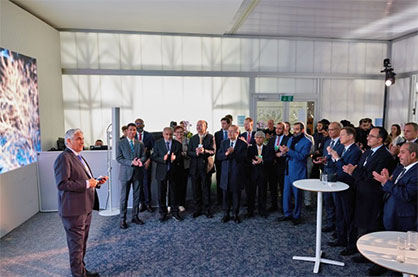
SABIC used its reception hosted in the company’s iconic ICEhouse™ (Innovation for the Circular Economy) with global business figures and policymakers, to outline its new advances on its sustainability journey.

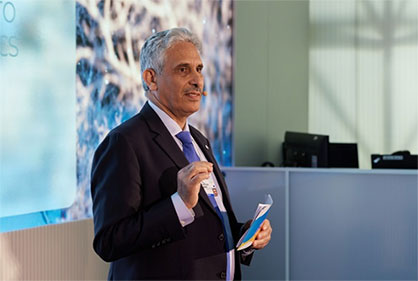
Abdulrahman Al-Fageeh, SABIC CEO (A) said, “At SABIC, we are committed to helping provide our customers with more sustainable solutions, and our target of one million metric tons of TRUCIRCLE™ solutions by 2030 intends to help usher in the new circular economy.” He added, “Driving circularity for plastics will require a rapid transformation of the entire value chain, which is only possible through collective action, innovation, and collaboration across the industry and eco system of waste management. Therefore, we are working hard with downstream and upstream partners to accelerate this process.”

SABIC pioneered the industry back in Davos in 2019, when it announced plans to build a world-first small-scale commercial unit to produce certified circular polymers from the advanced recycling of used plastics. Since then, SABIC has been employing existing facilities to process smaller volumes of advanced recycled materials for brand owners and customers for a variety of applications already available in the market.

Construction of the company’s first commercial unit in Geleen, the Netherlands is now entering the final stages and deliveries of first circular polymers are expected in 2023.

As a next step on the roadmap to meet this 2030 target, SABIC will upscale volumes globally of advanced and mechanical recycling as well as bio-based materials. In that context, SABIC also announced that it is exploring a new world-scale commercial advanced recycling investment that would have a potential capacity to process around 200 kilotons (KT) of circular materials per year, as well as other projects such as a small-scale advanced recycling plant in Saudi Arabia.

Since 2020, SABIC’s certified circular polypropylene has been used in ice cream tubs from the Unilever’s A-brand ice cream brand, Magnum, the first to use recycled plastic in the ice cream industry. In another successful collaboration, SABIC teamed up with Mars and Landbell in an innovative closed-loop recycling project designed to close the loop on KIND® snack bar wrap based on certified circular polypropylene.


© 2023 Sabic
© 2023 Sabic


SABIC’s circular polymers and technologies are offered through TRUCIRCLE™, a set of solutions launched to help give value chain partners access to more sustainable materials. The TRUCIRCLE™ portfolio includes not only certified circular products, but also certified bio-based products, based on certified 2nd and 3rd generation renewable feedstock, and mechanical recycled polymers, ocean and ocean bound recycled solutions, as well as closed loop services and design for recyclability.
© 2023 Sabic
© 2023 Sabic


SABIC’s certified circular and certified renewable products are verified and authenticated in a mass balancing approach under the International Sustainability and Carbon Certification (ISCC) PLUS scheme.

TRUCIRCLE™ solutions were showcased in Davos, Switzerland, at SABIC’s Innovation for the Circular Economy (ICEhouse™), a distinctive concept-structure designed to demonstrate new possibilities for building in closed-loop carbon systems that reduce energy and material waste.

More News from SABIC

More News on Recycling / Circular Economy

#Recycling / Circular Economy

Managed workwear services are providing a blueprint for the circular textile economy

Managed workwear service providers are demonstrating how commercial success and circularity can go hand in hand by extending garment lifespans through repair, laundering, reuse and recycling, according to “Managed workwear services—a circular textile economy ahead of the game”, a new 14‑page report from the global business information company Textiles Intelligence.

#Recycling / Circular Economy

Eco-design as the foundation of circular textiles

Based on the results of an extensive European analysis, the Erasmus+ project Skills4Circularity is currently developing three practice-based training modules covering recycling technologies, eco-design for the circular economy and sustainable manufacturing. This was preceded by a comprehensive company survey and a joint analysis conducted by the project partners under the leadership of IVGT. The results show that the greatest challenges lie not so much in a lack of technology as in skills gaps.

#Recycled Fibers

Usha Yarns secures growth equity investment from Fullerton Carbon Action Fund

Usha Yarns Limited (“Usha Yarns”), a producer of high-quality recycled yarns with advanced, well established production processes, announced a growth equity investment from the Fullerton Carbon Action Fund (“Fullerton”), a private equity strategy managed by Fullerton Fund Management that backs established mid-market companies across Emerging Asia to accelerate decarbonisation.

#Recycling / Circular Economy

German 'ZOLL' turns end-of-life uniforms into valuable raw materials

Together with CWS Workwear, the German Customs Administration is extending the life cycle of service uniforms through reuse, recycling and material recovery, demonstrating how circular economy principles can be successfully implemented in the public sector while delivering significant savings.

Latest News

#Functional Fabrics

PERFORMANCE DAYS announces new focus topic & forums for October 2026

With its upcoming October 13–14, 2026 edition, PERFORMANCE DAYS is placing the spotlight on one of the textile industry’s most important transformations: “Bio-Based Materials – From Fiber to Fabric”, a two-part Focus Topic exploring the future of bio-based innovation across the textile value chain. Part 1, presented in October 2026, will focus on fibers and next-generation material developments, while Part 2 at the March 2027 edition will shift the perspective toward dyeing, finishing, additives, and processing technologies.

#Nonwoven machines

MENANG rapidly resumes production with new ANDRITZ airlay line after major fire

MENANG, a Malaysian manufacturer of nonwoven automotive components, has resumed production after a major fire severely damaged its airlay line in mid-March 2026. A new airlay line supplied by ANDRITZ enabled production to restart within only four months.

#Exhibitions & Events

Febratex 2026 to be the largest edition of the leading textile trade fair in the Americas with 10 exhibition halls

Febratex 2026 will be the largest edition in the history of the leading textile trade fair in the Americas. Dedicated to the textile and apparel manufacturing industries, the event will take place from August 18–21, 2026, in Blumenau, Santa Catarina, Brazil, with a strong focus on technology, sustainability, and business generation.

#Raw Materials

Cotton Brazil Dialogues field trip brings international stakeholders closer to Brazil’s cotton production chain

How do you build trust across the global textile value chain? By opening the farm gates. This is the principle behind the Cotton Brazil Dialogues. At the end of July, the programme welcomed its first group of international participants for a five-day immersion into Brazilian cotton production, combining field visits with technical workshops to showcase the quality, sustainability, innovation and traceability behind one of the world’s leading cotton origins.

TOP