[pageLogInLogOut]

#Recycling / Circular Economy

Carbios accelerates its industrial development
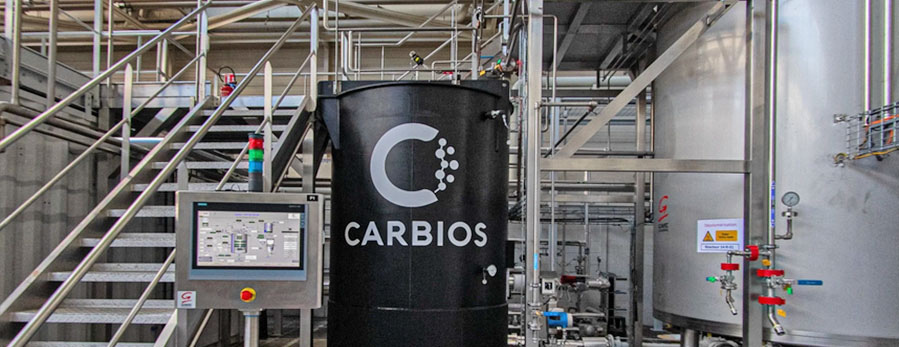
© 2022 Carbios
Carbios (Euronext Growth Paris: ALCRB), a pioneer in the development of enzymatic solutions dedicated to the end-of-life of plastic and textile polymers, today announced it will accelerate the industrial development of its revolutionary enzymatic recycling process (C-ZYME™) with the construction of its reference unit in Europe.

This industrial scale-up is supported by the excellent results obtained at the demonstration plant, which launched in September 2021

Two world-class PET producers have been shortlisted to host the reference unit operating Carbios’ technology and the final choice of a European site will soon be communicated

After studying several potential location proposals, Carbios has shortlisted two of the worlds’ leading PET producers to host this future reference unit. The industrial sites considered are in Europe, including one in France.

“To consolidate our strategy and be ready for 2025, the date by which major industrial players are aiming for 100% recyclable and recycled packaging, we are entering the final stage of our industrial development. Discussions with our potential partners and public authorities are in process and we can expect the location of our future first-of-its-kind reference unit to be announced in the coming weeks,” said Emmanuel Ladent, Chief Executive Officer of Carbios.

The excellent results obtained from Carbios’ industrial demonstration plant, which began operations last September in France, confirmed the industrial scale-up potential of the Company’s technology. With regard to the core of Carbios’ recycling process, the depolymerization kinetics and yields obtained are identical to those achieved in the Pilot facility. “These promising results allow us to envision a large-scale deployment of Carbios’ enzymatic recycling process,” said Prof. Alain Marty, Carbios’ Chief Scientific Officer.


Carbios’ industrial teams are completing the comparative audits of the potential industrial sites submitted by PET manufacturers. This team has also been strengthened with the recruitment of additional expert talent and is already working on the development plans for the construction of the reference unit. Engineering work has begun and is expected to be completed by the end of the year. Additionally, Carbios continues to work with renowned industrial partners such as Technip Energies and Novozymes.

C-ZYME™ is a response to the rising concern of plastic pollution. This world-first enzymatic technology converts PET (the dominant plastic in bottles, trays and polyester textiles) into its basic components, which can then be used to make 100% recycled and 100% recyclable PET, without loss of quality. The transition to a circular plastic economy will be accelerated by the industrialization of this disruptive process.




More News from TEXDATA International

#ITM 2026

ITM 2026: The new geography of textile production

New production hubs are emerging across North Africa and Central Asia, while Türkiye is accelerating its transformation toward higher-value, technology-driven and more sustainable textile manufacturing.

#Research & Development

“Production is a product”

From technical textiles and AI-driven robotics to the limitations of textile circularity: Professor Dr Thomas Gries looks back on more than two decades of development at ITA Aachen. In the interview, he explains why production technology remains a decisive success factor, discusses international collaborations and innovation ecosystems, and shares his views on the transformation of production landscapes and the challenges facing an increasingly regulated industry.

#Knitting & Hosiery

“We need to move away from the price trap and return to a value-driven mindset.”

With its new Textile Innovation Center, KARL MAYER is sending a strong signal for innovation, collaboration, and the future of textile applications. In this interview, Karl Josef Mayer discusses new opportunities in warp knitting, the processing of staple fibres, recycling, the changing role of machinery manufacturers, and why the textile industry must once again focus more strongly on the value of textiles. by Oliver Schmidt

#Associations

“Innovation, resilience and international experience remain the great strengths of the Swiss textile machinery industry”

Geopolitical uncertainty, growing competitive pressure from China, new free trade agreements and the shift towards a circular economy are currently reshaping the global textile industry. In this interview, Cornelia Buchwalder discusses the current mood within the Swiss textile machinery sector, the industry’s distinctive innovative strength, new market opportunities in India and Asia, and the technological trends that could shape the upcoming trade fair cycle leading up to ITMA 2027.

More News on Recycling / Circular Economy

#Recycling / Circular Economy

Recover™ names Enes Adak and Fehmi Yüksel as Co-CEOs to accelerate its next growth phase

Recover™, a leading materials science company and global producer of consistent high-quality, recycled cotton fibers and circular material solutions at scale, today announced the appointment of Enes Adak and Fehmi Yüksel as Co-Chief Executive Officers. This leadership transition marks an important step in Recover’s evolution as the company enters its next stage of development.

#Recycling / Circular Economy

Arc'teryx introduces System 0™, a new framework for the future of product design and circularity

Arc'teryx Equipment, the global design company specializing in technical high-performance apparel and equipment, today introduced System 0™, a new framework that reimagines how products can be designed, manufactured, used, repaired, and ultimately regenerated. System 0 represents the next evolution for sustainability in the outdoor industry, as it embeds circular thinking across an entire product lifecycle while maintaining the uncompromising performance standards that define the Arc’teryx brand.

#Recycling / Circular Economy

2. RETRAKT EU Conference - „Join the Circle“: Turning challenges of the textile sector into chances

On 19 November 2026, the second RETRAKT EU Conference – “Join the Circle” will take place in Brussels. The event, which focuses on the transformation of the textile sector towards a circular economy, will be held under the motto: “Turning Challenges in the Textile Sector into Chances.”

#Recycled Fibers

Indorama Ventures supports KH Editions in building on its RECO experience Taking Thai circular fashion to New York Fashion Week

Indorama Ventures Public Company Limited, a global sustainable chemical company, is supporting KH Editions, a Thai fashion brand that has grown through the RECO program, by providing fabrics woven with deja™ recycled polyester yarn. The fabrics have been used to create two fashion looks and accessories from the brand’s ten-look Spring/Summer 2027 collection, which will be presented in New York City, United States, on 15 September 2026 during New York Fashion Week.

Latest News

#Industry 4.0 / Digitalization

Coats Digital launches AI-powered GSD RealMotion for motion analysis

Coats Digital has launched GSD RealMotion, an AI-powered solution designed to provide apparel manufacturers with greater visibility into factory-floor operations. By analysing shop-floor video and applying Coats Digital’s GSD methodology, the solution turns video recordings into structured, motion-by-motion method studies.

#Textile chemistry

Archroma and Lameirinho partner in pioneering deployment of InOneGO single-step dyeing

Archroma, a global leader in specialty chemicals, and Lameirinho, a leading home textiles manufacturer based in Portugal, are collaborating to bring InOneGO by Archroma, a new single-step dyeing process, into commercial production. Lameirinho’s first InOneGo bedlinens collection is now available worldwide.

#Knitting & Hosiery

KARL MAYER launches extra-wide HKS 3-M EL for increased productivity

KARL MAYER has launched a new extra-wide version of its HKS 3-M EL tricot machine, designed to increase productivity particularly in the manufacture of textiles for sports, activewear and athleisure applications.

#Research & Development

Reducing development times for technical textiles by accelerated thermo-oxidative aging in a high-pressure autoclave

Synthetic polymers used in technical textiles can be effectively protected against degradation caused by heat, oxygen, and water through the use of stabilizer systems. This enables service lives of several decades, extending to more than 50 years. As the use of durable technical textiles continues to grow, so does the demand for reliable methods to predict their service life within economically feasible testing periods. For the first time the German Institutes of Textile and Fiber Research Denkendorf (DITF) developed methods for robust service life prediction for textiles in an IGF research project.

TOP