[pageLogInLogOut]

#Recycling / Circular Economy

Covestro relies on circulating process water
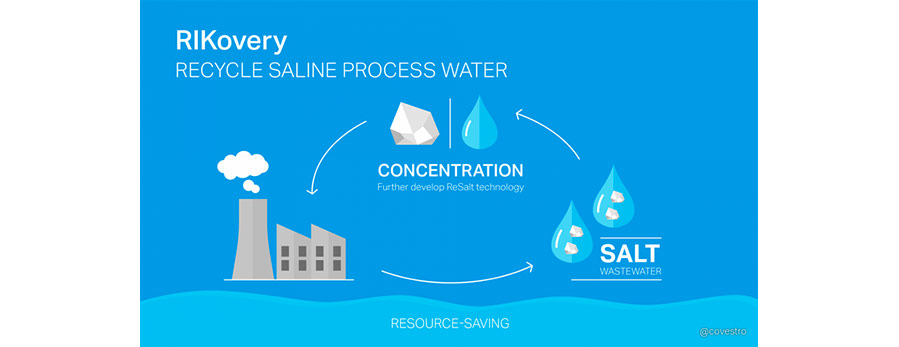
Recycling salt from process waters: Covestro is participating in the RIKovery project. © 2021 Covestro
Covestro intends to increase the circular use of process water in the future. To this end, the company is focusing specifically on research and development and is participating in the new RIKovery research project (funding code 02WV1569). Funded by the German Federal Ministry of Education and Research, the project follows on from the successful work in the ReSalt project (funding code 02WV1408A) and continues research into the treatment of process water.
  • Research project aims to improve use of process water
  • Further development of existing technology targeted
  • Covestro supports UN SDGs with water campaign

Globally, water stress will affect approximately 50 percent of the world's population by 2050. That is why Covestro is already taking action today. At the production sites in Krefeld-Uerdingen and Caojing near Shanghai, industrial saline water recovery plants are already in operation that treat and reuse part of the process water from polycarbonate production. Covestro is thus helping to conserve resources.

With the RIKovery project, Covestro now wants to take the next technological step to be able to reuse even more process water than before. During the three-year runtime, the project consortium wants to explore how salt-containing industrial water streams can be used as fully as possible to relieve natural water resources.?

Further develop existing process technology

"Strengthening cycles is Covestro's declared goal. We are now taking the next step with RIKovery to use process water in a circular way. The further development of our existing technology shows that the direction is right. Now we need to stay on course to use even less water and salt as raw materials for industrial applications in the long term," says Klaus Schäfer, Chief Technology Officer at Covestro.

In addition to Covestro, other project partners from industry, plant engineering and research are working together. They also include the RWTH Aachen and TH Cologne universities, the Water Technology Center, the Analytical Research Institute for Non-Target Screening (AFIN-TS GmbH), BWS Anlagenbau und Service and Evonik Industries. Chris Malkomes of project partner K+S AG says: "We are pursuing the common vision of using saline industrial water streams by treating them. In addition, the aim is to obtain the most highly concentrated permeate possible from the tailings waters of the potash industry, which can be integrated into existing production cycles and utilized there."


"Forward-looking, efficient industrial water management will become a key factor for safe industrial production in the future," says Thomas Track of DECHEMA, which is coordinating the project accompanying the BMBF funding initiative. "Water-efficient sites are a real locational advantage with a view to resource conservation, but also with a view to droughts favored by climate change."

Covestro supports UN SDGs with internal water initiative

Covestro is aware of the special responsibility that the use of the valuable resource of drinking water entails. For this reason, the Leverkusen-based materials manufacturer has additionally launched an internal initiative to creatively develop proposals for sustainable water use. As part of this campaign, the workforce was called upon to submit ideas with business potential based on the United Nations Sustainable Development Goals (SDGs).

Employees from all regions participated in the water initiative. This resulted in dozens of ideas for innovative solutions around the topic of water. A jury selected more than 20 from all the ideas. These are now being tested at the working level.

Among the suggestions from the workforce, many ideas were generated for urban agriculture, but also for cleaning water of microplastics. A major role was also played by the company's own water consumption in production and how this can be improved.

If the ideas prove to be effective and feasible, they will be introduced on a large scale. In this way, Covestro is helping to protect the important resource of drinking water even better in the future.



More News from Covestro AG

#Technical Textiles

Covestro showcases monomaterial concept in autonomous SUE People Mover

UE | STUDIOS has unveiled the fully autonomous electric minibus “Self-driving Urban E-Shuttle” (SUE), placing strong emphasis on sustainable material design. Developed within a project funded by the Federal Ministry for Economic Affairs and Energy (BMWE) and the European Union, the vehicle will begin public road testing this year. At the core of the concept is the consistent use of recyclable monomaterials to improve circularity at end of life.

#Textile chemistry

Covestro and Heraeus Precious Metals collaborate to enable safer, more sustainable antimicrobial textile coatings

Laboratory tests reveal that AGXX antimicrobial surface technology from Heraeus Precious Metals is fully compatible with Impranil® PU dispersions which are part of the waterborne INSQIN® textile coating technology from Covestro, paving the way for more sustainable antimicrobial textile coatings. This discovery comes at a key moment for the textile coatings industry. As the sharing economy continues to grow, more people are coming into regular contact with high-use surfaces, creating ideal conditions for bacteria, viruses, and other microorganisms to thrive.

#Textile chemistry

Covestro celebrates decade of innovation and sustainable growth

Covestro celebrates its 10-year anniversary today. Since its carve-out from Bayer in 2015, the company has developed into a global leader in high-performance polymer materials and a pioneer in circular economy solutions. With a strong focus on innovation and sustainability, Covestro’s materials are now embedded in countless applications worldwide – from mobility and construction to electronics, healthcare, and consumer goods.

#Textile chemistry

Covestro extends contract with CTO Dr. Thorsten Dreier ahead of schedule until 2031

Dr. Thorsten Dreier will remain Chief Technology Officer of Covestro for a further five years. The Supervisory Board has extended his contract, which runs until June 2026, ahead of schedule from July 1, 2026 to June 30, 2031.

More News on Recycling / Circular Economy

#Recycling / Circular Economy

AI Circular Economy Conference 2026 fuels innovation at the intersection of AI and Circular Economy

The AI Circular Economy Conference 2026, organised by nova-Institute, brought together 116 participants from 15 countries in Cologne and online to explore the transformation of the chemical and materials industry supported and accelerated by artificial intelligence. During the two-day event, leading experts from industry, research, start-ups and the investment community discussed how AI can maximise the potential of renewable carbon creating efficient circular value chains. The conference featured 24 presentations and multiple panel discussions, highlighting the growing convergence of digital technologies and circular material systems. It demonstrated how artificial intelligence is progressing from the experimental stage to real industrial implementation within the circular economy.

#Recycled_Fibers

Circ deepens access to recycled fibers with Xinxiang Bailu Chemical Fiber Co., Ltd. partnership agreement

Circ®, a global leader in textile‑to‑textile recycling, today announced a new partnership agreement with Xinxiang Bailu Chemical Fiber Co., a Canopy Dark Green Shirt producer and one of the world’s leading producers of viscose filament. The agreement marks a significant step in Circ’s continued expansion in China and strengthens its position within the country’s rapidly evolving circular textile ecosystem; further supporting Circ’s ability to supply recycled fibers near existing fashion supply chains.

#Recycled_Fibers

Worn Again Technologies unveils the Accelerator

Worn Again Technologies unveils the Accelerator, the next major step towards commercialising its pioneering Textile-to-Fibre recycling process and proving the technical and economic feasibility of polycotton recycling.

#Recycling / Circular Economy

Textile‑to‑textile recycling leader Circulose joins Spinnova’s ecosystem to accelerate technology scale‑up

Textile‑to‑textile recycling leader Circulose joins Spinnova’s ecosystem (consortium) to help advance the scale‑up of Spinnova’s technology. Spinnova has actively sought partners to accelerate commercial scale‑up, and Circulose, as a key player in textile recycling, strengthens the ecosystem by providing a raw material that is in high demand across the industry.

Latest News

#INDEX 2026

EDANA unveils nominees for INDEX™26 Awards: Highlighting the next generation of nonwoven excellence

EDANA is proud to unveil the highly anticipated nominees for the INDEX™26 Awards, the nonwoven industry’s highest accolade for technical and sustainable excellence. Out of a record-breaking field of entries, these finalists represent the cutting edge of material science—from bio-based hygiene fibers and PFAS-free protective textiles to revolutionary water-filtration machinery. Each nominee has been selected by a jury of industry experts for their ability to solve critical global challenges, including the transition to a circular economy and the pursuit of enhanced consumer performance.

#Raw Materials

Lenzing Group positions bio‑based materials as a strategic asset for Europe’s economic security

The Lenzing Group, a leading supplier of regenerated cellulose fibers for the textile and nonwovens industries, hosted a high‑level roundtable in Brussels to discuss how bio‑based materials can strengthen Europe’s economic security and support the shift toward a fossil‑free future. Organized in cooperation with Euractiv, the event brought together representatives of the European Commission, the UK Mission to the EU, academia, civil society, and industry.

#Natural Fibers

Beyond Cotton: Natural Fibres in the Spotlight at the Bremen Cotton Conference - Branded by DNFI

Climate targets, fragile supply chains, and rising regulatory requirements are fundamentally changing the perspective of the textile industry - the focus is increasingly shifting toward the base material. Not only cotton, but natural fibres are gaining significant importance: they stand out not only because of their outstanding functional properties, but also because they make a valuable contribution to the bioeconomy and responsible product development.

#Textiles & Apparel / Garment

Coats to showcase innovative reinforcement and filler materials for leather goods and accessories at APLF 2026

Coats, a world-class Tier 2 manufacturer and trusted partner for the apparel and footwear industries, will be promoting four advanced materials from its ‘Lifestyle Solutions’ portfolio at APLF 2026 in Hong Kong in March. Each innovation has been specifically engineered to help luxury and premium brands elevate the craft, durability, sustainability and creative expression required in the manufacturing of handbags, purses, and other high-end designer accessories.

TOP