[pageLogInLogOut]

#Recycling / Circular Economy

From old tires to new car parts: Neste, Borealis and Covestro aim at closing the loop for automotive industry

Neste, Borealis and Covestro have signed a project agreement to enable the recycling of discarded tires into high-quality plastics for automotive applications. The collaboration aims at driving circularity in plastics value chains and the automotive industry. When no longer fit for use, tires are liquefied by means of chemical recycling and then processed into base chemicals and further into polycarbonates of high purity. These can then be used in various automotive applications, from parts of headlamps to radiator grilles.
From old tires to new raw material © 2024 COVESTRO


“Circularity requires cooperation, and this cooperation with our partners Neste and Borealis is testament to the possibilities at our disposal,” says Guido Naberfeld, Senior Vice President, Head of Sales and Market Development Mobility at Covestro. “We are creating options to turn old tires into new car parts again. With that, we are supporting our automotive customers and addressing an increasingly prominent question discussed across the value chain: How to match high-performance materials with recycled content? Projects like this can be the answer.”

As part of the collaboration, Neste turns liquefied discarded tires into a high-quality raw material for polymers and chemicals manufacturing and supplies it to Borealis. Borealis will then process the Neste-produced raw material into base chemicals phenol and acetone, which are supplied to Covestro. Covestro can use these materials to make polycarbonates. The share of recycled content is attributed via the mass balancing approach all the way to the final products using ISCC Plus certification.
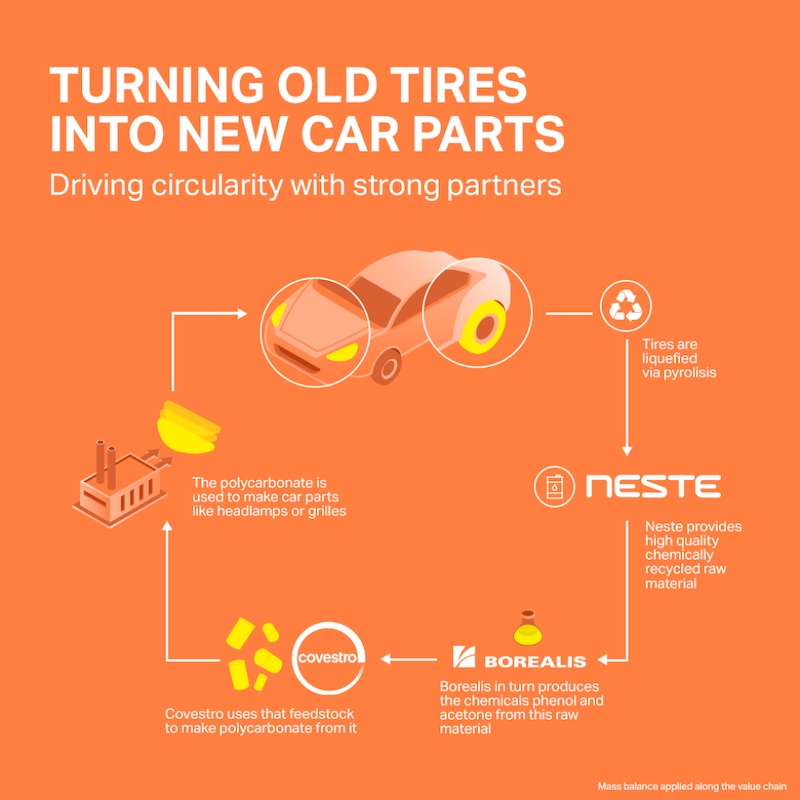
Neste Borealis Covestro automotive circularity project infographic © 2024 Neste Borealis Covestro


The first products based on the collaboration are already available as each party has manufactured the first batch of their respective contribution to the project. Aside from polycarbonates, the project partners may also consider polyurethanes as a possible end product, which could also find its way into parts of the interior of a car. The companies emphasize that the potential to scale-up these types of developments should be considered when setting ambitious targets for future EU regulations, such as the End of Life Vehicles Regulation.

“We are demonstrating the importance of value chain cooperation to give new value to waste,” says Thomas Van De Velde, Senior Vice President Base Chemicals at Borealis. “We are proud that Borealis, in collaboration with Neste, is able to play a role in this project, providing more sustainable solutions for polymer applications for Covestro and its customers.”

Photo: Strong partnership for a circular economy (from left to right): Jeroen Verhoeven (Neste), Thomas Van De Velde (Borealis), Guido Naberfeld (Covestro) aim to make new car parts from discarded tires.
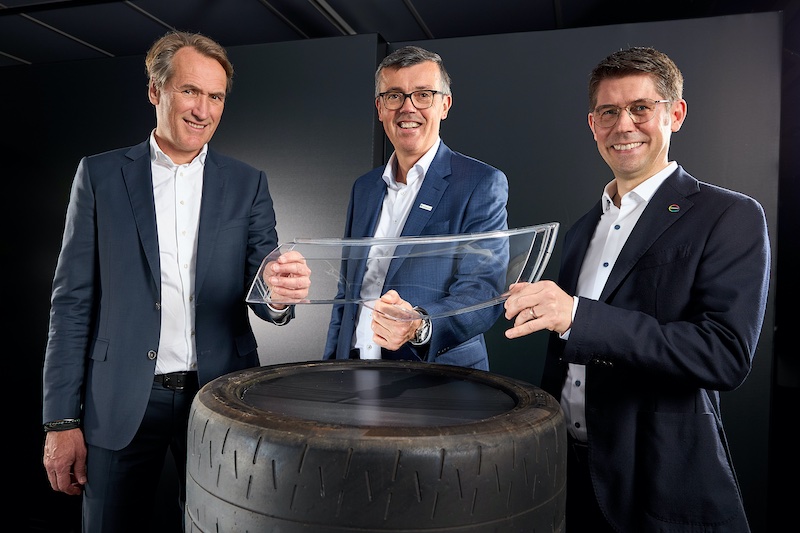
Photo: Strong partnership for a circular economy (from left to right): Jeroen Verhoeven (Neste), Thomas Van De Velde (Borealis), Guido Naberfeld (Covestro) aim to make new car parts from discarded tires © 2024 COVESTRO


“This project can serve as a blueprint when it comes to establishing circularity in the field of plastics in cars,” says Jeroen Verhoeven, Vice President Value Chain Development for polymers and chemicals at Neste. “It shows how low-quality waste materials can be turned into very high-quality plastics. This is good news for the polymers and automotive industries as well as for the environment.”

The collaboration will be presented during the in Mannheim, Germany on June 19-20, 2024.


More News from Covestro AG

#Textile chemistry

Covestro and Heraeus Precious Metals collaborate to enable safer, more sustainable antimicrobial textile coatings

Laboratory tests reveal that AGXX antimicrobial surface technology from Heraeus Precious Metals is fully compatible with Impranil® PU dispersions which are part of the waterborne INSQIN® textile coating technology from Covestro, paving the way for more sustainable antimicrobial textile coatings. This discovery comes at a key moment for the textile coatings industry. As the sharing economy continues to grow, more people are coming into regular contact with high-use surfaces, creating ideal conditions for bacteria, viruses, and other microorganisms to thrive.

#Textile chemistry

Covestro celebrates decade of innovation and sustainable growth

Covestro celebrates its 10-year anniversary today. Since its carve-out from Bayer in 2015, the company has developed into a global leader in high-performance polymer materials and a pioneer in circular economy solutions. With a strong focus on innovation and sustainability, Covestro’s materials are now embedded in countless applications worldwide – from mobility and construction to electronics, healthcare, and consumer goods.

#Textile chemistry

Covestro extends contract with CTO Dr. Thorsten Dreier ahead of schedule until 2031

Dr. Thorsten Dreier will remain Chief Technology Officer of Covestro for a further five years. The Supervisory Board has extended his contract, which runs until June 2026, ahead of schedule from July 1, 2026 to June 30, 2031.

#Textile chemistry

Suiting up Team Sonnenwagen with more sustainable sportswear created through a three-way partnership

Team Sonnenwagen Aachen, a solar racing collective from RWTH Aachen and FH Aachen, Germany, is on a mission to advance sustainable mobility solutions and become world champions. This August, the student team will participate in the 2025 Bridgestone World Solar Challenge, a biannual 3,000-kilometer race across the Australian outback. During the five-day event, 50 student teams from around the world will compete with solar vehicles that they must design, assemble, and drive themselves.

More News on Recycling / Circular Economy

Latest News

#Raw Materials

Aid by Trade Foundation reaches new milestones in supply chain transparency

The Aid by Trade Foundation (AbTF) is reaching new milestones as it leads the way towards greater physical traceability for Cotton made in Africa® (CmiA) cotton. With around 700 suppliers and producers in a total of 25 countries, the Aid by Trade Foundation has reached a new record number of partners who can trace CmiA cotton from the product back to its origin. This is more than double the previous year’s figure.

#Natural Fibers

Merino wool moves into China’s high-performance sportswear market

China’s leading sportswear brands are beginning to treat Merino wool not as a lifestyle material, but as a performance input as natural fibres move from the margins of sportswear into elite technical applications. That shift is increasingly evident in the material strategies of major domestic groups such as ANTA.

#Knitting & Hosiery

KARL MAYER at JEC: Multiaxial reinforced CFRP pultrusion profiles are picking up speed in the mobility sector

KARL MAYER Technical Textiles will be showcasing exciting new application potentials for multiaxial non-crimp fabrics in combination with the pultrusion process at the upcoming JEC in Hall 5, Booth C 46. The advancement of the tried-and-tested pultrusion process enables the cost-efficient production of complex CFRP multi-chamber profiles, which are used in the CETROVO high-speed metro. The world's first carbon-intensive lightweight rail vehicle of this type is designed for speeds of up to 140 km/h.

#Digital Printing

Erreà upgrades sportswear printing operations with seven high-performance Mimaki digital textile printers

Mimaki Europe, a leading manufacturer of industrial inkjet printers and cutting systems, has supported renowned Italian sportswear brand, Erreà in upgrading its digital textile printing operations with the installation of seven high-performance Mimaki systems. The new installation includes three Tiger600-1800TS industrial dye-sublimation printers and four TS330-1600 solutions, replacing a previous fleet of 28 digital printers. This major upgrade marks a significant step forward in Erreà’s production strategy, enabling the company to streamline its printing infrastructure while improving efficiency, colour consistency and overall production control.

TOP