[pageLogInLogOut]

#Recycling / Circular Economy

EU backs Renewcell to boost circularity in the fashion industry
© 2021 Renewcell
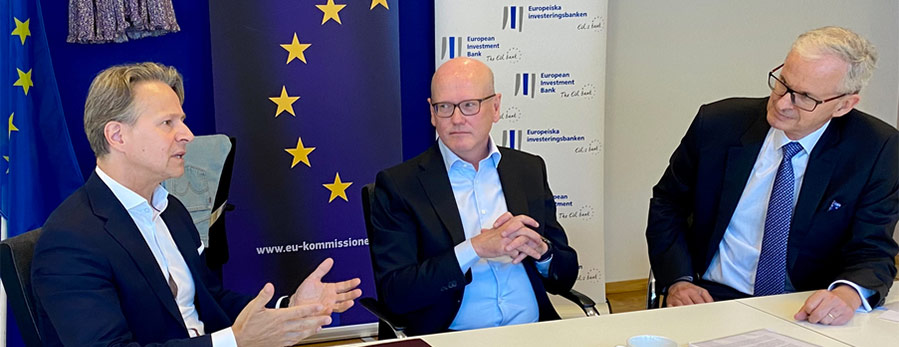
The European Investment Bank (EIB) has signed a loan agreement of up to SEK 311 million with Renewcell from Sweden. The loan was extended under “InnovFin – EU Finance for Innovators”, with the financial backing of the European Union under Horizon 2020, the EU’s programme for research and innovation. The full effectiveness of the agreement is contingent upon approval of the terms at an extraordinary general meeting by the shareholders of Renewcell. A summons to the extraordinary general meeting will be communicated at a later time.
  • European Investment Bank lends up to SEK 311 million (€30.75 million) to fashion industry innovator Renewcell for first commercial scale factory in Sundsvall.
  • Renewcell’s product Circulose® is the only commercially available textile-to-textile recycled material of virgin equivalent quality.
  • The credit line is supported under InnovFin, funded by the EU’s Horizon 2020 research and innovation programme.


The Sweden-based fashion innovator has devised a way to turn discarded clothing into Circulose®, a pulp of which new fabric can be made, thus boosting circular economy as a concept in the fashion industry. After proving their concept, Renewcell will use the EIB-loan to build their first full commercial-scale textile recycling plant, able to produce 60,000 tonnes per year, at the Ortviken industrial site near Sundsvall.

In the coming decade, the global middle class is expected to continue to grow, which will cause an increase in fashion consumption. Thus, and with an eye to climate change, the fashion industry needs to shift to circularity. In its bid to make the fashion industry more circular, Renewcell’s technology can be an important factor in reaching the EU’s target for waste reduction, as well setting the tone for the development of the European recycling industry. The company is able to supply commercial volumes of 100% textile-to-textile recycled materials, and is now scaling up to meet the growing demand for its product Circulose® with backing from Europe.


Mariya Gabriel, European Commissioner for Innovation, Research, Culture, Education and Youth, said: “I am delighted to announce our first circular economy project supported under InnovFin Energy Demonstration Projects. Not only it will be a crucial addition to our portfolio, I expect it to pave the way for several new projects in this domain, which we need to accelerate in order to reduce waste and pollution.”

Renewcell CEO, Patrik Lundström, added: “We see the investment at Ortviken, Sundsvall as part of an Industrial Evolution to sustainability, in which we put existing skills, infrastructure and know-how of Swedish industry into a new circular context. We are proud to have the backing of the EIB in our effort to make fashion circular at scale.”

“When it comes to revolutionising existing industries, this really is cutting-edge." said EIB Vice-President Thomas Östros. “As the EU’s climate bank, it is definitely a priority for us to support projects that can turn around current business models, to make them more sustainable or even circular. After financing Northvolt and Nilar’s new battery concepts, this is yet another innovative Swedish company we are very proud to get behind. Renewcell has the potential to seriously reduce the climate impact of the fashion industry, something we are happy to assist with.”
More News from TEXDATA International

#ITM 2026

ITM 2026: The new geography of textile production

New production hubs are emerging across North Africa and Central Asia, while Türkiye is accelerating its transformation toward higher-value, technology-driven and more sustainable textile manufacturing.

#Research & Development

“Production is a product”

From technical textiles and AI-driven robotics to the limitations of textile circularity: Professor Dr Thomas Gries looks back on more than two decades of development at ITA Aachen. In the interview, he explains why production technology remains a decisive success factor, discusses international collaborations and innovation ecosystems, and shares his views on the transformation of production landscapes and the challenges facing an increasingly regulated industry.

#Knitting & Hosiery

“We need to move away from the price trap and return to a value-driven mindset.”

With its new Textile Innovation Center, KARL MAYER is sending a strong signal for innovation, collaboration, and the future of textile applications. In this interview, Karl Josef Mayer discusses new opportunities in warp knitting, the processing of staple fibres, recycling, the changing role of machinery manufacturers, and why the textile industry must once again focus more strongly on the value of textiles. by Oliver Schmidt

#Associations

“Innovation, resilience and international experience remain the great strengths of the Swiss textile machinery industry”

Geopolitical uncertainty, growing competitive pressure from China, new free trade agreements and the shift towards a circular economy are currently reshaping the global textile industry. In this interview, Cornelia Buchwalder discusses the current mood within the Swiss textile machinery sector, the industry’s distinctive innovative strength, new market opportunities in India and Asia, and the technological trends that could shape the upcoming trade fair cycle leading up to ITMA 2027.

More News on Recycling / Circular Economy

#Recycling / Circular Economy

Managed workwear services are providing a blueprint for the circular textile economy

Managed workwear service providers are demonstrating how commercial success and circularity can go hand in hand by extending garment lifespans through repair, laundering, reuse and recycling, according to “Managed workwear services—a circular textile economy ahead of the game”, a new 14‑page report from the global business information company Textiles Intelligence.

#Recycling / Circular Economy

Eco-design as the foundation of circular textiles

Based on the results of an extensive European analysis, the Erasmus+ project Skills4Circularity is currently developing three practice-based training modules covering recycling technologies, eco-design for the circular economy and sustainable manufacturing. This was preceded by a comprehensive company survey and a joint analysis conducted by the project partners under the leadership of IVGT. The results show that the greatest challenges lie not so much in a lack of technology as in skills gaps.

#Recycled Fibers

Usha Yarns secures growth equity investment from Fullerton Carbon Action Fund

Usha Yarns Limited (“Usha Yarns”), a producer of high-quality recycled yarns with advanced, well established production processes, announced a growth equity investment from the Fullerton Carbon Action Fund (“Fullerton”), a private equity strategy managed by Fullerton Fund Management that backs established mid-market companies across Emerging Asia to accelerate decarbonisation.

#Recycling / Circular Economy

German 'ZOLL' turns end-of-life uniforms into valuable raw materials

Together with CWS Workwear, the German Customs Administration is extending the life cycle of service uniforms through reuse, recycling and material recovery, demonstrating how circular economy principles can be successfully implemented in the public sector while delivering significant savings.

Latest News

#Recycled Fibers

Naia™ from Eastman strengthens western hemisphere textile connections at Apparel Sourcing Show Guatemala

As brands and retailers explore more diversified and responsive sourcing networks, the Naia™ brand from Eastman is strengthening its engagement with the textile and apparel value chain across the western hemisphere. From August 18–20, the company will participate for the first time in Apparel Sourcing Show Guatemala, a regional meeting point for apparel sourcing, manufacturing and nearshoring.

#Man-Made Fibers

Dornbirn GFC 2026 expands conference program with new thematic sessions

For 65 years, Dornbirn GFC has stood for innovation and is one of the world’s leading conferences in the fiber industry. From September 16 to 18, 2026, the international fiber community will meet in Dornbirn, Austria, to discuss current trends, technological developments, and forward-looking solutions. More than 600 experts from industry and academia from over 30 countries are expected to attend. With around 100 presentations by renowned speakers, a 2,5-day conference program, and three parallel presentation rooms with moderated sessions, Dornbirn GFC provides a first-class platform for knowledge exchange, networking, and international collaboration. Together, participants will generate ideas and impulses that will sustainably shape the future of the global fiber industry.

#Research & Development

Europe is committed to recycling end-of-life wind turbine blades

Starting in 2026, Europe’s wind energy industry has committed itself to ensuring that wind turbine blades do not end up in landfills once they reach the end of their service life. The EU-funded research project REWIND is exploring ways to reuse this composite waste. The German Institutes of Textile and Fiber Research Denkendorf (DITF) are one of 13 project partners from seven countries.

#Functional Fabrics

PERFORMANCE DAYS announces new focus topic & forums for October 2026

With its upcoming October 13–14, 2026 edition, PERFORMANCE DAYS is placing the spotlight on one of the textile industry’s most important transformations: “Bio-Based Materials – From Fiber to Fabric”, a two-part Focus Topic exploring the future of bio-based innovation across the textile value chain. Part 1, presented in October 2026, will focus on fibers and next-generation material developments, while Part 2 at the March 2027 edition will shift the perspective toward dyeing, finishing, additives, and processing technologies.

TOP