[pageLogInLogOut]

#Recycling / Circular Economy

Fashion for Good launches World of Waste
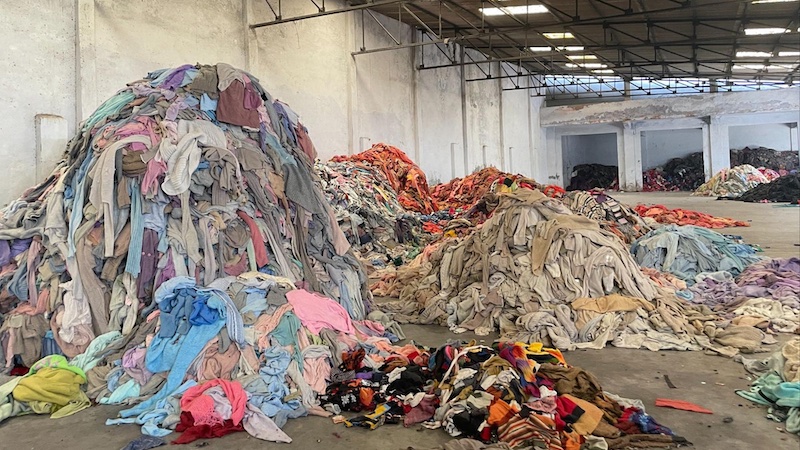
With catalytic funding from Laudes Foundation and IDH, Fashion for Good partnered with Reverse Resources, Global Fashion Agenda, Circle Economy, and Accelerating Circularity to launch World of Waste. A free online tool mapping global textile waste hotspots providing aggregated regional data on waste volume, composition, and type, enabling recyclers and innovators to efficiently identify and utilise textile waste resources worldwide.
© 2024 Fashion for Good


Addressing the gap: The lack of a centralised global tool for textile waste

The textile industry faces increased scrutiny on its substantial amounts of waste generated each year. This presents a challenge for the industry, but also a massive opportunity for circularity and transparency; with efforts underway to track, reduce, and utilise waste towards better end-of-life practices. 

Waste reflects a burden on resources, inefficient processes, and unmanaged emissions, highlighting the need for action. Rising regulations are also inciting action from the industry, such as recyclers using textile waste as feedstock to displace virgin fibre production. However, information on textile waste is currently fragmented, with data scattered across a multitude of organisations and platforms. This lack of centralised knowledge and standardised data hampers the industry’s ability to address and capitalise on textile waste.

To tackle this issue, Fashion for Good, with catalytic funding from Laudes Foundation and IDH, has partnered with Reverse Resources, Global Fashion Agenda, Circle Economy, and Accelerating Circularity – who actively address many facets of textile waste and leverage each other's diverse skill sets and wealth of information to create a tool consolidating the outcomes of individual research. This tool provides an overview of data points on waste quantities, types, compositions, and other insights, as well as links to the original studies. With information on waste attributes, data collection methodologies, organisations involved, and a lens on upcoming studies for a region, the tool empowers users of textile waste, as well as stakeholders looking to further the industry’s knowledge base. 

"We're excited to launch worldofwaste.co, a tool providing crucial data on global textile waste hotspots. This collaborative effort brings together key industry partners to empower recyclers and innovators with insights into waste volumes and compositions, helping turn waste into valuable resources and accelerating the shift towards a more circular and sustainable fashion industry." – Katrin Ley, Managing Director of Fashion for Good

Visit World Of Waste

With a lens on global hotspots of textile waste, as well as links to established resources for each region, strategies aimed at valorising waste become more attainable. For instance, recyclers can strategise their feedstock sourcing by gaining insights into waste streams and their specific characteristics. Governments can utilise this data to develop informed policies and regulations that encourage sustainable waste management practices. Fostering connections between stakeholders, both local and international, can help address operational challenges towards the advancement of circularity. 

“This initiative is the first of its kind, aiming to create a global database of textile waste availability. It will serve as a vital tool for industry stakeholders, offering both a comprehensive view and detailed insights to inform business decisions. By consolidating data, the platform will unlock opportunities to optimise sourcing and enhance the recycling ecosystem, empowering recyclers, brands, and retailers to innovate, streamline operations, and drive efficiency in textile waste management for a more sustainable industry”, says Pramit Chanda, Global Director-Textiles & Manufacturing, IDH. 

Anita Chester, Head of Fashion, Laudes Foundation, stats: “Access to deep data to accurately determine where and how to intervene will be the real unlock in solving the mounting issue of waste generated across fashion’s supply chain. Ultimately, we know that better informed and more cohesive efforts between actors will lead to increased (financial and non-financial) support to scale innovations, industry proactively investing to transform their supply chains, and policy creating the enablers to support the transition to an inclusive and circular fashion industry.” 

Over time, coverage will be expanded with the inclusion of additional countries and waste types. The growing database will surface economic and composition insights and integrate policy information for more utility. Stay tuned as we enhance the platform’s capabilities and advance our understanding of textile waste

This initiative marks a significant step towards building a more transparent, collaborative, and circular fashion industry. By uniting key players from across the ecosystem, we are not only addressing the pressing issue of textile waste but also unlocking its potential as a resource. As the platform continues to grow, incorporating more data and insights from other organisations working on assessing waste in newer regions and different waste categories, we aim to provide deeper clarity and drive meaningful change. Together, we can pave the way for a fashion industry that values sustainability, reduces waste, and contributes to a healthier planet for future generations.

More info:

https://www.worldofwaste.co


More News from Fashion for Good

#Recycling / Circular Economy

Fashion for Good releases open-source blueprint for near-net-zero textile manufacturing

Fashion for Good launches the first open-source blueprint for near-net-zero textile manufacturing, tackling one of fashion’s biggest emissions hotspots. Developed under the Future Forward Factory project, the blueprint offers Tier 2 manufacturers in India five practical, financially viable pathways to reduce carbon emissions by up to 93%.

#New Materials

From premiums to parity: How Fashion for Good is rewriting the economics of new materials

Fashion for Good launches Price Parity Toolkit: developed with support from Laudes Foundation, Canopy and Finance Earth, the framework introduces an innovative financing approach (premium decoupling) to remove price premiums from the supply chain and unlock faster adoption of lower-impact materials across the industry.

#Natural Fibers

Fashion For Good launches “Beyond50 Denim” to address hemp integration barriers in global denim production

Fashion for Good, together with leading global brands BESTSELLER, C&A, PDS Limited, Reformation, and Target, launched Beyond50 Denim: Combining Cottonised Hemp and Green Chemistry, a project accelerating the use of hemp as an alternative to conventional cotton in denim. By combining two pioneering innovations (SEFF’s Nano-Pulse™ cottonised hemp fibres and FIBRE52™’s proprietary chemistry formulations with soft handfeel), the project seeks to demonstrate that hemp-based denim can match or even surpass cotton in both performance and appeal.

#Sustainability

Fashion For Good unveils “The Next Stride”, a new footwear project to replace fossil fuel mate-rial with bio-based sole innovation

Fashion for Good today announced the launch of The Next Stride: Bio-Based Materials for Footwear Soles, a 12-month project to transform the $400 billion footwear industry¹ by reimagining one of its most impactful components: the sole. In partnership with adidas, Target, and Zalando, alongside leading material innovators Algenesis Labs, Balena, Evoco, KUORI, and Yulex, the initiative will test and validate bio-based polymers as high-performance alternatives to the fossil fuel–derived materials that dominate footwear production. By focusing on the sole (the foundation of every shoe), The Next Stride aims to accelerate the industry’s shift toward scalable, circular solutions.

More News on Recycling / Circular Economy

#Recycling / Circular Economy

Reju announces site selection for first U.S. industrial sized facility regeneration hub in Rochester, New York

Reju, the textile-to-textile regeneration company, today announced it has selected the site for its first U.S.-based industrial facility marking a significant milestone in its efforts to scale globally. This future Regeneration Hub will be in Rochester, New York, reinforcing Reju’s commitment to the adoption of circular textile system across key regions worldwide.

#Business

Canopy introduces a first-of-its-kind $2 billion USD investment blueprint to decarbonize global materials supply chains

Today, the global, solutions-driven not-for-profit Canopy joined partners at Davos to introduce a new finance model designed to accelerate the growth of low-carbon materials and transform the paper, packaging, and textile supply chains. The event was anchored by a keynote speech from Sri A Revanth Reddy, Hon’ble Chief Minister of Telangana, with India set to host the first iteration of the new investment blueprint.

#Recycled_Fibers

Borealis invests EUR 49 million in Burghausen, Germany to accelerate design for circularity

Borealis announces a EUR 49 million strategic investment to scale up production of Borstar® Nextension polypropylene (PP) at its manufacturing site in Burghausen, Germany. This will expand commercial production of next-generation single-site polypropylene (ssPP) grades that deliver enhanced purity, processability, and performance - supporting customers in key sectors including packaging, healthcare, mobility, and fibers, to meet evolving market and regulatory demands.

#Recycling / Circular Economy

From local actions to industrial innovations: SOLSTICE shares mid-project results

Since its launch in May 2024, the SOLSTICE project is accelerating the transition from linear models to circular regional ecosystems in the textile industry, focusing on four key territories: Grenoble-Alpes Métropole (France), Berlin (Germany), Prato (Italy), and Catalonia (Spain). By mid-project, SOLSTICE has already revealed both regional disparities and promising solutions to strengthen textile repair, reuse, and recycling infrastructure.

Latest News

#Fabrics

MUNICH FABRIC START: Between Attitude and Sensuality

The future begins where we reimagine it. After seasons of restraint, Spring.Summer 27 marks a conscious counter-trend: optimism, sensuality, and creative freedom are replacing pragmatism and neutrality. Physical presence and individuality are regaining importance – as a response to uncertainty, exhaustion, and algorithmic predictability. The overarching theme of PLEASURE stands for fashion as an emotional space, as an expression of attitude and cultural reflection. Colours, surfaces, and materials become vehicles for self-confidence and joie de vivre.

#Denim

organIQ seek: smart alternative to potassium permanganate

CHT Group announces new technical findings within its organIQ seek platform that significantly advance the transition toward permanganate-free denim bleaching. Through extensive industrial testing and application research, CHT confirms that organIQ seek can now be used with remarkable effectiveness as a substitute for potassium permanganate in spray bleach, while remaining aligned with sustainability expectations and cost realities in the European market. At the COLOMBIATEX in Medellín as well as at the Exintex in Puebla and the Kingpins Show in Amsterdam the CHT Group will present organIQ seek as an alternative to potassium permanganate.

#Functional Fabrics

PERFORMANCE DAYS: Focus topic shifts to the beginning of the value chain

Following the last Focus Topic in October 2025, which placed Textile-to-Textile Recycling at its core, PERFORMANCE DAYS continues to drive the conversation around circularity – this time with an expanded and more upstream perspective. The upcoming Focus Topic, “Textile to Textile: The Role of Collectors and Sorters,” presented during the spring edition on March 18–19, will spotlight one of the most essential yet often overlooked components of a functioning circular textile system: the efficient collection and sorting of post-consumer textiles.

#Knitting & Hosiery

Proven performance, optimised costs – the new RE 6 EL

Nowadays textile companies increasingly need to produce small production runs and respond to market changes with instantaneous pattern changes in order to operate profitably – meaning they require machines that offer maximum flexibility, reliability and cost efficiency. KARL MAYER understands the challenges of the market and is launching its new RE 6 EL. The Raschel machine offers the core strengths of the classic RSE 6 EL and essentially the same performance parameters, but has been further cost-optimised largely due to local production advantages. This makes the newcomer an efficiency champion in production, especially when it comes to frequent pattern changes.

TOP