[pageLogInLogOut]

#Recycling / Circular Economy

Fashion for Good releases open-source blueprint for near-net-zero textile manufacturing

Fashion for Good launches the first open-source blueprint for near-net-zero textile manufacturing, tackling one of fashion’s biggest emissions hotspots. Developed under the Future Forward Factory project, the blueprint offers Tier 2 manufacturers in India five practical, financially viable pathways to reduce carbon emissions by up to 93%.

Fashion for Good launches the first open-source blueprint for near-net-zero textile manufacturing, tackling one of fashion’s biggest emissions hotspots. Developed under the Future Forward Factory project, the blueprint offers Tier 2 manufacturers in India five practical, financially viable pathways to reduce carbon emissions by up to 93%.

THE URGENT NEED FOR PRACTICAL DECARBONISATION STRATEGIES

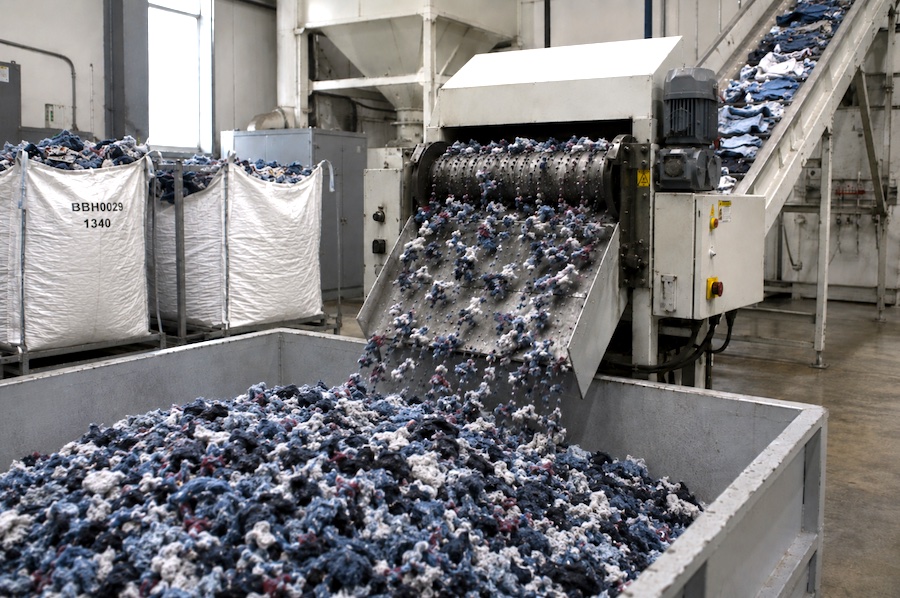
Textile dyeing, treatment, and finishing facilities (Tier 2 of the fashion supply chain) are a major source of pollution and emissions. These wet processes consume high amounts of water, energy, and chemicals, yet manufacturers face a tangle of barriers: prohibitive upgrade costs, a fragmented approach, and no clear path forward. Without a holistic playbook, decarbonisation remains out of reach and unjustified for most, hindering the industry’s biggest opportunity to decarbonise.

A BLUEPRINT FOR SCALING THE FUTURE OF TEXTILE MANUFACTURING

Developed as part of the Future Forward Factories project, this one-of-its-kind blueprint is freely available to manufacturers, brands, bringing together energy interventions, disruptive process innovations and best-in-class technologies.

Designed as a practical guide for Tier 2 textile manufacturers in India producing cotton knits and wovens, the blueprint launches today through Fashion for Good. The initiative is backed by catalytic funders Laudes Foundation and H&M Foundation, as well as Apparel Impact Institute, IDH, and on-the-ground experts Bluwin, Wazir Advisors, Grant Thornton Bharat, and Sattva Consulting. Arvind Mills serves as the anchor partner supporting the blueprint’s development in India.

The blueprint provides five tailored pathways based on product type and production process, identifying best available technologies and innovative processes to achieve near-net-zero operations. In case of full implementation of all processes and infrastructure upgrades, factories can achieve up to:

  • 93% reduction in carbon emissions
  • 33% reduction in water usage and
  • 41% reduction in electricity consumption.

Critically, each pathway includes financial analysis (payback periods, internal rates of return, and net present value calculations), revealing where additional support is needed. The blueprint also incorporates a Policy Landscape Overview that maps available government incentives, and includes a “How to Navigate” section enabling manufacturers to identify the scenario most applicable to them.

“The Future Forward Factory blueprint removes the guesswork and delivers a pragmatic solution to a complex problem,” said Katrin Ley, Managing Director of Fashion for Good. “By making this knowledge freely available, we are systematically dismantling the biggest barrier to decarbonisation: the lack of a clear, implementable ‘how-to.’ Every manufacturer now has access to concrete guidance and validated financial data. This is more than a roadmap; it is the essential guide for the industry’s factory transformation.”

Fashion for Good aims to support a selected set of manufacturers in India to retrofit their facilities with the help of this blueprint, with the support of Apparel Impact Institute (Aii). Selected facilities will gain hands-on guidance, technical expertise, and financial clarity to implement the blueprint. Manufacturers interested in taking part in the programme can register their interest here.

“As we build this facility, we are committed to sharing what we will learn. The Future Forward Factory blueprint is proof that a holistic understanding of the decarbonisation journey can unlock an investment case and create operational efficiencies for long-term profitability. Moving from assessments to the actual deployment of solutions.” Abhishek Bansal, SVP-Sustainability at Arvind Mills.

Moving beyond theory, the blueprint‘s viability will be concretely demonstrated by Fashion for Good and Arvind. The partners are aiming to transition from concept to reality and are in the process of exploring the set-up of the first Future Forward factory using this blueprint. This near-net-zero textile production facility will function as a demonstrative, operational proof of concept and will set the foundation for future blueprints, which Fashion for Good is already looking to develop in South Asia and Latin America, developing bespoke solutions to suit the diverse needs of different manufacturing contexts.

Indian Manufacturers and other industry stakeholders are invited to join a webinar hosted on Fashion for Good LinkedIn on 8th December 2025. This session will offer a guided walkthrough of the blueprint’s structure and practical advice for effective implementation.

To get the blueprint, please visit the Fashion for Good website at this link:

https://www.fashionforgood.com/case-study/future-forward-factories/


More News from Fashion for Good

#New Materials

From premiums to parity: How Fashion for Good is rewriting the economics of new materials

Fashion for Good launches Price Parity Toolkit: developed with support from Laudes Foundation, Canopy and Finance Earth, the framework introduces an innovative financing approach (premium decoupling) to remove price premiums from the supply chain and unlock faster adoption of lower-impact materials across the industry.

#Natural Fibers

Fashion For Good launches “Beyond50 Denim” to address hemp integration barriers in global denim production

Fashion for Good, together with leading global brands BESTSELLER, C&A, PDS Limited, Reformation, and Target, launched Beyond50 Denim: Combining Cottonised Hemp and Green Chemistry, a project accelerating the use of hemp as an alternative to conventional cotton in denim. By combining two pioneering innovations (SEFF’s Nano-Pulse™ cottonised hemp fibres and FIBRE52™’s proprietary chemistry formulations with soft handfeel), the project seeks to demonstrate that hemp-based denim can match or even surpass cotton in both performance and appeal.

#Sustainability

Fashion For Good unveils “The Next Stride”, a new footwear project to replace fossil fuel mate-rial with bio-based sole innovation

Fashion for Good today announced the launch of The Next Stride: Bio-Based Materials for Footwear Soles, a 12-month project to transform the $400 billion footwear industry¹ by reimagining one of its most impactful components: the sole. In partnership with adidas, Target, and Zalando, alongside leading material innovators Algenesis Labs, Balena, Evoco, KUORI, and Yulex, the initiative will test and validate bio-based polymers as high-performance alternatives to the fossil fuel–derived materials that dominate footwear production. By focusing on the sole (the foundation of every shoe), The Next Stride aims to accelerate the industry’s shift toward scalable, circular solutions.

#Sustainability

Fashion for Good and Altmat to accelerate adoption of next-gen fibres through Altag® Fibre Club

Fashion for Good announces today a strategic partnership with Altmat, a pioneering materials science company transforming agricultural waste into high-value materials, to advance its innovative Fibre Club initiative. Altag® Fibre Club is designed to fast-track the commercial adoption of next-generation fi bres from agri-residue at scale, supporting the industry's transition toward circular materials.

More News on Recycling / Circular Economy

#Recycling / Circular Economy

Sahil Kaushik appointed CEO of Infinited Fiber as the company advances a phased path to commercial scale

Infinited Fiber has appointed Sahil Kaushik as Chief Executive Officer. Kaushik has served as Acting CEO alongside his role as Chief Operating Officer and will continue to oversee operations until a new COO is appointed.

#Recycling / Circular Economy

trinamiX with new management

BASF is examining strategic options for its subsidiary trinamiX GmbH. trinamiX specializes in biometric imaging and mobile material analysis. These activities are not part of BASF’s core business, on which the company is focusing as part of the implementation of its new strategy.

#Recycling / Circular Economy

Reju announces site selection for first U.S. industrial sized facility regeneration hub in Rochester, New York

Reju, the textile-to-textile regeneration company, today announced it has selected the site for its first U.S.-based industrial facility marking a significant milestone in its efforts to scale globally. This future Regeneration Hub will be in Rochester, New York, reinforcing Reju’s commitment to the adoption of circular textile system across key regions worldwide.

#Business

Canopy introduces a first-of-its-kind $2 billion USD investment blueprint to decarbonize global materials supply chains

Today, the global, solutions-driven not-for-profit Canopy joined partners at Davos to introduce a new finance model designed to accelerate the growth of low-carbon materials and transform the paper, packaging, and textile supply chains. The event was anchored by a keynote speech from Sri A Revanth Reddy, Hon’ble Chief Minister of Telangana, with India set to host the first iteration of the new investment blueprint.

Latest News

#Digital Printing

Epson launches SureColor G9000: high-production Direct-To-Film printer delivering greater productivity and reliability

Epson today announces the launch of the SureColor G9000, a new high-production Direct-To-Film (DTFilm) printer designed to meet growing global demand for flexible and efficient textile transfer printing. Expanding Epson’s DTFilm line-up alongside the SC-G6000, the SC-G9000 introduces enhanced speed, reliability and ease of maintenance for commercial garment decorators and textile producers.

#Nonwoven machines

Three ANDRITZ spunlace lines start operating at Alar Silk Road New Materials in China

Alar Silk Road New Materials and ANDRITZ have successfully commissioned three spunlace lines in crosslapped configuration at Alar’s facility in Aral City, Xinjiang, China.

#Raw Materials

Better Cotton Initiative opens enrollment in the US with promising opportunities for producers

Producer enrollment for the US Program of the Better Cotton Initiative (BCI) is open until May 15 for the 2026-2027 season. With over 2,600 members spanning the cotton supply chain and more than 11,000 users of its Better Cotton Platform (BCP) as of 2025, BCI’s standard is implemented in 15 countries and covers one fifth of global cotton production.

#Knitting & Hosiery

SHIMA SEIKI to exhibit at GMMSA Expo India

Leading Japanese computerized flat knitting technologist SHIMA SEIKI MFG., LTD. of Wakayama, Japan, together with its Indian sales representative Universal MEP Projects & Engineering Services, Ltd., will participate in the upcoming Garments Machinery Manufacturers & Suppliers Association (GMMSA) Expo India 2026 exhibition to be held in Ludhiana, India next month. Through its lineup at GMMSA, SHIMA SEIKI aims to further strengthen its presence within the Indian market with an exhibit that caters to diverse needs, consisting of seam-free WHOLEGARMENT® knitting technology as well as a brand-new shaping machine with high productivity and excellent cost performance.

TOP