[pageLogInLogOut]

#Recycled Fibers

© 2025

EREMA Group partners with Australian technology pioneer BlockTexx®
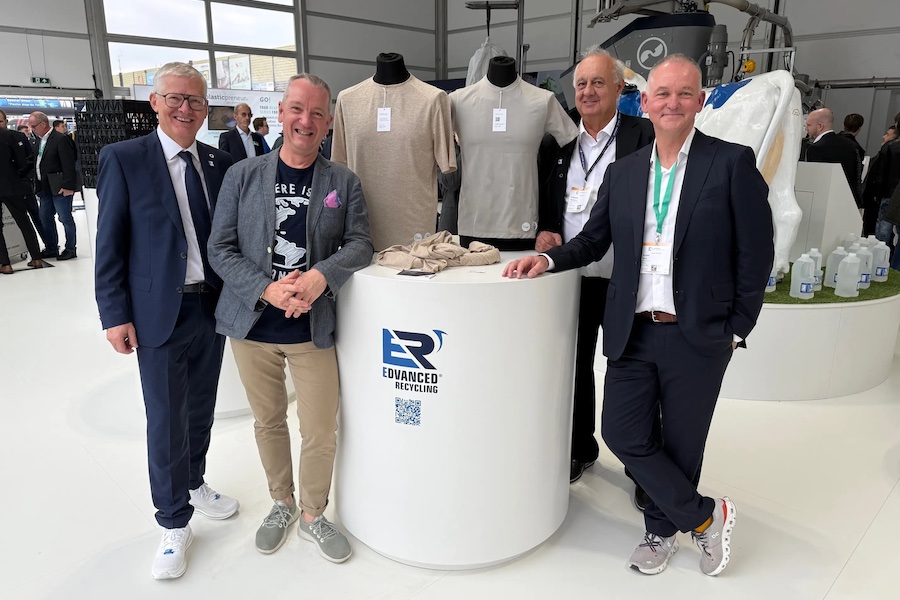
From left: Manfred Hackl (EREMA Group), Graham Ross (BlockTexx®), Wolfgang Hermann (EREMA Group), and Adrian Jones (BlockTexx®) next to T-shirts made from 100% recycled polyester. © 2025 EREMA
At K show in Düsseldorf, the world’s leading trade fair for plastics and rubber, EREMA Group announced a strategic investment in clean technology company BlockTexx®. The Australian pioneer has developed a process that separates polyester and cellulose from blended textiles. By combining both companies’ technologies, the partnership aims to scale post-consumer textile-to-textile recycling to industrial levels.


Through the strategic collaboration the EREMA Group emphasizes its commitment to returning polyester to the apparel production cycle and scaling up textile-to-textile recycling. “The PET fibre industry is three times the size of the PET bottle industry. We have been investing in the research and development of textile and fibre recycling for several years. With the technology we already provide for PET fibre recycling, our next step is to aim for full-scale industrial textile recycling. We consider BlockTexx® a key partner in this. Their technology paves the way for used textiles to re-enter the production cycle,” said Manfred Hackl, CEO of EREMA Group.

BlockTexx®‘s process separates polyester and cellulose from post-consumer textiles and clothing, providing the polyester for EREMA’s technology. The INTAREMA® FibrePro:IV system will process the polyester into recycled pellets suitable for new garment production. “Our thermomechanical recycling system is a core element for textile recycling,” said Wolfgang Hermann, Business Development Manager for Fibres & Textiles at EREMA Group. “However, full-scale textile recycling requires a combination of technologies, with BlockTexx® unlocking the solution for processing polyester-blended textiles.“

Industrial-scale expansion

BlockTexx® operates its first plant in Australia with a processing capacity of 10,000 tonnes per year, with plans for a second plant of 50,000 tonnes per year. Scaling up requires a strong investment partner. “Blended textiles like cotton-polyester account for over 60 per cent of global apparel production but are notoriously difficult to recycle due to fibre incompatibility and chemical contamination”, says Adrian Jones, co-founder of BlockTexx®. EREMA Group’s investment brings not only capital but also deep recycling expertise, proven technology and infrastructure. From the very beginning, it felt like a true partnership, Jones notes: “Both companies share the same intellectual curiosity and EREMA Group was committed to this journey from day one.”
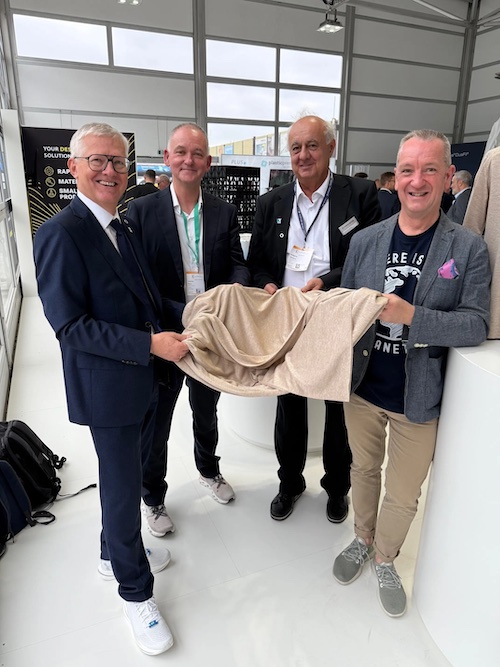
The same representatives  holding the new fabric made from 100% recycled polyester at the Edvanced Recycling Center, where EREMA demonstrates live recycling and products made of recyclate during the K show. © 2025 EREMA
The same representatives holding the new fabric made from 100% recycled polyester at the Edvanced Recycling Center, where EREMA demonstrates live recycling and products made of recyclate during the K show. © 2025 EREMA


Textile industry faces recycling challenges

According to global non-profit Textile Exchange 75 million tonnes of synthetic fibres were produced in 2023, with polyester being the most common, accounting for 57 per cent of total fibre production. Recycling rates for polyester are estimated at only 1 per cent. “Currently, nearly all the recycled polyester in the clothing you see in retail stores is derived from PET plastic bottles” says Graham Ross, co-founder of BlockTexx®. As per Textile Exchange, recycled fibres constituted 7.7 per cent of the global fibre market in 2023, with 7 per cent being recycled polyester from waste PET bottles. Hackl emphasizes: “The goal must be to ensure that rPET from bottles is returned to new bottles. This investment is not only positive for the textile industry, but also for the plastics industry. By keeping rPET in the bottle-to-bottle loop, we can stabilize supply and prices for the market.”

With the EU recently adopting binding legislation that will make textile producers responsible for the collection, sorting and recycling of textile waste through mandatory Extended Producer Responsibility (EPR) schemes, the sector is set for change. As these rules come into force over the coming years, the demand for post-consumer textile recycling solutions is expected to grow significantly. “The EU legislation could fundamentally transform the sector. While most textile production takes place in Asia, Europe is a major consumer of fashion. This legislation will therefore have a significant global impact”, Ross notes.

Setting new standards for circularity

By combining mechanical processing, chemical separation, and fibre regeneration, the partnership establishes a model that sets new industrial standards for circularity. “Twenty-five years ago, people could not imagine bottle-to-bottle recycling. Today it is standard. I believe the same will happen for textile-to-textile recycling”, says Hackl. “The textile industry has been slow to recognize the importance of recycling, often citing difficulties as an excuse. Now there are no more excuses. Textile-to-textile recycling will become a reality at industrial-scale through the collaboration between EREMA and BlockTexx®,” adds Jones.

More News from EREMA

More News on Recycled Fibers

#Techtextil 2026

RE&UP to showcase Next-Gen circularity in ISKO Pro workwear at Techtextil

RE&UP takes part in Techtextil 2026, where the team will be present at the ISKO Pro booth (Hall 9, Booth D31). Together, RE&UP and ISKO Pro are demonstrating how textile-to-textile solutions meet the non-negotiable specifications of the workwear sector.

#Recycled Fibers

Circulose and CTA announce collaboration to enable lyocell fibers using CIRCULOSE® pulp

Circulose has announced an agreement with China Textile Academy Green Fibre (CTA) to offer lyocell fibers produced using CIRCULOSE® pulp. Producing lyocell from recycled pulp at commercial scale is an important step in making textile-to-textile recycled materials available across a wider range of textile applications.

#Recycled Fibers

Recover™ and Prosperity Textile announce strategic denim partnership

Recover™, a global producer of low-impact, high-quality recycled cotton fiber at scale, has announced a strategic partnership with Prosperity Textile, a vertically integrated denim fabric manufacturer operating at industrial scale.

#Recycled Fibers

UNIFI celebrates recycled and circular Innovation with ninth annual REPREVE® Champions of Sustainability Awards

Unifi, Inc. (NYSE: UFI), the makers of REPREVE® and one of the world’s leading innovators in recycled and synthetic yarns, today announced the winners of its ninth annual REPREVE Champions of Sustainability Awards, recognizing brands and mills that are advancing circularity and responsible manufacturing across the global textile industry.

Latest News

#Knitting & Hosiery

“We Believe in the Value of Textiles”: Successful Opening of the KARL MAYER TEXTILE INNOVATION CENTER

KARL MAYER inaugurated its new, state-of-the-art TEXTILE INNOVATION CENTER (TIC) with a four-day opening week from April 21 to 24. The highlight of the week was the grand opening on Thursday, which drew a strong turnout from the international textile industry: around 220 customers, brands, and partners from across the textile value chain came to the company’s headquarters in Obertshausen for a first-hand look at the new high-tech development environment and lively exchange with industry peers.

#Techtextil 2026

Speed and connectivity: Techtextil and Texprocess provided market-ready solutions for industries under pressure

With more than 36,000 visitors and 1,700 exhibitors from a total of 112 countries, Techtextil and Texprocess 2026 demonstrated how innovation comes into industrial use. The convergence of research, industry and application proved to be a breeding ground for new material solutions, manufacturing and processing technologies. Natural fibres, performance apparel, connected systems and AI-driven processing technologies emerged as key growth and future markets.

#INDEX 2026

Italian Textile Machinery heads to Geneva for Index 2026

An important delegation of Italian companies will exhibit at the upcoming INDEX 2026, the world’s leading event for the nonwovens sector, taking place from May 19 to 22 in Geneva (Switzerland). Numerous Italian exhibitors will be present within the Italy Pavilion, organized by the Italian Trade Agency (ICE) and ACIMIT, an exhibition area of over 140 square meters dedicated to the latest innovations proposed by the Italian industry.

#Textile processing

Vivien Altmann-Morelli new Director of Texcare

As of May 1, 2026, Vivien Altmann-Morelli will take over as Director of Texcare International and the associated brand Textile Care & Cleaning Technologies. In addition, the Food Technologies brand will also fall under her responsibility.

TOP