[pageLogInLogOut]

#Recycling / Circular Economy

New EREMA polyolefin plant outputs more than 4 tonnes per hour
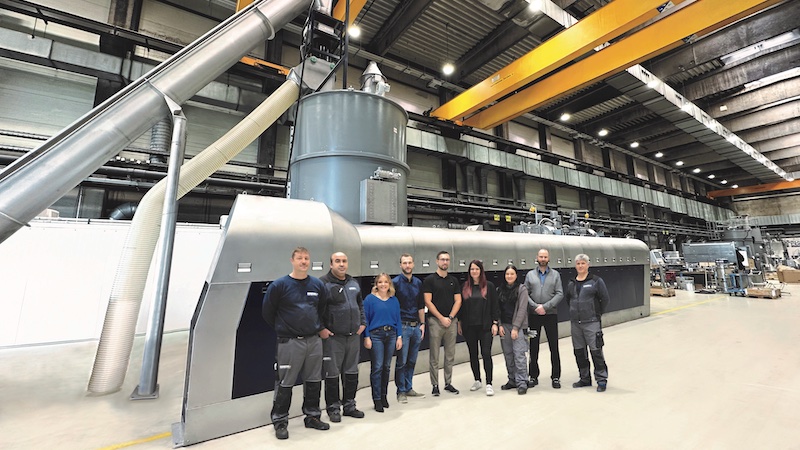
Premiere at EREMA: the new INTAREMA® 2325 sees the world's leading manufacturer of plastics recycling systems grow its post-consumer series to enter a new dimension in recycling. The INTAREMA® 2325 T-VEplus® RegrindPro® with laser filter is the largest system ever built to recycle polyolefin regrind and marks a milestone in the very latest recycling technology.
The INTAREMA® 2325 T-VEplus® RegrindPro® is the largest machine ever built for PO regrind and achieves a throughput of over 4 tonnes per hour. The picture shows the project team in front of the new plant © 2024 EREMA


As the demand for recycled plastics increases, so does the need for larger recycling machines. This is an industry where EREMA can draw on a wealth of proven experience. In the PET sector, the machine manufacturer has already implemented several projects with large-scale systems of this magnitude featuring their VACUREMA® technology. Now the company is following that up in polyolefin recycling. The new size of INTAREMA® is EREMA’s response to market demand. "New legislation and the voluntary commitment of major product brands mean that in the future, our customers will need to process an increasing volume of plastic waste to make high quality recycled pellets without any compromises," says Markus Huber-Lindinger, Managing Director at EREMA. "The INTAREMA® 2325 is our answer to this need."

More recycled pellets per hour

The INTAREMA® generation of machines is EREMA's flexible series for handling a wide variety of feed materials. Available in 13 sizes for film and 9 sizes for regrind applications, the INTAREMA® range covers a broad spectrum. The new 2325 model with a preconditioning unit (PCU) diameter of 2.30 metres and an extruder screw with a diameter of 250 millimetres enables the production of high volumes of high-quality recycled pellets using a single machine. "With a throughput of over 4,000 kilograms per hour for PO regrind, the INTAREMA® 2325 sets new standards in terms of performance and efficiency," emphasises Huber-Lindinger. The system also impresses with its compact footprint in contrast to its high throughput capacity.

Consistent processes combined with a high level of automation

The plant is packed with innovative technology. The proven key principle of the TVEplus® Counter Current® system lies in melt filtration upstream of extruder degassing. This makes it possible to produce recycled pellets of impressively high quality, meaning that the proportion of recycled plastics used in the final product can be significantly higher than with lower-quality recycled pellets. "Our extensive trials with around 500 tonnes of material have shown that the INTAREMA® 2325 impresses with high-quality recycled pellets at high throughput rates, all within a very stable process," says Sophie Pachner, R&D Manager for Process Engineering at EREMA.

Like all INTAREMA® systems, this one is also equipped with patented Counter Current® technology. The plastic material moves through the preconditioning unit in the opposite direction to the extruder screw, ensuring a consistently high output over a wide temperature range. This system, combined with a high degree of automation thanks to the intelligent Smart Start® user interface and energy-saving ecoSAVE® technology, makes the INTAREMA® series particularly user-friendly and efficient.

Largest laser filter ever

"We are convinced that the INTAREMA® 2325 is capable of achieving very high throughputs even with challenging process parameters," says Huber-Lindinger. "This machine is further proof of our company's outstanding engineering capabilities and our willingness and expertise to solve major challenges in plastics recycling."

Many of the specially built, large-scale components were installed and matched together for the first time during this project, such as 690-volt motors and the largest laser filter system ever built by EREMA. The 2/406 Quattro Laser Filter has a total filter area of 7,800 square centimetres and contributes to the high stability of the plant thanks to its robust design and precision filtration. The control panel array is also something new. At 12 metres long, the electrical container is imposing, but it is compact relative to the size of the machine. The well-thought-out configuration makes prior installation, transport and maintenance work particularly straightforward.

Machine available at short notice

EREMA offers machines for all applications, from small through to XXL sizes. From small systems for production waste with a throughput of around 100 kilograms per hour to large-scale PET systems with an output of 6,000 kilograms per hour, the company’s product range covers the whole spectrum. "The INTAREMA® 2325 fits perfectly into our wide product portfolio and enables us to respond even more specifically to the needs of our customers," says Huber-Lindinger.

The INTAREMA® 2325 is available immediately and can currently be purchased through EREMA's Fast Track scheme, which offers selected machines with particularly short delivery times. More information is available online at https://www.erema.com/en/fast-track-machines

More News from EREMA

More News on Recycling / Circular Economy

#ITM 2026

BB Engineering unveils new, patented “Val-uePack” spin pack at ITM

At the upcoming ITM in Istanbul, taking place June 9–13 at the Tüyap Fair Convention and Congress Center in Hall 7, Booth 702B, BB Engineering will once again be represented at a joint booth with its parent company, Barmag, and its representative, Tekstil Servis. The German machine manufacturer will show-case its expertise in man-made fiber and recycling technology, presenting its entire product portfolio, which includes compo-nents such as extruders and filters, as well as complete sys-tems for spinning synthetic fibers, air-texturing, and PET recy-cling.

#Recycled Fibers

Syre expands partnership with Target to advance next-generation recycled materials at scale

Advancing next-generation materials to support scalable circular solutions across global retail Stockholm, May 2026 — Syre, the textile impact company hyperscaling textile-to-textile recycling today announced an expanded collaboration with Target to accelerate the adoption of next-generation recycled materials across retail at scale.

#Recycling / Circular Economy

Project REWEAR investigates diverse economies of rewear as a global practice of circularity

Every year, European households discard millions of tonnes of clothing. Around a quarter of what gets separately collected is exported, much of it classified as rewearable. A significant share ends up in markets like Kantamanto in Accra, Ghana, where an estimated 15 million garments arrive every week. New research published today reveals what happens when that clothing arrives.

#Recycling / Circular Economy

RE&UP contributes to Global Fashion Summit 2026 circularity discussion

RE&UP contributed to the global conversation on textile circularity at Global Fashion Summit 2026 in Copenhagen, where Fatih Konukoğlu, Chairman of RE&UP and Vice Chairman of Sanko Holding, took part in both the keynote session “The New Rules” and the panel discussion “A Reckoning and Renewal for Circular Horizons”, alongside leaders from H&M Group, Looper Textile Co. and Sourcing Journal.

Latest News

#INDEX 2026

“We clearly see that reliability, flexibility, service and total cost of ownership are becoming increasingly important again.”

The nonwovens industry continues to face a challenging market environment. Nevertheless, AUTEFA Solutions reports successful projects, new line sales and growing demand for energy-efficient and flexible solutions. In this interview, André Imhof of AUTEFA Solutions talks about competitiveness against Chinese suppliers, new service and recycling concepts, the growing importance of application development and the opportunities created by countercyclical investments.

#INDEX 2026

“Needle punching technology is more universal and sustainable than ever!”

Needle punching technology was long regarded as a rather traditional and comparatively slow technology within the nonwovens industry. In this interview, Johann Philipp Dilo explains why needle punching is more relevant than ever today – ranging from energy efficiency and resource conservation to hygiene applications, new machine concepts and design-oriented nonwoven solutions.

#Research & Development

Textile climate control system in workwear – exhibition at the 2026 SME Innovation Day!

Conventional protective workwear often reaches its limits during strenuous physical activity. In particular, the transport of sweat and excess body heat poses a problem. The German Institutes of Textile and Fiber Research (DITF) conducted research on flow-optimized, air-conducting textile structures that enable targeted climate control directly on the body. These structures can be integrated straight into protective work garments. The textile climate control system supports the body’s natural thermoregulation. This contributes to improved workplace safety and comfort.

#Nonwovens

PET spunbond from China – EDANA welcomes imposition of provisional anti-dumping measures

On 13 May 2026, after eight months of investigation, the European Commission imposed provisional anti-dumping duties of 45.6-50.0% on imports of PET spunbond from China. EDANA welcomes this expression of the Commission’s clear determination to protect EU industries from the unfair trade practices of Chinese producers.

TOP