[pageLogInLogOut]

#Raw Materials

Textile Exchange’s latest report aims to drive a shift away from unchecked resource extraction in fashion, apparel, and textile
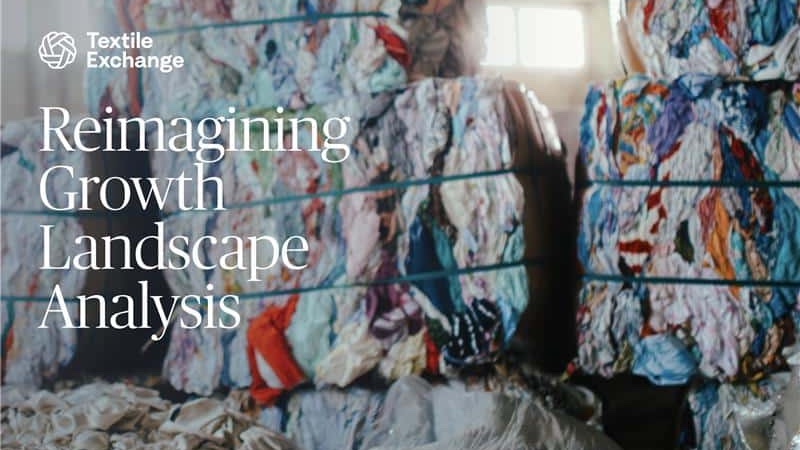
The Reimagining Growth Landscape Analysis is a comprehensive report examining the prevailing linear “take-make-waste” business model. The report highlights that the industry’s current trajectory is incompatible with achieving key climate, nature, and human rights goals, with impacts only increasing while growth remains a business imperative. It calls on existing scientific and academic literature to provide a set of pathways to reimagine value creation beyond exponential increases in the extraction and production of new raw materials to create new products.
Report cover Reimagining Growth Landscape Analysis © 2024 Textile Exchange


Detailed in the Reimagining Growth Landscape Analysis is the case for pivoting business success in the industry from the traditional interpretation of growth to a model aligned with “regenerative economy” and “post-growth” principles. This will be necessary not only to bring it back in line with the planet’s limits, but to ensure its own resilience, mitigating future risks associated with supply chain instability, resource depletion, overreliance on finite resources, and incoming legislation. 

Beyond outlining the risks of business-as-usual, the Reimagining Growth Landscape Analysis looks at the potential pathways for value creation through an approach that respects both environmental and social imperatives, contributing to a better future for all. 

Download the report  

https://textileexchange.org/app/uploads/2024/12/Reimagining-Growth-Landscape-Analysis.pdf

Discover some of the key takeaways 

+ Reimagining growth looks different for every material. For virgin fossil-based synthetics, Textile Exchange advocates for phasing them out as quickly as possible. For natural materials, it’s about ensuring the availability of sustainably sourced renewable materials—like regenerative and organic options—while limiting growth to protect the conversion of pristine ecosystems.

+ Growth as it has been traditionally defined — whether in terms of sales, production, or market share — is deeply ingrained in overarching financial systems and corporate culture. In most cases, pressure to prioritize growth outweighs sustainability goals, particularly when facing investors and shareholders who are accustomed to short-term financial returns.

+ A significant challenge associated with elevating this topic to business leaders is terminology. An industry survey conducted as part of the research for this report indicated a lack of alignment on a single term that accurately and clearly articulates the concepts for all stakeholders. However, the report emphasizes that this should not hinder progress.

+ Pathways for change at the raw material level include eliminating the use of virgin fossil-based synthetic materials and championing sustainably sourced renewable and closed-loop, textile-to-textile recycled feedstocks. Designing durable, high-quality products and scaling circular business models, such as repair, rental, resale, and responsible take-back initiatives, will also be key, as well as eliminating marketing practices that drive overconsumption and supporting consumer awareness, education, and engagement instead.

+ These pathways require systemic support, advocating for ambitious government policy and collective corporate commitment to accelerate the transition to a post-growth model. Ensuring a just transition — protecting the rights, livelihoods, and well-being of people across the value chain — is also essential, making space for contributions from all stakeholder groups to leave no one behind.

+ The shift that needs to occur for transformational change is at the market level, rather than just at the individual business level, and it cannot be achieved by a single brand or the textile industry alone. Businesses should explore the role they can play in helping to drive this shift, sharing best practices and learnings to support others to follow suit.

More News from Textile Exchange

#Sustainability

Textile Exchange evolves its membership structure to unlock the next stage of collective action for climate and nature

Textile Exchange is excited to announce that it is evolving its membership structure to a more action-oriented, impact-driven model designed to provide clearly defined pathways that help organizations respond to the climate and nature crisis.

#Sustainability

Key takeaways from the 2025 Textile Exchange conference

Brands and retailers, suppliers, innovators, recyclers, farmers, non-profit organizations, and academics convened at Textile Exchange’s Annual Conference, held in the Lisbon Conference Centre.

#Sustainability

Textile Exchange announces the winners of the 2025 Climate and Nature Impact Awards

Textile Exchange is pleased to announce the winners of the 2025 Climate and Nature Impact Awards. These awards recognize individuals and partnerships making progress toward a regenerative and equitable raw materials economy.

#Sustainability

Textile Exchange Conference 2025: Setting the course for systemic change

The 2025 Textile Exchange Conference brought together more than 1,600 participants on site in Lisbon and online, marking two days of intense dialogue on the future of sustainable and regenerative material systems. With a focus on collaboration, data-driven progress, and systemic transformation, the sessions highlighted both the challenges and the opportunities in building a truly resilient textile industry.

More News on Raw Materials

#Natural Fibers

Human Rights Day: Cotton made in Africa reinforces its commitment to ensuring respect for human rights in cotton production

The sustainable cotton standard Cotton made in Africa (CmiA) has always focussed on respect for human rights, including by prohibiting child labour and discrimination. With the new version of the CmiA standard coming into force, AbTF raises requirements for due diligence in the areas of human rights and risk management.

#Research & Development

How innovations drive BASF’s success

“Innovation has always been part of BASF’s DNA. Especially in these volatile times, it is crucial to leverage our innovative strength to develop competitive solutions that differentiate us as a company in our markets and give us a competitive edge,” said Dr. Stephan Kothrade, Member of the Board of Executive Directors of BASF and Chief Technology Officer, at the company’s Research Press Briefing held today. To achieve this, BASF implemented its “Winning Ways” strategy about a year ago with the clear goal of becoming the preferred chemical company to enable its customers’ green transformation.

#Natural Fibers

38th International Cotton Conference Bremen launches registration and unveils key topics

Participants can now register online for the 38th International Cotton Conference Bremen, which will be held on 25-27 March 2026 at the Haus der Bürgerschaft parliament building on market square. All visitors can look forward to a high-calibre conference programme, numerous additional meetings and a valuable exchange of knowledge and information. The comprehensive range of topics covering the entire value chain will provide practical expertise, address current developments, answer key industry questions, and provide new impetus for the future.

#Natural Fibers

ICAC to collaborate with Uzbekistan and Bizpando on regenerative agriculture

The Government of Uzbekistan has allocated 55,000 hectares of land to implement a regenerative agriculture program for cotton as part of a collaborative project with the International Cotton Advisory Committee (ICAC) and Bizpando, a company with a a blockchain-based internet platform designed to ensure supply chain compliance.

Latest News

#Spinning

First PA66 spinning plant with EvoQuench successfully commissioned

With the successful commissioning of a multi-digit PA66 spinning line for microfiber yarns, Chinese textile company Shandong Nanshan Fashion Technology Co., Ltd. has added yarn production to its textile value chain.

#Knitting & Hosiery

SHIMA SEIKI returns to ShanghaiTex

Leading flat knitting solutions provider SHIMA SEIKI MFG., LTD. of Wakayama, Japan, together with its Hong Kong and Chinese market subsidiary SHIMA SEIKI (HONG KONG) LTD., will exhibit at the ShanghaiTex 2025 exhibition (Booth No.: Hall N3, Booth A20) held in Shanghai, China this month. This marks the return of SHIMA SEIKI to ShanghaiTex after a 14-year hiatus, its last exhibit at the show having been in 2011.

#Research & Development

Fraunhofer CCPE presents the “Monomaterial Design Set” – Innovative solutions for circular product design

Composite materials made from different types of plastic often extend the lifetime of products but make recycling more difficult in the circular economy. That is why Fraunhofer CCPE has developed the “Monomaterial Design Set”. This new approach helps to reduce the variety of plastics used in durable products and offers circular solutions for designers and product developers.

#Man-Made Fibers

arena introduces renewable LYCRA® EcoMade fiber in its latest swimwear collection

Italian swimwear specialist arena has unveiled a new collection that brings sustainability and performance even closer together. Launched on December 4, the line features swimsuits made from recycled nylon and renewable LYCRA® EcoMade fiber — the first time the bio-based spandex has been used commercially in swimwear.

TOP