[pageLogInLogOut]

#Raw Materials

Cotton experts meet in Bremen in 2024
© 2023 Bremen Cotton Exchange
There are just over 100 days to go until the start of the International Cotton Conference Bremen 2024. Traditionally, the event is renowned for its high-level professional discussions on issues relating to cotton and its supply chain, and for linking scientific research with practical application.

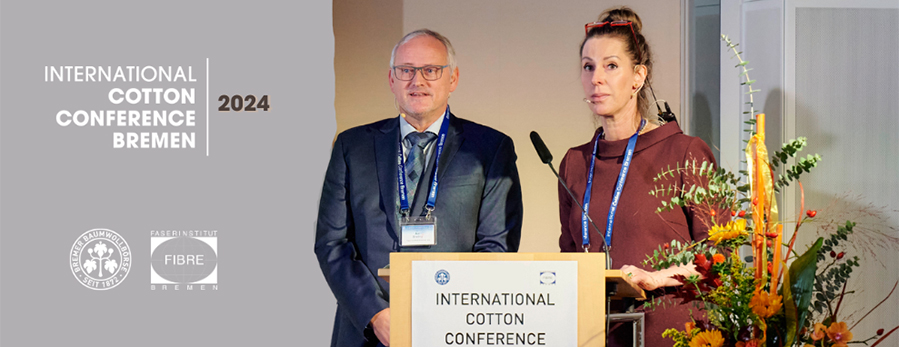
In this interview with the Bremen Cotton Report editors, organisers Elke Hortmeyer, Bremen Cotton Exchange, and Axel Drieling, Faserinstitut Bremen e.V. (Fibre Institute Bremen), explain among other things the three key reasons why it’s worth coming to Bremen in March 2024. They also look at this year’s new features, programme highlights and the Bremen Cotton Week.

© 2023 Bremen Cotton Exchange


After Corona and the anniversary, can we expect another ‘normal’ conference in 2024?

Elke Hortmeyer: For us there is now a ‘new normal’. This means that we are not simply going back to the old-style conference but continuing with the great new developments from recent years. We are organising the International Cotton Conference Bremen in such a way that we can continue to offer hybrid sessions and a high-performance online platform for all participants.

In principle, we are continually striving to improve the programme and organisation. The heart of the conference remains unchanged: cotton quality, scientific findings, and the global cotton market, all discussed at a high level.

What are the thematic highlights of the conference?

Axel Drieling: Naturally, every visitor has their own interests, so everyone can pick out their own particular highlights from a broad range of talks covering the entire cotton value chain.

In addition to annually recurring topics, the 2024 conference will for the first time include an entire session dedicated to the subject of ginning. Another session will show opportunities along the way to achieving circularity with the whole range of cotton and mixed textile recycling, combined with technical, economic, and ecological evaluations. At this year’s event we will again take a closer look at another cotton/textile region. We won’t reveal which one just yet. But it’s great that we can present content from every continent and a variety of regions in our wide-ranging lectures. We have speakers from North and South America, for example, along with the Mediterranean, Africa, Asia, China, and Australia.

Will there be another presentation of scientific posters?

Drieling: Yes, there will. This year we will actually present the largest poster collection since the conference began. This includes a large poster group from Côte d’Ivoire where various cotton cultivation topics are being intensively researched.

What new conference features can attendees look forward to?

Hortmeyer: Quite a few! We already had a change of venue last year. We will do this again in 2024. This year’s event will be held in Bremen’s parliament building right next to the Cotton Exchange. After the Town Hall and Chamber of Commerce, we are gradually making our way around the market square, but always staying close to the Cotton Exchange. And, of course, we are looking forward to seeing many new faces amongst the speakers.


Will there be another Bremen Cotton Week?

Hortmeyer: The main conference will take place as announced from Wednesday to Friday in the parliament building. It will be accompanied by several other industry meetings and seminars, both before and after. All in all, attendees will spend an enjoyable week in Bremen, engaging not only with the key topic of cotton, but also the entire field of textile processing and other natural fibres.

Drieling: More specifically, there’s the ITMF Testing Committee Seminar on Monday and the Textile & Spinners Seminar on Tuesday, presented by the ITMF and IVGT.

What are the three most important reasons why people should definitely not miss this conference?

Drieling: Off the cuff, I would say “Experts, Topics, Party”!

Hortmeyer: Exactly! Firstly, many experts will come together in Bremen knowing they will meet other experts. This level of skill density is unique in the world.

Drieling: Secondly, unlike many national cotton conferences, the event in Bremen covers the full breadth of content from cotton cultivation and production through to the end product and retailers.

Hortmeyer: And thirdly, there’s the Bremen Cotton Night. The party on Thursday evening is now legendary, and this year it takes place once again in the medieval cellar rooms of Bremen’s historic Town Hall.

Thank you very much for the interview!



More News from Bremer Baumwollbörse

#Raw Materials

Fiber traceability - A vehicle to ensure sustainability or injustice?

The Bremen Cotton Exchange is making a new paper available for download. In this paper, analyst Veronica Bates Kassatly and statistician Terry Townsend examine the justifications behind this approach and assess the consequences for textile and apparel sustainability claims and global legislation.

#Raw Materials

A Powerful Opening: Global thought leaders launch the International Cotton Conference Bremen

The International Cotton Conference Bremen will open on 25 March 2026 in the Parliament building of the Free Hanseatic City of Bremen with a keynote session of exceptional calibre. Distinguished international experts will set the stage for the conference by offering incisive perspectives on the most pressing challenges and the defining trends shaping the future of the global cotton trade. Their insights will span a broad spectrum — from geopolitically driven disruptions affecting global supply chains to the opportunities emerging from innovation-led agriculture capable of supporting a growing world population. Together, these opening keynotes will frame the dialogue of the conference, highlighting both the complexity of today’s market environment and the pathways toward a resilient and forward-looking cotton sector.

#Natural Fibers

Beyond Cotton: Natural Fibres in the Spotlight at the Bremen Cotton Conference - Branded by DNFI

Climate targets, fragile supply chains, and rising regulatory requirements are fundamentally changing the perspective of the textile industry - the focus is increasingly shifting toward the base material. Not only cotton, but natural fibres are gaining significant importance: they stand out not only because of their outstanding functional properties, but also because they make a valuable contribution to the bioeconomy and responsible product development.

#Raw Materials

Beyond the wardrobe – innovative cotton takes the spotlight

Cotton can do more – a lot more. Cutting-edge textiles and high-tech products made from 100% cotton prove just how powerfully performance and sustainability can come together. That very surge of innovation is front and centre at the 38th Bremen Cotton Conference, taking place March 25–27, 2026, at Bremen’s Parliament on the historic market square – culminating in a bold and dedicated closing session on Friday. In the spotlight: performance upgrades for pure cotton, smart strategies for circular textile waste solutions, and pioneering concepts for demanding technical applications. From natural fibre–reinforced composites to highly effective flame-retardant solutions, cotton steps out of the closet and shows the future potential woven into every fibre.

More News on Raw Materials

Latest News

#

DTF vs DTG Printing - The technologies shaping today’s custom merchandise market

From sportswear to branded tote bags, custom merchandise continues to grow in popularity across sectors, driving print shops to cater to short runs, personalisation, and rapid turnaround. As print providers look to this market, two printing technologies often stand out: Direct‑to‑Film (DTF) and Direct‑to‑Garment (DTG). Each offers its own benefits, and understanding these differences helps determine the most suitable production method for print service providers.

#Associations

Towards pragmatic and harmonised labelling in the EU

EDANA, alongside 14 European associations, urges the European Commission and Member States to adopt a pragmatic approach for the future harmonised packaging labels, in line with the EU’s agenda for the EU Single Market, simplification and competitiveness. The system should rely on text-free pictograms, available in achromatic or monochromatic versions matching the packaging palette, with the possibility of using digital labelling as a core element. Our associations represent manufacturers of consumer goods across Europe.

#Spinning

"We will become a recycling powerhouse"

The textile industry is now in its fourth consecutive year of crisis, while automation, artificial intelligence and recycling are reshaping the rules of the game. In this interview, Rieter CEO Thomas Oetterli discusses the first signs of a market recovery, reflects on his first three years at the helm of the company, explains the integration of Barmag, outlines Rieter’s vision of the fully automated spinning mill and highlights the strategic importance of recycling. In doing so, he explains why the new Rieter Group aims to play a leading role in transforming the textile value chain into a circular economy.

#Sustainability

Textile Exchange unveils agenda for 2026 conference in Vancouver

Textile Exchange has released the agenda for its 2026 Conference, which will take place from October 12–16 in Vancouver, Canada. Under the theme “The Implementation Era,” the event will focus on translating sustainability commitments into practical action and scaling solutions across businesses, supply systems, and landscapes.

TOP