[pageLogInLogOut]

#Raw Materials

Continued growth for Cotton made in Africa
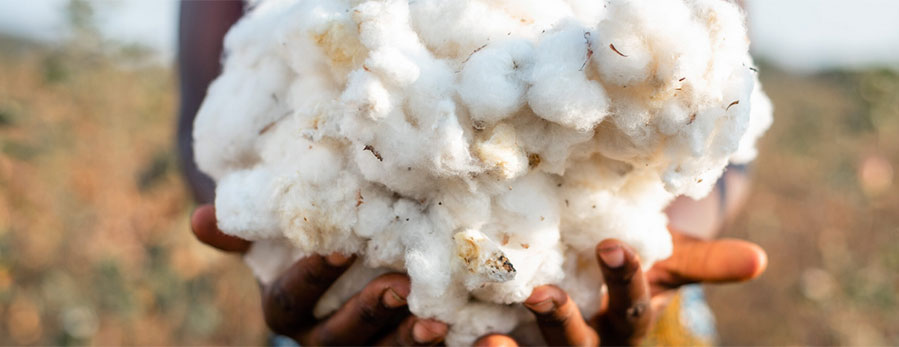
© 2021 Cotton made in Africa
International demand for Cotton made in Africa (CmiA) cotton continues to grow. New partners—including BRAX from Germany, Jolo Fashion Group from the Netherlands and Shinsegae International from South Korea—are joining the CmiA initiative to promote sustainable cotton cultivation, protect the environment, and improve the working and living conditions of small-scale farmers and their families, currently numbering around one million.

Tina Stridde, the managing director of the Aid by Trade Foundation and of its CmiA initiative, is pleased with the new partnerships, saying, “Only with committed partners at our side can we advocate together for small-scale farmers in Africa, their families, and the responsible production of our raw materials now and in the future. Our recent growth shows that companies from around the world, whether small brands or global enterprises, can achieve their own sustainability goals through Cotton made in Africa and make them visible to their customers.”

“Cotton made in Africa has impressed us,” comments Shinsegae International Co-CEO and Head of Jaju division Lee Seock-koo. “The standard addresses both social and ecological aspects of sustainable cotton production. This allows us to source our textiles sustainably and to offer our customers what they are increasingly looking for: a sustainable alternative to conventional goods.”

As one of the world’s leading initiatives for sustainably produced cotton in Africa, Cotton made in Africa represents a socially and environmentally responsible basis for the global textile chain. It gives a face to the small-scale farmers who form the bedrock of the fashion industry. Working in accordance with the Cotton made in Africa standard, some one million small-scale farmers from ten countries in Sub-Saharan Africa currently account for around 30 percent of African cotton production. According to the most recent study results, CmiA cotton has a significantly smaller ecological footprint than the global average. With greenhouse gas emissions at 13 percent below the global average for cotton cultivation, CmiA cotton also contributes less to climate change [1].


Small-scale farmers benefit from agricultural and business training that enables them to improve their yields and cultivation methods. Beyond sustainable cotton production, Cotton made in Africa actively advocates for issues like healthcare, respect for children’s rights, and equal rights for men and women. This directly contributes to improved awareness of social issues in village communities. Factory workers in the ginneries, where cotton seeds are separated from the fibres by machine, benefit from improved working conditions. Consumers can identify these products through the Cotton made in Africa label. Each purchase represents a direct investment in improving living conditions and protecting our environment.

[1] Data for CmiA refer to Sphera (2021) – CmiA Life Cycle Assessment (LCA). Published online at cottonmadeinafrica.org. Retrieved from: ‘https://cottonmadeinafrica.org/wp-content/uploads/CmiA_LCA-Study_2021.pdf [Online Resource].Global averages are drawn from data published in The life cycle inventory & life cycle assessment of cotton fiber & fabric (Cotton Inc, 2017).



More News from TEXDATA International

#Recycling / Circular Economy

textile.4U publishes special edition “Top 100 Textile Recycling Companies 2025”

With a comprehensive 176-page special edition, textile.4U is dedicating its latest issue entirely to one of the most dynamic and influential topics in today’s textile industry: textile recycling. The new issue, published exclusively in high-quality print, presents the Top 100 textile recycling companies researched and selected by TexData – organizations that already play a key role in the transition to circular textiles or are expected to have a significant impact in the near future.

#Recycling / Circular Economy

Responsible Textile Recovery Act of 2024 signed by Governor

Senator Josh Newman (D-Fullerton) is proud to announce that Senate Bill 707 (SB 707), the Responsible Textile Recovery Act of 2024, has been signed into law by the Governor of California, Gavin Newsom. This groundbreaking legislation establishes the country’s first Extended Producer Responsibility (EPR) textile recycling program, marking a significant step forward in the state’s efforts to combat waste and promote sustainability.

#Textiles & Apparel / Garment

Modtissimo promotes sustainability with 28 coordinates in the Green Circle

Modtissimo is proving more and more to be a textile and clothing show that delivers the latest innovations in the area of sustainability, with the iTechStyle Green Circle being the main showcase for companies' creations. In this 60+4 edition, taking place on 12 and 13 September, 28 coordinates will be exhibited in a section organised by CITEVE and curated by Paulo Gomes.

#Europe

The EU and Egypt team up to mobilise private sector investments at Investment Conference and sign a Memorandum of Understanding underpinning €1 billion in macro-financial assistance for Egypt

At the EU-Egypt Investment Conference, co-organised by the EU and the Government of Egypt on 29-30 June, the EU and Egypt are teaming up to intensify private sector investments in Egypt. They are also signing a Memorandum of Understanding (MoU) for the disbursement to Egypt of up to €1 billion in Macro-Financial Assistance.

More News on Raw Materials

#Natural Fibers

Human Rights Day: Cotton made in Africa reinforces its commitment to ensuring respect for human rights in cotton production

The sustainable cotton standard Cotton made in Africa (CmiA) has always focussed on respect for human rights, including by prohibiting child labour and discrimination. With the new version of the CmiA standard coming into force, AbTF raises requirements for due diligence in the areas of human rights and risk management.

#Research & Development

How innovations drive BASF’s success

“Innovation has always been part of BASF’s DNA. Especially in these volatile times, it is crucial to leverage our innovative strength to develop competitive solutions that differentiate us as a company in our markets and give us a competitive edge,” said Dr. Stephan Kothrade, Member of the Board of Executive Directors of BASF and Chief Technology Officer, at the company’s Research Press Briefing held today. To achieve this, BASF implemented its “Winning Ways” strategy about a year ago with the clear goal of becoming the preferred chemical company to enable its customers’ green transformation.

#Natural Fibers

38th International Cotton Conference Bremen launches registration and unveils key topics

Participants can now register online for the 38th International Cotton Conference Bremen, which will be held on 25-27 March 2026 at the Haus der Bürgerschaft parliament building on market square. All visitors can look forward to a high-calibre conference programme, numerous additional meetings and a valuable exchange of knowledge and information. The comprehensive range of topics covering the entire value chain will provide practical expertise, address current developments, answer key industry questions, and provide new impetus for the future.

#Natural Fibers

ICAC to collaborate with Uzbekistan and Bizpando on regenerative agriculture

The Government of Uzbekistan has allocated 55,000 hectares of land to implement a regenerative agriculture program for cotton as part of a collaborative project with the International Cotton Advisory Committee (ICAC) and Bizpando, a company with a a blockchain-based internet platform designed to ensure supply chain compliance.

Latest News

#Recycled_Fibers

Leading fashion brands step up to unlock the next chapter of Circulose

Since 2024, under new ownership and leadership, Circulose has set a renewed strategic direction focused on securing long-term commitments with partner brands to bring CIRCULOSE® back to market at scale. This strategy has proven successful.

#Research & Development

More safety and comfort for protective clothing thanks to auxetic fabrics

When everyday materials are pulled, they stretch or elongate in the direction of the pull and become narrower in cross-section. We can also observe this property in two-dimensional textiles. Auxetic structures behave differently here. They have the striking property of not changing under tensile stress or even increasing their width or thickness. These properties are advantageous, for example, in protective textiles or textile filter media. The DITF are researching auxetic fabrics for various applications.

#Recycled_Fibers

Recycling mixed-fibre garments becomes a reality: RadiciGroup, The LYCRA Company and Triumph take circular fashion a step forward

The process, which is both economically and environmentally sustainable, has enabled the production of an underwear set made from 100% recycled nylon and LYCRA® fibre in a closed-loop system.

#Spinning

First PA66 spinning plant with EvoQuench successfully commissioned

With the successful commissioning of a multi-digit PA66 spinning line for microfiber yarns, Chinese textile company Shandong Nanshan Fashion Technology Co., Ltd. has added yarn production to its textile value chain.

TOP