[pageLogInLogOut]

#Raw Materials

ICAC makes ‘Cotton This Month’ free to all for three months due to pandemic

As part of its Covid-19-focussed communications strategy, the International Cotton Advisory Committee (ICAC) is making one of its flagship publications, Cotton This Month, free to all for the months of May, June and July. It includes the major report, which is released the first business day of each month, as well as the mid-month update.

The ICAC, recognising the serious threat to the global cotton supply chain, is foregoing the revenue from the publication because the organisation believes it’s more important to keep all cotton and textile stakeholders informed and connected.

‘Once the world gets the coronavirus under control, the cotton and textile industries will face the serious challenge of restarting their stalled global supply chains’, said ICAC Executive Director Kai Hughes.

‘To minimise the suffering of so many vulnerable people, we will need to be ready to get back to work as quickly and safely as possible — and that can only happen if all stakeholders stay informed and connected throughout the crisis. Making some of our information free will help stakeholders make informed strategic decisions to ensure that happens’.

Other initiatives in the ICAC’s Covid-19 communications strategy are:

  • A video interview series called ‘Cotton Connects’, in which the ICAC Secretariat interviews global cotton and textile industry leaders to get advice and updates;
  • A Twitter campaign to publicly recognise those global brands and retailers that are meeting their responsibilities by paying for, or agreeing to pay for, all orders that have been completed or are under construction; and
  • Driving and coordinating global support for the much-anticipated World Cotton Day on 7 October 2020, in which individuals, associations and businesses will celebrate and show their support for cotton, the world’s most important natural fibre.


To access ‘Cotton This Month’, please click here:

https://www.icac.org/Publications?MenuId=41

To view the Cotton Connects series of video interviews, please click here:

https://www.icac.org/News/NewsDetails?NewsId=2332&YearId=2020

To learn more about World Cotton Day, please lick here:

https://www.icac.org/Home/WorldCottonDay?MenuId=71

More News from International Cotton Advisory Committee (ICAC)

#Raw Materials

China projected to increase cotton production, yields, and imports in 2026/27

World cotton production in the 2026/27 season is projected at 25.9 million tonnes, exceeding global consumption of 25.2 million tonnes, according to the May 2026 issue of Cotton This Month. That means both production and consumption are expected to remain close to current season levels, while global cotton trade is projected to decline by 2.7% to approximately 9.6-9.7 million tonnes.

#Raw Materials

ICAC launches Carbon Credits Initiative to deliver new income streams to cotton farmers

The International Cotton Advisory Committee (ICAC) has announced a new initiative designed to unlock additional income streams for cotton farmers through participation in carbon credit markets, linking sustainable production practices directly to financial returns.

#Raw Materials

Global production expected to decline in 2026/27 as policy shifts and weak demand reshape trade

Early projections for the 2026/27 season indicate that global cotton lint production will decline by 4% to 24.9 million tonnes, while world consumption is expected to remain stable at approximately 25 million tonnes, according to the April 2026 issue of Cotton This Month.

#Raw Materials

The 83rd Plenary Meeting: Reports from the ICAC Secretariat

Every year, one of the most anticipated sessions at the International Cotton Advisory Committee's (ICAC) Plenary Meeting is the Reports from the Secretariat — and the 83rd edition in Bremen, Germany, did not disappoint.

More News on Raw Materials

#Raw Materials

ECCO introduces first shoe featuring innovative protein-based fibre

ECCO, in partnership with Spinnova, announces the launch of the limited edition ECCO BIOM® 720, a first-of-its-kind shoe utilising an often overlooked leather by-product, transformed into a protein-based fibre. The fibres are produced using patented technology that advances material innovation while reducing waste and supporting full resource use across the leather and textile industry.

#Raw Materials

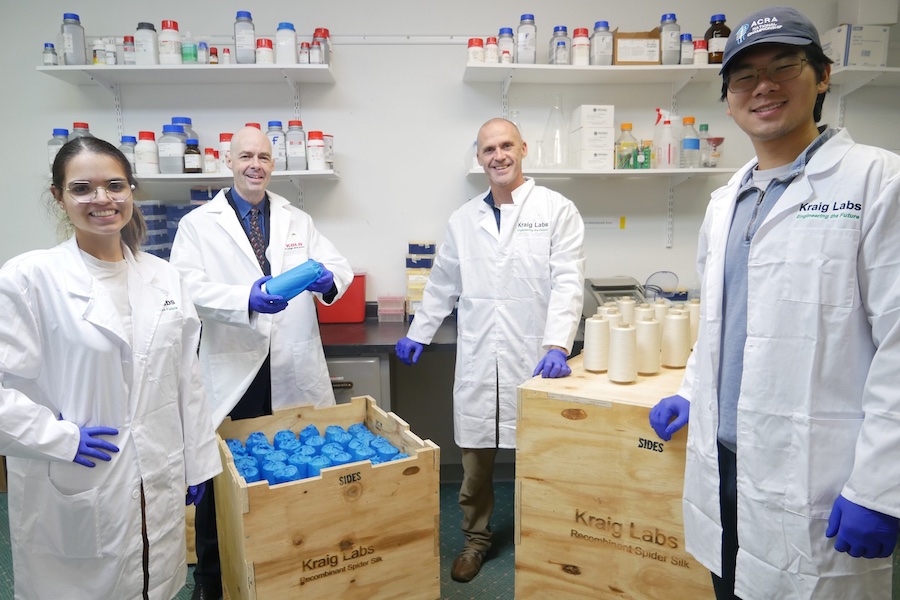
Kraig Biocraft Laboratories reports major progress converting record-setting spider silk cocoon production into reeled silk

Kraig Biocraft Laboratories, Inc. (OTCQB: KBLB) (“the Company”, “Kraig Labs”, or “Kraig’s”), a world leader in spider silk technology*, today announced significant progress in the processing of its recently produced recombinant spider silk cocoons into reeled silk.

#Textile processing

trinamiX mobile NIR spectroscopy: New applications for the footwear and textile industry

trinamiX GmbH expands its solution portfolio for the circular economy, now enabling the identification of materials used in the footwear and textile industries. With its mobile near-infrared (NIR) spectroscopy solutions, trinamiX supports manufacturers, sorters, recyclers, and brand owners in reliably identifying materials and improving transparency across increasingly complex value chains.

#Raw Materials

Fiber traceability - A vehicle to ensure sustainability or injustice?

The Bremen Cotton Exchange is making a new paper available for download. In this paper, analyst Veronica Bates Kassatly and statistician Terry Townsend examine the justifications behind this approach and assess the consequences for textile and apparel sustainability claims and global legislation.

Latest News

#INDEX 2026

“We clearly see that reliability, flexibility, service and total cost of ownership are becoming increasingly important again.”

The nonwovens industry continues to face a challenging market environment. Nevertheless, AUTEFA Solutions reports successful projects, new line sales and growing demand for energy-efficient and flexible solutions. In this interview, André Imhof of AUTEFA Solutions talks about competitiveness against Chinese suppliers, new service and recycling concepts, the growing importance of application development and the opportunities created by countercyclical investments.

#INDEX 2026

“Needle punching technology is more universal and sustainable than ever!”

Needle punching technology was long regarded as a rather traditional and comparatively slow technology within the nonwovens industry. In this interview, Johann Philipp Dilo explains why needle punching is more relevant than ever today – ranging from energy efficiency and resource conservation to hygiene applications, new machine concepts and design-oriented nonwoven solutions.

#Research & Development

Textile climate control system in workwear – exhibition at the 2026 SME Innovation Day!

Conventional protective workwear often reaches its limits during strenuous physical activity. In particular, the transport of sweat and excess body heat poses a problem. The German Institutes of Textile and Fiber Research (DITF) conducted research on flow-optimized, air-conducting textile structures that enable targeted climate control directly on the body. These structures can be integrated straight into protective work garments. The textile climate control system supports the body’s natural thermoregulation. This contributes to improved workplace safety and comfort.

#Nonwovens

PET spunbond from China – EDANA welcomes imposition of provisional anti-dumping measures

On 13 May 2026, after eight months of investigation, the European Commission imposed provisional anti-dumping duties of 45.6-50.0% on imports of PET spunbond from China. EDANA welcomes this expression of the Commission’s clear determination to protect EU industries from the unfair trade practices of Chinese producers.

TOP