[pageLogInLogOut]

#Raw Materials

A sustainable supply chain, from the ground up: a case study of CCI

Cotton Council International (CCI) is a global non-profit organisation, which promotes US cotton using their COTTON USA™ brand. While they have participated at previous editions of Intertextile, in 2019 they took part in Yarn Expo for the first time. Messe Frankfurt had a chance to sit down with Ms Karin Malmström, Director of CCI China & Northeast Asia, to discuss the benefits of using a sustainable raw material throughout the entire supply chain.

Messe Frankfurt: Thank you for meeting with us, Ms Malmström! Could you tell us more about what Cotton Council International represents?

Ms Karin Malmström: CCI’s main purpose is to promote the US cotton industry to overseas markets – like a matchmaking service. The US cotton industry is really one entity, because it is so strictly governed by the United States Department of Agriculture. We have 18,500 different farmers but only one set of standards for the whole country. This helps to set a benchmark for the best practices in sustainable cotton growth. Any of our farmers can be audited at any time, and if they don’t pass, they can’t sell their cotton, so the quality of US cotton is ensured and completely traceable.

MF: What made you decide to join Yarn Expo Spring this year?

KM: We want to share our sustainability efforts with people, so we are exhibiting at Yarn Expo because it’s the beginning of the supply chain. If you don’t get it right at the beginning, you’ll never get it right at the end. Your finished product is as good as the material you put into it. It’s that simple! We really start from the ground up. We have been working with Field to Market, who are a neutral third party, to measure our sustainability efforts over the last 35 years. Finally the results are out, and the US cotton industry has reduced its water usage by 82% and soil loss by 44%, which is amazing. We have goals to keep reducing environmental impact, and we use technology to achieve this. Some of our farmers use sensors, drones – all the equipment in the tool box.

One exciting thing we’ve just established this year is the US Cotton Trust Protocol, which will be our signature sustainability programme from now on. We’re here to give people a preview – it’s ready to roll out officially next year, in 2020. It’s a stringent system of checks and balances; independently, we can trace and test every single bale. In terms of environmental impact, this system makes sure that every bale of US cotton is traceable, transparent and measurable.

MF: And what kind of response have you had throughout the supply chain?

KM: Our partners are hearing clear messages from their customers. They are demanding traceability. So the beautiful advantage of using traceable cotton is that it’s easier for the brands and retailers to do their due diligence, by starting right from the origin. It also makes sense for business. You can reduce your costs when cotton is contamination-free, because the running is smoother, there’s less breakage; it really makes a difference at every single stage. We have the technical expertise now to help mills upgrade and improve their capabilities. So that’s really exciting now. And of course, at the end of the day, having a higher quality product means you can command a higher premium at retail. Everybody benefits, throughout the whole supply chain.


MF: Could you tell us more about consumers who look out for high-quality materials?

KM: There is more awareness of the environmental damage caused by microfibres. The world is overproducing synthetics, and only a tiny fraction is recycled. The rest ends up in landfill, or is burned, or contributes to plastic pollution in the oceans just through laundry alone. Cotton presents a naturally biodegradable alternative that can be produced with renewable energy.

People are consciously shopping and impulse-buying is declining, depending on demographics. Millennials in particular are really starting to see fast fashion, especially if synthetic, as completely unsustainable. They are becoming more interested in higher quality products that last longer and are more environmentally-friendly – and they are willing to pay more and proudly wear it often, like a statement. It’s the opposite of a trend. It’s a conscious lifestyle choice.

MF: Earlier you described your role as a matchmaker. What do you think is the key to building partnerships, and does exhibiting at Yarn Expo help?

KM: CCI has had very good response both here at Yarn Expo and at Intertextile. We don’t just sit at our booth, we have team members going out to connect with fellow exhibitors and look for potential partners – maybe we can help them to improve their business and upgrade their products. We can also connect with our existing accounts at this fair, because we always have new industry updates to offer.

Building partnerships is really about sharing industry intelligence, and we are a valuable source of information that covers the entire supply chain across the world. We feel very confident about our partnerships in China, because over many years we’ve built great relationships face-to-face. This is key to doing business in China, and you can do that here.

MF: It’s great to see passion for sustainability in the industry. Thank you for taking the time to speak to us!

Yarn Expo overview

Yarn Expo Spring 2019 was held concurrently with Intertextile Shanghai Apparel Fabrics – Spring Edition, Intertextile Shanghai Home Textiles – Spring Edition, PH Value and the China International Fashion Fair (CHIC) from 12 – 14 March 2019, and featured 468 exhibitors and 28,302 trade buyers. The fair is organised by Messe Frankfurt (HK) Ltd and the Sub-Council of Textile Industry, CCPIT.

The next edition of Yarn Expo Autumn will take place from 25 – 27 September 2019, once again at the National Exhibition and Convention Center (Shanghai).
More News from Messe Frankfurt (HK) Ltd.

#Textiles & Apparel / Garment

Design, innovation and sustainability propel VIATT 2026’s expanding role in ASEAN textile sourcing

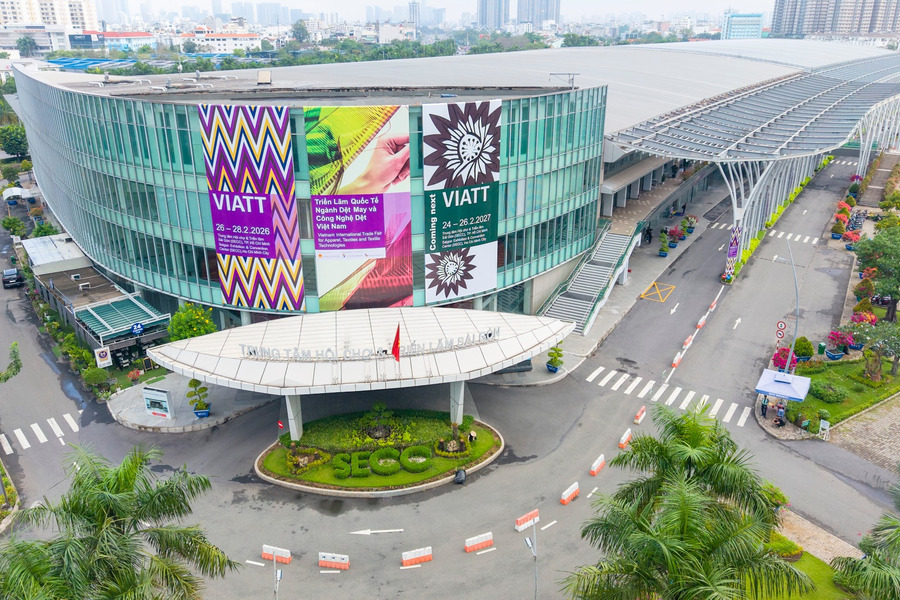
At its third edition, the Vietnam International Trade Fair for Apparel, Textiles, and Textile Technologies (VIATT) further reinforced its role as a key sourcing and business platform for ASEAN’s textile industry. The three-day fair welcomed over 17,000 visits from 54 countries and regions, and featured over 460 exhibitors from 21 countries and regions across 18,000 sqm. The 2026 edition was marked by the introduction of new international pavilions and zones, broadening the fair’s sourcing scope across new geographies and product categories. The fringe programme, headlined by the debut Trend Forum, further distinguished VIATT as the region’s most integrated textile trade platform – uniquely spanning the entire value chain.

#Home Textiles

Intertextile Shanghai Home Textiles – Spring Edition opens next week to spotlight smart textiles, sleep trends and sustainable sourcing

The home textiles industry is ready to gather in Shanghai next week as Intertextile Shanghai Home Textiles – Spring Edition 2026 prepares to open at the National Exhibition and Convention Center from 11 – 13 March. Bringing together more than 360 exhibitors from six countries and regions, the fair will showcase an extensive array of home textiles, including bedding, towelling, carpets, home textile technologies, textile design and more, serving as a forward‑thinking hub where design, sustainability and smart living converge.

#Home Textiles

Intertextile Shanghai Home Textiles returns in August as global sourcing hub and trend barometer for home textiles industry

Following the conclusion of Heimtextil last month, the flagship fair in Messe Frankfurt’s global home and contract textiles portfolio, Intertextile Shanghai Home Textiles – Autumn Edition will return 18 – 20 August 2026 at the National Exhibition and Convention Center (Shanghai). Building on the momentum generated in Frankfurt, the Shanghai fair will reinforce its position as the foremost home and contract textile platform in Asia – successfully bridging the gap between East and West, and connecting global product trends, supply-chain shifts, and buyer demand in one marketplace.
#Textiles & Apparel / Garment

VIATT 2026 to debut German Pavilion, strengthening European participation alongside key Asian textile hubs

Vietnam’s textile and garment sector continues to be a major contributor to the country’s economic growth, with export revenues expected to reach USD 46 billion in 2025, a 5.6% increase from 2024 . From 26 – 28 February, the Vietnam International Trade Fair for Apparel, Textiles and Textile Technologies (VIATT) is set to contribute to economic growth opportunities by accelerating digital transformation and green transition across the entire textile value chain. The upcoming edition will respond to the rising demand for advanced technologies and sustainable materials with the introduction of the German Pavilion, alongside strong exhibitor participation from key Asian sectors, as well as several high-profile fringe events.

More News on Raw Materials

#Raw Materials

A Powerful Opening: Global thought leaders launch the International Cotton Conference Bremen

The International Cotton Conference Bremen will open on 25 March 2026 in the Parliament building of the Free Hanseatic City of Bremen with a keynote session of exceptional calibre. Distinguished international experts will set the stage for the conference by offering incisive perspectives on the most pressing challenges and the defining trends shaping the future of the global cotton trade. Their insights will span a broad spectrum — from geopolitically driven disruptions affecting global supply chains to the opportunities emerging from innovation-led agriculture capable of supporting a growing world population. Together, these opening keynotes will frame the dialogue of the conference, highlighting both the complexity of today’s market environment and the pathways toward a resilient and forward-looking cotton sector.

#Raw Materials

Lenzing Group positions bio‑based materials as a strategic asset for Europe’s economic security

The Lenzing Group, a leading supplier of regenerated cellulose fibers for the textile and nonwovens industries, hosted a high‑level roundtable in Brussels to discuss how bio‑based materials can strengthen Europe’s economic security and support the shift toward a fossil‑free future. Organized in cooperation with Euractiv, the event brought together representatives of the European Commission, the UK Mission to the EU, academia, civil society, and industry.

#Natural Fibers

Beyond Cotton: Natural Fibres in the Spotlight at the Bremen Cotton Conference - Branded by DNFI

Climate targets, fragile supply chains, and rising regulatory requirements are fundamentally changing the perspective of the textile industry - the focus is increasingly shifting toward the base material. Not only cotton, but natural fibres are gaining significant importance: they stand out not only because of their outstanding functional properties, but also because they make a valuable contribution to the bioeconomy and responsible product development.

#Raw Materials

International Women’s Day: Cotton made in Africa strengthens equality for women through targeted investments

On the occasion of International Women’s Day—which will be observed on 8 March under the motto “Rights. Justice. Action. For ALL Women and Girls”—the Aid by Trade Foundation (AbTF), which is responsible for Cotton made in Africa® (CmiA), underlines its long-standing and ongoing commitment to the equality of women in African cotton production areas.

Latest News

#Techtextil 2026

Smart sensors, smart savings - Reducing energy and cost in textile finishing

As energy prices, sustainability requirements and quality expectations continue to rise, manufacturers of technical textiles face increasing pressure to optimize efficiency while ensuring process reliability. At the same time, skilled labor shortages require production systems that are intuitive, automated and easy to manage. PLEVA addresses these challenges with robust, maintenance-friendly sensor technologies combined with intelligent process control.

#Techtextil 2026

From preparation to 3D weaving: Stäubli’s solutions at Techtextil 2026

Stäubli, a global leader in high performance weaving technologies, is pleased to announce its participation at Techtextil 2026 in Frankfurt, Germany, the leading international trade fair for technical textiles and nonwovens. As technical textiles continue their rapid expansion across demanding markets such as defense, mobility, aerospace, construction, energy… Stäubli will showcase innovative solutions designed to empower mills to produce the next generation of advanced fabrics. Stäubli will exhibit its trend-setting technologies at the Swiss Pavilion Booth B01.6 in Hall 12.0.

#Techtextil 2026

DIENES at Techtextil 2026: Flexible pilot lines for bio-based fiber development

The growing relevance of bio-based materials in technical textiles is accompanied by increasing demands for reproducibility, high-quality data, and scalable process routes. Especially when working with cellulose and its derivatives, chitosan, lignin-based approaches, or bio-based PAN as a carbon-fiber precursor, R&D teams face variable feedstock quality, tighter process windows, and the need for reliable comparability across trials. This calls for flexible, data-driven experimental setups that can be reconfigured efficiently when recipes, solvents, and raw-material batches change.

#Texprocess 2026

Gunold showcases embroidery product range and services at Texprocess

At Texprocess 2026, GUNOLD will present numerous hands-on examples related to embroidery in Hall 8, Booth E20. The focus is on creative embroidery designs as well as the extensive product range of threads, nonwovens, and accessories for embroidery and embellishment. “Trade visitors can once again look forward to many new and creative embroidery designs. Of course, we will also showcase the matching products required to bring these ideas to life,” announces Marketing Manager Stephan Gunold.

TOP