[pageLogInLogOut]

#Natural Fibers

ICAC releases 2025 edition of the Specialty Cotton Report

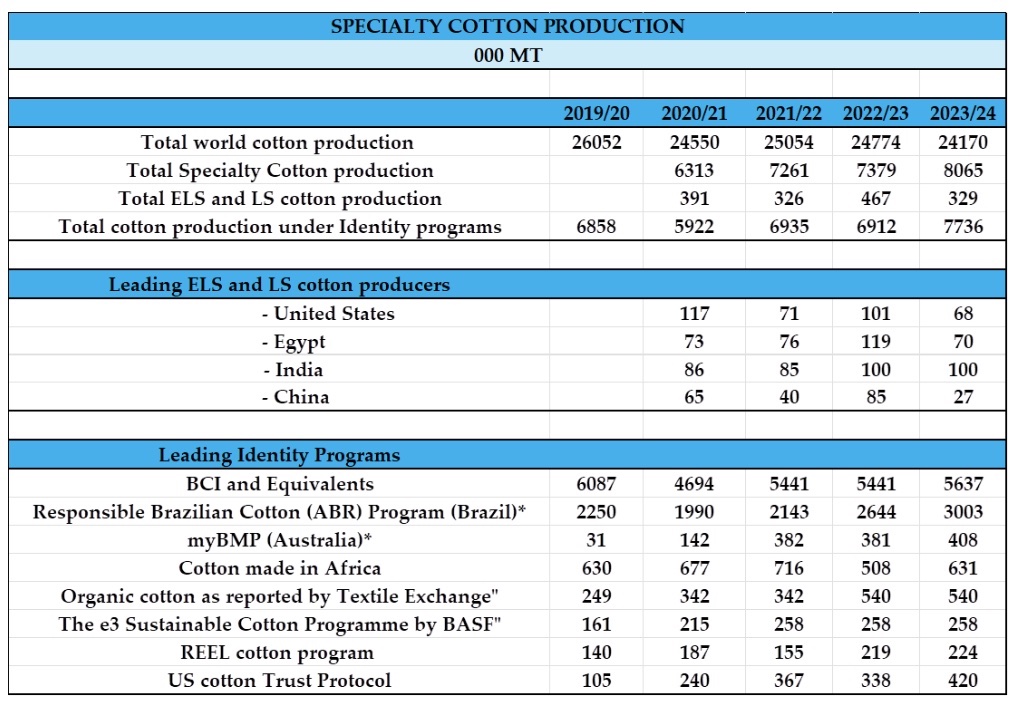
The ICAC has released the newest edition of the Specialty Cotton Report, a free publication that was created in 2023 to highlight the many new "identity cotton programs" that have been emerging around the world, in addition to covering long-staple (LS) and extra-long staple (ELS) cotton. For the ICAC's purposes, "specialty cotton" refers to any cotton that is remarkable in some way — LS, ELS, or falls under a specific identity program.

The publication opens with a letter from the editor, Economic Affairs Officer Parkhi Vats, who highlights the modern consumer — one who values fair wages for producers and genuinely cares about the environmental impacts of the products they buy.

“The sector embraced climate change and sustainability more closely and saw the rise of the new value-oriented consumer who demands cotton that is climate friendly, sustainable, ensures fair prices to its producers, supports livelihoods and gender equality, and protects the environment,” Ms Vats says.
© 2025 ICAC
© 2025 ICAC


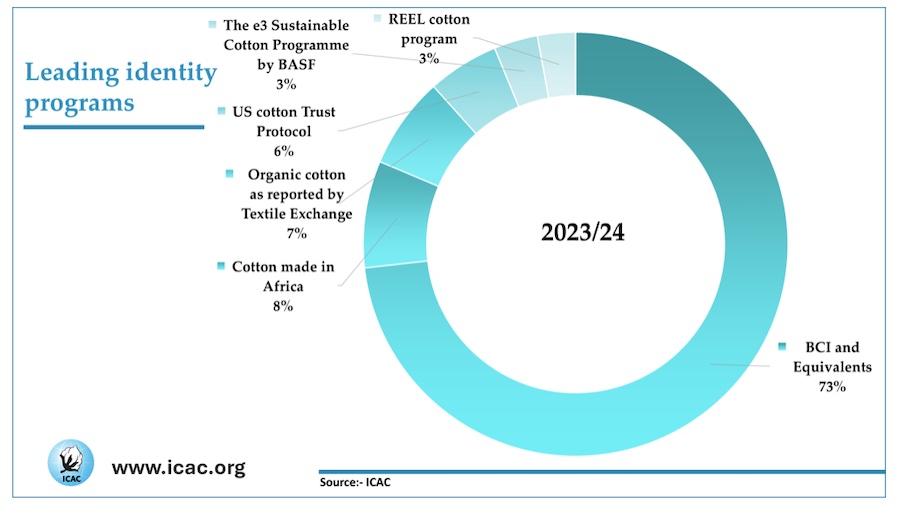
After an overview of the global long- and extra-long staple cottons and the primary countries that produce it, Ms Vats highlights the major identity cottons, including:

Australia's myBMP;

Better Cotton Initiative and equivalents;

Brazil's ABR program;

Cotton made in Africa;

CottonConnect's REEL;

Regenerative Organic Alliance; and

US Cotton Trust Protocol.
© 2025 ICAC
© 2025 ICAC


To read the 2025 ICAC Specialty Cotton Report, pleased click the link below:

https://icac.org/wp-content/uploads/2025/10/SCR2025.pdf


More News from International Cotton Advisory Committee (ICAC)

#Raw Materials

The 83rd Plenary Meeting: Reports from the ICAC Secretariat

Every year, one of the most anticipated sessions at the International Cotton Advisory Committee's (ICAC) Plenary Meeting is the Reports from the Secretariat — and the 83rd edition in Bremen, Germany, did not disappoint.

#Raw Materials

ICAC projects slight decline in production, relative stability for consumption

Global cotton production is projected to decline by 4% in the 2026/27 season to 24.8 million tonnes, while consumption is expected to remain relatively steady at 25.0 million tonnes, according to the March 2026 edition of Cotton This Month.

#Europe

ICAC to support European Commission on pending PEF legislation

The International Cotton Advisory Committee (ICAC) is proud to announce that it has been included as a member of the European Commission’s Technical Advisory Board (TAB) on the Product Environmental Footprint methodology. The Commission developed the Product Environmental Footprint (PEF) to assess and communicate the life cycle environmental performance of products and organizations.

#Natural Fibers

ICAC to collaborate with Uzbekistan and Bizpando on regenerative agriculture

The Government of Uzbekistan has allocated 55,000 hectares of land to implement a regenerative agriculture program for cotton as part of a collaborative project with the International Cotton Advisory Committee (ICAC) and Bizpando, a company with a a blockchain-based internet platform designed to ensure supply chain compliance.

More News on Natural Fibers

#Raw Materials

Textile Exchange publishes cotton Life Cycle Assessment study to strengthen impact data

Textile Exchange has published the first in a series of seven Life Cycle Assessment (LCA) studies designed to improve the quality and robustness of environmental impact data for raw material production across the fashion, textile, and apparel industry. The first LCA study focuses on cotton and addresses critical data gaps and methodology variability through new high-quality data across key producing countries. The study includes organic, regenerative, recycled, and country averages for conventional cotton production systems, providing a clearer picture of the associated environmental impact.

#Raw Materials

A Powerful Opening: Global thought leaders launch the International Cotton Conference Bremen

The International Cotton Conference Bremen will open on 25 March 2026 in the Parliament building of the Free Hanseatic City of Bremen with a keynote session of exceptional calibre. Distinguished international experts will set the stage for the conference by offering incisive perspectives on the most pressing challenges and the defining trends shaping the future of the global cotton trade. Their insights will span a broad spectrum — from geopolitically driven disruptions affecting global supply chains to the opportunities emerging from innovation-led agriculture capable of supporting a growing world population. Together, these opening keynotes will frame the dialogue of the conference, highlighting both the complexity of today’s market environment and the pathways toward a resilient and forward-looking cotton sector.

#Natural Fibers

Beyond Cotton: Natural Fibres in the Spotlight at the Bremen Cotton Conference - Branded by DNFI

Climate targets, fragile supply chains, and rising regulatory requirements are fundamentally changing the perspective of the textile industry - the focus is increasingly shifting toward the base material. Not only cotton, but natural fibres are gaining significant importance: they stand out not only because of their outstanding functional properties, but also because they make a valuable contribution to the bioeconomy and responsible product development.

#Raw Materials

International Women’s Day: Cotton made in Africa strengthens equality for women through targeted investments

On the occasion of International Women’s Day—which will be observed on 8 March under the motto “Rights. Justice. Action. For ALL Women and Girls”—the Aid by Trade Foundation (AbTF), which is responsible for Cotton made in Africa® (CmiA), underlines its long-standing and ongoing commitment to the equality of women in African cotton production areas.

Latest News

#Techtextil 2026

Modernizing Needling – DiloGroup at Techtextil & INDEX 2026

With the theme “Modernizing Needling”, the DiloGroup presents a comprehensively enhanced portfolio for needling technology. The objective is to further increase the performance and application range of needlefelt production lines in terms of productivity, flexibility, and the development of new products, thereby meeting the growing demands of modern technical textiles.

#Advertorial

New Gravimax MMX-R X-ray sensor platform opens up new application fields

The demands placed on quality control in web-based production processes are increasing: materials are becoming more complex, basis weights are varying more widely, and at the same time, pressure is growing to make processes more efficient and transparent. Precise measurement data across the entire web width has therefore become a key factor in ensuring stable production processes. With its new Gravimax MMX-R sensor platform, Mahlo introduces a radiometric measurement solution designed to set new standards in determining basis weight and material composition. The platform combines advanced X-ray technology with newly developed signal processing, enabling measurement tasks that previously often required multiple sensor technologies.

#Recycling / Circular Economy

Carbios confirms Longlaville plant in France following financing progress

Carbios has reaffirmed its plans to build its Longlaville plant in France within a project financing framework, targeting the start of production in the first half of 2028. The company also reports a solid cash position of around €60 million at the end of 2025 and has appointed Benoît Grenot as Deputy Chief Executive Officer to support the execution of its strategic projects.

#Composites

KARL MAYER strengthens partnerships in the composites industry at JEC World 2026

KARL MAYER further strengthened its role as a reliable and competent partner to the composites industry at JEC World 2026. The global market leader in textile machinery manufacturing used the trade show to meet key customers, establish numerous new contacts, and engage in in-depth technical discussions.

TOP