[pageLogInLogOut]

#Market Analysis & Forecasts

Smart textiles market to reach USD 16.51 Billion by 2030 due to advancements in material science and technology | by SNS insider

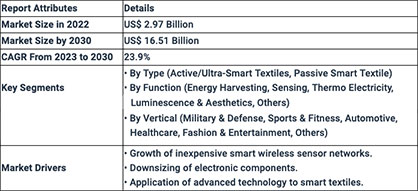
Based on SNS Insider analysis, the smart textiles market is expected to grow rapidly in the coming years due to the increasing demand for wearable technology, sports and fitness applications, medical applications, advancements in material science and technology, and government initiatives and funding. SNS Insider reported that the Smart Textiles Market had a valuation of USD 2.97 billion in 2022, and is projected to achieve a market size of USD 16.51 billion by 2030, with a compound annual growth rate (CAGR) of 23.9% during the forecast period spanning from 2023 to 2030.

Smart Textiles Market Scope & Segmentation By Type, By Function, By Vertical, By Regions | Global Forecast 2023-2030

Smart textiles represent an exciting area of research and development that has the potential to revolutionize various industries. Their integration of technology and textiles provides endless possibilities for innovation and creativity, and we can expect to see more groundbreaking applications of smart textiles in the future. 


Market Analysis

The growth in the smart textiles market is expected to continue in the coming years. Smart textiles have a wide range of applications, including healthcare, sports and fitness, military, and fashion. Advances in technology and materials science are making it possible to create ever-more sophisticated textiles that can perform a wider range of functions. As the population continues to age and the demand for healthcare services grows, smart textiles are likely to play an increasingly important role in improving patient outcomes and reducing healthcare costs.


Impact of Russia-Ukraine Conflict

The impact of the Russia-Ukraine conflict on the market is complex and multifaceted. While supply chain disruptions and decreased consumer demand are certainly challenges for the industry, there may also be new opportunities for growth in certain sectors. As the conflict continues to evolve, it will be important for smart textiles companies to stay informed and adapt to changing market conditions. 


Key Regional Development

Advancements in technology are playing a significant role in driving growth in the North American smart textiles market. Emerging technologies such as wearable sensors, smart fabrics, and conductive materials are creating new opportunities for innovation in the market, and are helping to drive demand for smart textiles-based products and services. Another factor contributing to the growth of the North American market is the region's high rates of food consumption. This has led to an increased demand for smart textiles-based food packaging and preservation solutions that can help to extend the shelf life of perishable products and reduce food waste.


Key Takeaway from Smart Textiles Market Study

In recent years, the passive smart textile segment has dominated the market, and it is anticipated to continue its reign in the forecast period. Passive smart textiles are designed to respond to external stimuli such as temperature, light, and pressure.

The energy harvesting segment is gaining popularity due to its potential to reduce the dependence on conventional energy sources, which are not only finite but also harmful to the environment. Additionally, energy harvesting technology enables the development of self-powered and sustainable smart textile solutions.

Recent Developments Related to Smart Textiles Market

Microsoft has recently made significant progress in the field of smart fabric technology by developing a fabric that can detect objects and gestures. This innovation is a result of the company's relentless efforts to explore the potential of textile-based sensors and bring new dimensions to the world of wearable.

Researchers at Louisiana State University have developed a new type of smart textile that can detect fever in infants. This innovative technology is expected to revolutionize the way healthcare professionals monitor the health of newborns and young children. These sensors can detect changes in body temperature and alert caregivers to potential signs of fever in infants.


Buy Exclusive PDF Copy of the Research Report along With ME Sheet:

https://www.snsinsider.com/checkout/2096


More News from TEXDATA International

#Recycling / Circular Economy

textile.4U publishes special edition “Top 100 Textile Recycling Companies 2025”

With a comprehensive 176-page special edition, textile.4U is dedicating its latest issue entirely to one of the most dynamic and influential topics in today’s textile industry: textile recycling. The new issue, published exclusively in high-quality print, presents the Top 100 textile recycling companies researched and selected by TexData – organizations that already play a key role in the transition to circular textiles or are expected to have a significant impact in the near future.

#Recycling / Circular Economy

Responsible Textile Recovery Act of 2024 signed by Governor

Senator Josh Newman (D-Fullerton) is proud to announce that Senate Bill 707 (SB 707), the Responsible Textile Recovery Act of 2024, has been signed into law by the Governor of California, Gavin Newsom. This groundbreaking legislation establishes the country’s first Extended Producer Responsibility (EPR) textile recycling program, marking a significant step forward in the state’s efforts to combat waste and promote sustainability.

#Textiles & Apparel / Garment

Modtissimo promotes sustainability with 28 coordinates in the Green Circle

Modtissimo is proving more and more to be a textile and clothing show that delivers the latest innovations in the area of sustainability, with the iTechStyle Green Circle being the main showcase for companies' creations. In this 60+4 edition, taking place on 12 and 13 September, 28 coordinates will be exhibited in a section organised by CITEVE and curated by Paulo Gomes.

#Europe

The EU and Egypt team up to mobilise private sector investments at Investment Conference and sign a Memorandum of Understanding underpinning €1 billion in macro-financial assistance for Egypt

At the EU-Egypt Investment Conference, co-organised by the EU and the Government of Egypt on 29-30 June, the EU and Egypt are teaming up to intensify private sector investments in Egypt. They are also signing a Memorandum of Understanding (MoU) for the disbursement to Egypt of up to €1 billion in Macro-Financial Assistance.

More News on Market Analysis & Forecasts

Latest News

#Spinning

First PA66 spinning plant with EvoQuench successfully commissioned

With the successful commissioning of a multi-digit PA66 spinning line for microfiber yarns, Chinese textile company Shandong Nanshan Fashion Technology Co., Ltd. has added yarn production to its textile value chain.

#Knitting & Hosiery

SHIMA SEIKI returns to ShanghaiTex

Leading flat knitting solutions provider SHIMA SEIKI MFG., LTD. of Wakayama, Japan, together with its Hong Kong and Chinese market subsidiary SHIMA SEIKI (HONG KONG) LTD., will exhibit at the ShanghaiTex 2025 exhibition (Booth No.: Hall N3, Booth A20) held in Shanghai, China this month. This marks the return of SHIMA SEIKI to ShanghaiTex after a 14-year hiatus, its last exhibit at the show having been in 2011.

#Research & Development

Fraunhofer CCPE presents the “Monomaterial Design Set” – Innovative solutions for circular product design

Composite materials made from different types of plastic often extend the lifetime of products but make recycling more difficult in the circular economy. That is why Fraunhofer CCPE has developed the “Monomaterial Design Set”. This new approach helps to reduce the variety of plastics used in durable products and offers circular solutions for designers and product developers.

#Man-Made Fibers

arena introduces renewable LYCRA® EcoMade fiber in its latest swimwear collection

Italian swimwear specialist arena has unveiled a new collection that brings sustainability and performance even closer together. Launched on December 4, the line features swimsuits made from recycled nylon and renewable LYCRA® EcoMade fiber — the first time the bio-based spandex has been used commercially in swimwear.

TOP