#Market Analysis & Forecasts
Global nonwoven filter media market size projected to reach USD 10.0 Billion by 2030, growing with a CAGR of 6.2%: Latest research study
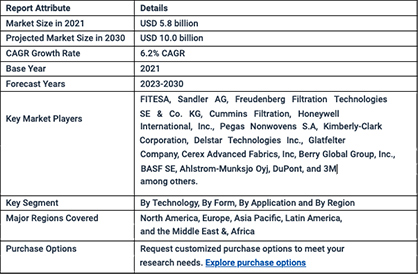
[177 + Pages Research Study] According to a market research study published by Zion Market Research, the demand analysis of Global Nonwoven Filter Media Market size & share revenue was valued at around USD 5.8 billion in 2021 and is estimated to grow about USD 10.0 billion by 2030, at a CAGR of approximately 6.2% between 2023 and 2030. The key market players are listed in the report with their sales, revenues and strategies are FITESA, Sandler AG, Freudenberg Filtration Technologies SE & Co. KG, Cummins Filtration, Honeywell International, Inc., Pegas Nonwovens S.A, Kimberly-Clark Corporation, Delstar Technologies Inc., Glatfelter Company, Cerex Advanced Fabrics, Inc, Berry Global Group, Inc., BASF SE, Ahlstrom-Munksjo Oyj, DuPont, and 3M among others., and others.
“According to the most recent research study, the demand for the global Nonwoven Filter Media Market size and share in terms of revenue was valued at USD 5.8 billion in 2022, and it is expected to surpass around USD 10.0 billion mark by 2030, growing at a compound annual growth rate (CAGR) of approximately 6.2% during the forecast period 2023 to 2030."
What is Nonwoven Filter Media? How big is the Nonwoven Filter Media Industry?
Nonwoven Filter Media Market Coverage & Overview:
Nonwoven filter media are synthetic fibers with randomly organized filaments that are connected and have a porous structure. Different processing techniques, including mechanical, chemical, and thermal ones, are used to process these synthetic fibers. They are employed for filtration or separation. Particularly in the textile manufacturing sector, nonwoven filter media are used. It is sometimes referred to as felts.
The numerous benefits provided by nonwoven filter media, such as constructed and engineered structures to fulfill the needs and regulations of the liquid and air filtration sector, are one of the key drivers fueling the growth of the nonwoven filter media market globally. Additionally, it has a long service life and great efficiency, making it the perfect material for filtration.
The global nonwoven filter media market is projected to experience a considerable uptick in the adoption of goods for geotextiles. Due to their capacity to tolerate high temperatures, the high acceptance rate of tailored products, durability, ease of handling, and cost-effectiveness, nonwoven filter media are favored over cloth, paper, or other filtration media. Additionally, during the projection period, the nonwoven filter media industry will experience considerable expansion due to the automotive industry's continuously expanding demand for nonwoven filter media.
Get a Free Sample PDF of this Research Report for more Insights with a Table of Content, Research Methodology, and Graphs - https://www.zionmarketresearch.com/sample/nonwoven-filter-media-market
(A free sample of this report is available upon request; please contact us for more information.)
Our Free Sample Report Consists of the Following:
Introduction, Overview, and in-depth industry analysis are all included in the 2023 updated report.
The COVID-19 Pandemic Outbreak Impact Analysis is included in the package
About 177+ Pages Research Report (Including Recent Research)
Provide detailed chapter-by-chapter guidance on Request
Updated Regional Analysis with Graphical Representation of Size, Share, and Trends for the Year 2023
Includes Tables and figures have been updated
The most recent version of the report includes the Top Market Players, their Business Strategies, Sales Volume, and Revenue Analysis
Zion Market Research research methodology
(Please note that the sample of this report has been modified to include the COVID-19 impact study prior to delivery.)
Market Growth Dynamics: Growth Factors
The expanding demand for filtering across a range of end-use industries, including the automotive, personal care, and healthcare sectors, is driving up demand for spun bonding. As a result, industry participants and research institutions are concentrating on increasing the use of this technology to create premium nonwoven filter media. For instance, according to the International Fiber Journal (IFJ) report from December 2020, NatureWorks LLC, a US-based plastic and fiber manufacturing company, collaborated with the Nonwovens Institute (NWI) to develop a new spun bonding nonwoven technology that enables the quick production of highly breathable and reusable N95 masks. Thus, driving segmental growth.
Market participants are leaning toward further growth in the nonwoven air filtration portfolio due to the expanding uses for air filtration. For illustration, in February 2021, the US-based company Cummins Filtration, which deals with nonwoven filter media, launched a new cabin air filter media for trucks and buses. Therefore, these types of product launches in the market will support the market expansion over the forecast period.
Directly Purchase a copy of the report with TOC @
https://www.zionmarketresearch.com/buynow/su/nonwoven-filter-media-market
Report scope
Nonwoven Filter Media Market: Segmentation Analysis
Based on the technology, the global market is bifurcated into spun bonding, airlaid, wetlaid, melt-blown, needlepunch, and others. The spun bonding segment accounted for the largest revenue share in 2021 and is expected to show its dominance during the forecast period. To create excellent nonwoven filter solutions, this technology is widely used.
Based on the form, the global nonwoven filter media market is categorized into air filtration and liquid filtration. The air filtration segment is projected to hold the largest market share over the forecast period. The need for premium air filter media is being driven by the growing concern about air pollution on a global scale. Nonwoven filters are used in a variety of applications, including operating rooms in hospitals, clean rooms for the optical and precision industries, air conditioning, pharmaceutical manufacturing, and many more, to assist reach the highest standards for air cleanliness.
Based on the application, the global nonwoven filter media industry is divided into transportation, water filtration, HVAC, food and beverages, healthcare, manufacturing, advanced technology, and hydrocarbon processing. The transportation segment is expected to dominate the market during the forecast period. Because it facilitates the infiltration of engine air, cabin air, lubricant, and fuel, nonwoven filter media play a significant role in automobiles. With rising production and sales, the demand for automobiles is expanding internationally, and in the years to come, this demand development will propel the nonwoven filter media market.
The global Nonwoven Filter Media market is segmented as follows:
By Technology
Spun Bonding
Airlaid
Wetlaid
Meltblown
Needlepunch
Others
By Form
Air Filtration
Liquid Filtration
By Application
Transportation
Water Filtration
HVAC
Food and Beverages
Healthcare
Manufacturing
Advanced Technology
Hydrocarbon Processing
Browse the full “Nonwoven Filter Media Market By Technology (Spun Bonding, Airlaid, Wetlaid, Meltblown, Needlepunch, and Others), By Form (Air Filtration and Liquid Filtration), By Application (Transportation, Water Filtration, HVAC, Food and Beverages, Healthcare, Manufacturing, Advanced Technology, and Hydrocarbon Processing) and By Region - Global and Regional Industry Overview, Market Intelligence, Comprehensive Analysis, Historical Data, and Forecasts 2022 – 2030.”- Report at https://www.zionmarketresearch.com/report/nonwoven-filter-media-market
Competitive Landscape
Some of the main competitors dominating the global Nonwoven Filter Media market include -
FITESA
Sandler AG
Freudenberg Filtration Technologies SE & Co. KG
Cummins Filtration
Honeywell International Inc.
Pegas Nonwovens S.A
Kimberly-Clark Corporation
Delstar Technologies Inc.
Glatfelter Company
Cerex Advanced Fabrics Inc
Berry Global Group Inc.
BASF SE
Ahlstrom-Munksjo Oyj
DuPont
3M.
Key Insights from Primary Research:
According to the analysis shared by our research forecaster, the Nonwoven Filter Media market is likely to expand at a CAGR of around 6.2% during the forecast period (2023-2030).
In terms of revenue, the Nonwoven Filter Media market size was valued at around US$ 5.8 billion in 2021 and is projected to reach US$ 10.0 billion by 2030.
Based on type segmentation, The spun bonding segment accounted for the largest revenue share in 2021
Based on application segmentation, The transportation segment is expected to dominate the market during the forecast period 2021
Based on form segmentation The air filtration segment is projected to hold the largest market share over the forecast period 2021
On the basis of geography/region, The Asia Pacific holds the largest share in 2021
Have Any Query? Ask Our Experts: https://www.zionmarketresearch.com/inquiry/nonwoven-filter-media-market
Key questions answered in this report:
What is the market size and growth rate forecast for Nonwoven Filter Media industry?
What are the main driving factors propelling the Nonwoven Filter Media Market forward?
What are the leading companies in the Nonwoven Filter Media Industry?
What segments does the Nonwoven Filter Media Market cover?
How can I receive a free copy of the Nonwoven Filter Media Market sample report and company profiles?
Key Offerings:
Market Size & Forecast by Revenue | 2023?2030
Market Dynamics – Leading Trends, Growth Drivers, Restraints, and Investment Opportunities
Market Segmentation – A detailed analysis By Technology, By Form, By Application, and by Region
Competitive Landscape – Top Key Vendors and Other Prominent Vendors
Request for Customization on this Report as per your requirements - https://www.zionmarketresearch.com/custom/6099
(We tailor your report to meet your specific research requirements. Inquire with our sales team about customising your report.)
Regional Analysis:
The Asia-Pacific region holds the largest share of the worldwide nonwoven filter media market in 2021, with a market share of more than 30 percent. Because of the expansion of the transportation and healthcare industries in this region, there is a considerable need for filters made of nonwoven materials. In recent years, the manufacturing of automobiles has become home to one of the sector's most active assembly lines. For example, the China Association of Vehicle Manufacturers says that the number of commercial vehicles that were manufactured in China in September 2021 grew to 310000 units, representing a growth of 35.5% month over month.
The India Brand Equity Foundation found that sales of passenger autos in India climbed significantly in April 2021, with a total of 261,633 units sold and a market share of 12.9%. This is comparable to the previous finding. The increasing number of vehicles in the region will have a multiplicative effect on the trend towards the greater application of nonwoven filters for the filtration of fuel, engine air, and cabin air. It is anticipated that the rising demand for medical respiratory solutions such as masks and respirators would result in a significant increase in the demand for nonwoven filter media in the healthcare industry. Thus, the expansion of the market in the region is being driven by the rising demand for nonwoven filter media in the transportation and healthcare industries.
In addition, it is projected that applications linked to hygiene will constitute the majority of the market for the product in both North America and Europe. It is projected that there would be a great deal of competition in this market as a result of the availability of various other filtering solutions on the market. It is anticipated that developed countries like the United States and Germany will experience tremendous market expansion as a result of their highly industrialized economies.
In 2019, the market for nonwoven filter media in North America held a sizeable share of the overall market, and it is projected that this market will experience considerable growth in the years to come. This development can be attributed to the rise in consumer demand for products relating to personal hygiene and care. The food and beverage, heating, ventilation, and air conditioning (HVAC), and automotive industries all benefit from industrial expansion when the forecast is positive.
By Region
North America
U.S.
Canada
Rest of North America
Europe
France
UK
Spain
Germany
Italy
Rest of Europe
Asia Pacific
China
Japan
India
South Korea
Rest of Asia Pacific
The Middle East & Africa
Saudi Arabia
South Africa
Rest of the Middle East & Africa
Latin America
Brazil
Argentina
Rest of Latin America
Recent Developments
In November 2021, Custom Filter LLC, situated in Illinois, was acquired by Rensa Filtration, a family of air filtration businesses. The leading producer of specialized HEPA and ULPA level filtration devices is Custom Filter. Additionally, with more than 60 years of experience servicing OEM, contract manufacturing, specialized, and a wide range of premium pleated filters, Custom Filter offers comprehensive testing and validation procedures. Through this acquisition companies expand their manufacturing capabilities and platforms.
To know an additional revised 2023 list of market players, request a brochure of the report: https://www.zionmarketresearch.com/requestbrochure/nonwoven-filter-media-market