#Market Analysis & Forecasts
Digital textile printing market to reach USD 311.7 Million by 2028, globally, at a CAGR of 10.1%
The growing need for printed fabric materials and textiles has induced manufacturers to adopt digital printing technology for better and faster fabric printing. The development of compact, fast, and lightweight printers attracts more customers towards printed fabric clothing products. The development of advanced Digital Textile Printings is likely to stimulate market growth in the coming years.
Key Players in the Digital Textile Printing Market are:
Mimaki (Nagano, Japan)
Kornit (Rosh Haayin, Israel)
SPGPrints (Boxmeer, The Netherlands)
Konica Minolta (Tokyo, Japan)
Atexco (Paris, France)
Dover Corporation (MS Printing Solutions Srl) (Illinois, U.S)
MS Printing (Pertusella VA, Italy)
Robustelli (Connecticut, U.S)
Kaiyuan (Gaoxin District Xi'an, China)
Sawgrass Technologies, Inc. (South Carolina, U.S.)
Mutoh (Tokyo, Japan)
La Meccanica (Urgnano, Italy)
Seiko Epson Corporation (Nagano, Japan)
COVID-19 Impact-
The global pandemic has severely impacted the global economy and stagnated the growth of several industries and markets. The market for Digital Textile Printings has witnessed a negative impact of the coronavirus outbreak. The disruptions in the global supply chain networks due to the implementation of stringent lockdowns and curfews have affected the market's growth. Additionally, the consumer’s focus has shifted to essential expenditures, which has declined the demand for clothing and textile products. Nonetheless, the vaccine is now available to the masses, and the market is gradually recovering. The market is expected to witness steep growth post-pandemic.
To get to know more about the short-term and long-term impact of COVID-19 on this market, please visit:
https://www.fortunebusinessinsights.com/digital-textile-printing-market-106237
Report Scope and Segmentation:
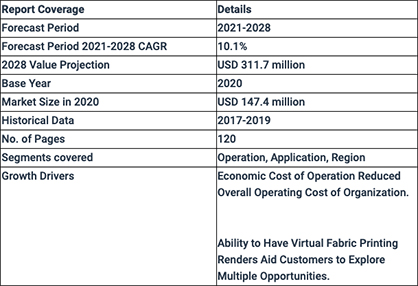
Market Drivers & Restraints-
Growing Consumer Awareness for Trending Fashion Apparel to Fuel Market Growth
Digital printing machines help businesses to improve profitability by reducing operational costs and enhancing print quality. Additionally, the automation of the process helps to cut down the human resource requirements at the facility. The overall cost advantage of digital printing machines is anticipated to bolster the global digital printing machine market growth. Additionally, the development of advanced digital printers by key manufacturers is likely to boost the growth of the market.
The growing consumer awareness for trending fashion apparel and clothing is expected to be the key factor driving the growth of the market. Moreover, the improving personal disposable income levels and living standards of consumers are anticipated to stimulate the market’s growth in the coming years.
Digital printing solutions offer virtual printed models of fabrics, and users can get a glimpse of the finalized product before initiating the actual process. This helps the consumers choose the best-suited fabric texture and is likely to amplify the market's growth.
However, the high costs of employing digital printers are expected to hinder the market growth.
Segmentation
On the basis of operations, the market is bifurcated into multi pass and single pass. On the basis of application, the market is segmented into clothing and apparel, soft signage, home décor, and others. Geographically, the market is classified into five major regions- North America, Europe, Asia Pacific, South America, and the Middle East & Africa.
Report Coverage
The report provides a granular analysis of the prospected market.
The report highlights a detailed analysis of key players operating across different geographies.
The report provides insights into the regulatory scenarios of the market.
The report is based on historical data and provides methods and opportunities for future growth.
The report also highlights the impact of the COVID-19 pandemic.
Regional Insights
Asia Pacific to Gain the Largest Share due to Growing Needs for Printed Fabrics
Asia Pacific is anticipated to hold the largest portion in the global Digital Textile Printing market share. India and China are expected to be the leading regions in the market. The ever-increasing population and the growing needs for printed fabrics are likely to bolster the growth of the market. North America is expected to witness considerable growth due to the substantial imports of textiles.
Europe is projected to gain steep growth in the coming years due to the increasing use of digital printing in the soft signage segment. The market possesses significant untapped growth potential.The surging urbanization and the expanding imports of textiles are anticipated to drive the growth in the Middle East and Africa.
Competitive Landscape
Key Players Bolster their Market Positions Through New Product Launches
The key players in the market are focused on strengthening their operations and logistical networks that were impacted by the coronavirus pandemic. They adopt various ingenious growth strategies such as partnerships, mergers, acquisitions, and others to garner growth and improve their market positions. The key players aim to diversify their product portfolios through new product launches and technological developments. For instance, in February 2020, Mimaki launched a hybrid digital textile printer called the Tx300P-1800 Mkll. The new printer is capable of performing transfer printing with interchangeable platens.
Table of Content:
Introduction
Definition, By Segment
Research Methodology/Approach
Data Applications
Executive Summary
Market Dynamics
Macro and Micro Economic Indicators
Drivers, Restraints, Opportunities and Trends
Impact of COVID-19 on Digital Textile Printing Market
Short-term Impact
Long-term Impact
Competition Landscape
Business Strategies Adopted by Key Players
Consolidated SWOT Analysis of Key Players
Global Digital Textile Printing Market Share Analysis and Matrix, 2020
Key Market Insights and Strategic Recommendations
Profiles of Key Players (Would be provided for 10 players only)
Overview
Key Management
Headquarters etc.
Offerings/Business Segments
Key Details (Key details are subjected to data availability in public domain and/or on paid databases)
Employee Size
Past and Current Revenue
Geographical Share
Business Segment Share
Recent Developments
Primary Interview Responses
Annexure / Appendix
More info:
https://www.fortunebusinessinsights.com/toc/digital-textile-printing-market-106237